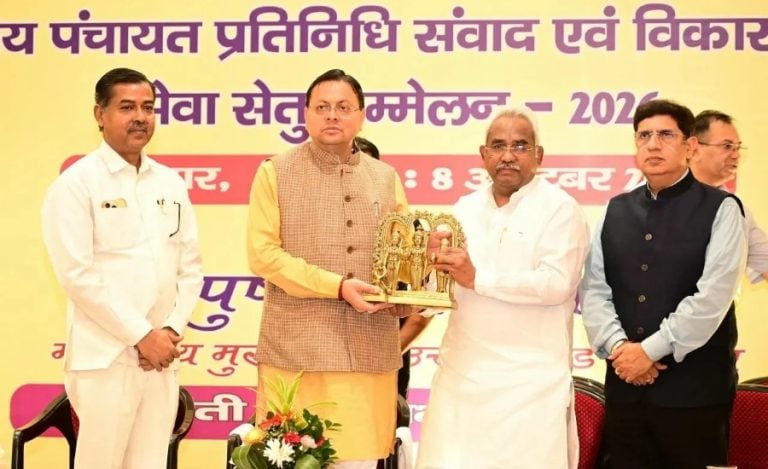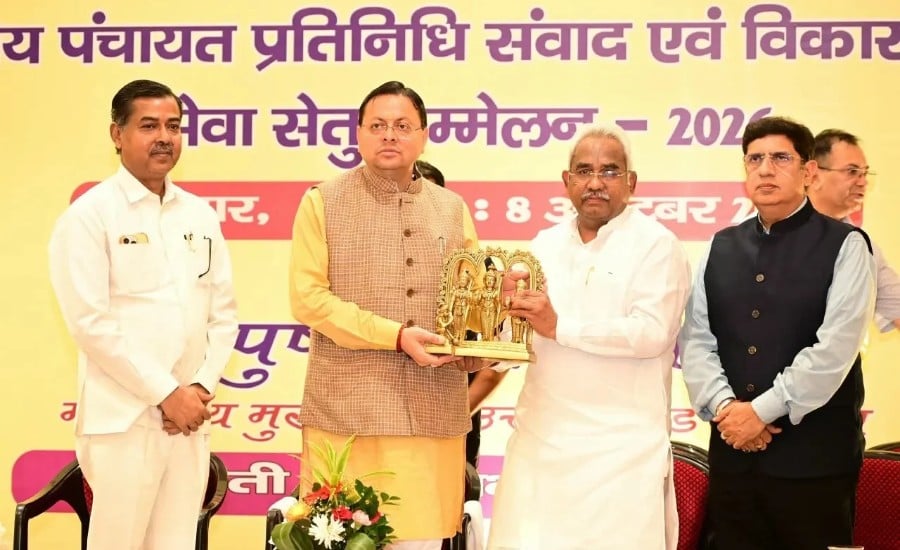
Dehradun: Uttarakhand Chief Minister Pushkar Singh Dhami has called on elected panchayat representatives to strengthen grassroots governance and ensure that government welfare schemes reach every eligible beneficiary.
He was speaking at a one-day orientation and training programme for representatives of the state’s three-tier panchayati raj system in Haridwar on Thursday. More than 60,000 panchayat representatives across Uttarakhand’s development blocks were connected with the training initiative.
Dhami urged representatives to work with the approach of “Mera Gaon–Meri Zimmedari” (My Village, My Responsibility), stressing that panchayats serve as an important link between the government and the public.
Focus on Local Needs and Development Planning
The Chief Minister said development plans at the gram, block and district panchayat levels were being prepared under the Jan Yojana Abhiyan, which began on October 2, 2026.
He asked panchayats to base their plans on local needs, public suggestions and available resources. Each plan, he said, should include clear targets, timelines and expected outcomes.
Basic services such as drinking water, roads, sanitation, education and healthcare should feature prominently in local development plans. He also called for regular reviews of project progress and greater attention to the needs of disadvantaged and vulnerable communities.
Dhami said the Centre, under Prime Minister Narendra Modi’s leadership, was providing panchayats with resources, infrastructure and modern technology to strengthen their role in local development. The state government was also working in this direction.
Training, Panchayat Buildings and Digital Governance
Highlighting progress in strengthening panchayat institutions, Dhami said more than 56,000 panchayat representatives received training during 2025–26.
Of Uttarakhand’s 7,817 gram panchayats, 5,972 have panchayat buildings operating as gram secretariats, according to the figures cited by the Chief Minister. Over the past five years, 1,362 panchayat buildings have been constructed and 584 repaired. More than 1,000 gram panchayats have also been computerised.
He said the e-GramSwaraj portal was being used to record panchayat action plans, financial and physical progress, and geotagging of works.
Emphasising financial transparency, Dhami said public money must be properly accounted for and that the quality and usefulness of development projects mattered more than the number of works completed. He urged representatives to monitor road quality, the effectiveness of drinking water schemes and the services provided through panchayat buildings.
Sanitation and Rural Livelihoods
Dhami highlighted the role of panchayats in keeping villages clean and healthy. He said district panchayats had been provided with waste-collection machines for cleaning rural motor roads and local markets, while special machines had also been installed at the development-block level.
He called for community participation and regular sanitation drives.
The Chief Minister also stressed the importance of strengthening rural livelihoods through self-help groups, women’s entrepreneurship, agriculture, horticulture, local products and tourism. Expanding employment and self-employment opportunities in villages and reducing migration were among the government’s priorities, he said.
Dhami also referred to measures for women’s empowerment, including 30 per cent horizontal reservation for women in government jobs, and called for the preservation of village cultural heritage.
Madan Kaushik Highlights Panchayats’ Role
Cabinet Minister Madan Kaushik said panchayats played an important role in implementing government schemes related to roads, electricity, panchayat buildings and schools.
He urged elected representatives to ensure that development programmes were implemented effectively and their benefits reached the intended recipients. Kaushik also referred to the nationwide Seva Sankalp Abhiyan, being organised to mark 25 years of service under Prime Minister Narendra Modi’s leadership.
The programme was attended by Cabinet Minister Pradeep Batra, District Panchayat Chairperson Kiran Chaudhary, Ranipur MLA Adesh Chauhan, former Cabinet Minister Swami Yatishwaranand, state minister Deshraj Karnwal, district officials and representatives from gram panchayats, among others.
Read Also: House of Himalayas Sales Cross ₹6 Crore, Boosting Rural Women Entrepreneurs in Uttarakhand