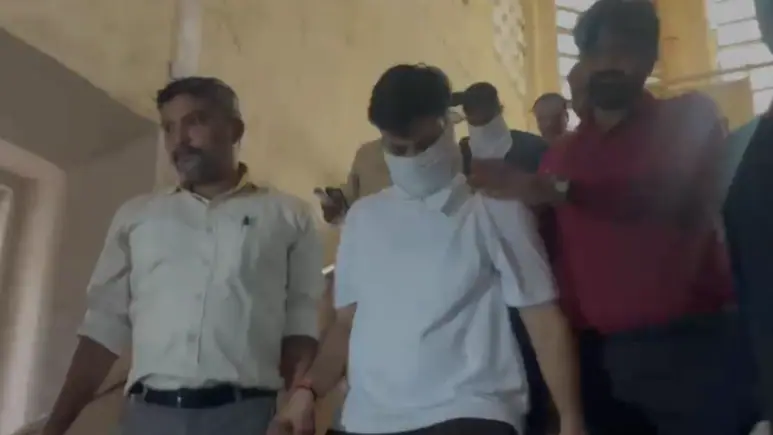
Mumbai/New Delhi: A fake Prime Minister’s Office (PMO) identity card, an armed bodyguard and an alleged government job offer have turned a security-related incident in Mumbai’s Bandra Kurla Complex (BKC) into a case involving alleged impersonation, fraud and conspiracy.
The Mumbai Police arrested 24-year-old Rohan Premal Parekh and his bodyguard, Dilip Rajaram Kunde, after the two were stopped at Jio World Plaza in BKC on September 7, a day before Prime Minister Narendra Modi was scheduled to attend an event at the Jio World Centre.
Parekh allegedly presented an identity card claiming that he was a Grade-C official of the PMO. His associate Kunde was stopped during security screening after a firearm was detected. Police subsequently examined Parekh’s credentials and found discrepancies in the alleged PMO identity card.
Both men were produced before a Mumbai court on Tuesday and were remanded to police custody until September 11. A third accused, identified as Prathamesh Ganesh Bagul, is wanted and is currently absconding.
Importantly, Mumbai Police have clarified that the incident was not connected to Prime Minister Modi’s visit or any actual breach of his security. The incident occurred at Jio World Plaza on September 7, while the Prime Minister’s programme was scheduled for September 8.
How Did the Mumbai Incident Come to Light?
According to the police investigation, the incident occurred at around 4:50 pm on September 7 at Jio World Plaza in BKC.
Security personnel were screening people entering the premises when they became suspicious of the group. Kunde, who was accompanying Parekh as his alleged bodyguard, was reportedly stopped after a door-frame metal detector indicated that he was carrying a firearm.
Police later recovered a licensed revolver, a holster and live cartridges from Kunde, according to reports based on the FIR.
Kunde then contacted Parekh. When Parekh arrived, he allegedly produced an identity card and claimed that he was associated with the Prime Minister’s Office.
The card reportedly described him as a Grade-C PMO official.
Instead of resolving the matter, however, the card raised further suspicion.
What Was Wrong With Rohan Parekh’s PMO ID?
The Crime Branch is examining the authenticity and origin of the identity card.
Investigators reportedly noticed several discrepancies in the document. While the card carried an issue date, it did not mention a validity or expiry date. Police also noted that although the document carried what appeared to be the signature of the issuing officer, the officer’s name or designation was absent.
These discrepancies prompted security personnel to question the authenticity of the card and led to police intervention.
Police have registered a case involving allegations of impersonation and unauthorised entry while armed, among other provisions of the Bharatiya Nyaya Sanhita.
The Crime Branch is now trying to establish how the identity card was created, who supplied it, why it was used and whether Parekh knowingly participated in an impersonation attempt.
Crime Branch Calls It a Serious Threat
During the court hearing, investigators stressed the seriousness of the matter and argued that custodial interrogation of Parekh and Kunde was necessary.
The prosecution told the court that the preliminary investigation indicated a serious case involving the use of a fake government identity to pressure private security personnel and gain entry into the premises.
Police also pointed to the involvement of a third person, Prathamesh Ganesh Bagul, who is currently wanted.
Investigators argued that questioning the arrested accused in custody was necessary to establish the complete sequence of events, determine the role of the absconding accused and trace the origin of the alleged fake credentials.
The court subsequently remanded Parekh and Kunde to police custody until September 11.
Who Is Rohan Parekh?
Rohan Parekh, 24, is at the centre of the case.
Police allege that he presented himself as a PMO official using the suspicious identity card. However, information that has emerged during the court proceedings has complicated the picture.
Parekh reportedly studied at the City, University of London, with a background in mathematics and finance. An alumni profile also identifies a Rohan Parekh as having studied mathematics and finance at City, University of London and having attended Blundell’s School in London.
His educational background has become relevant to the defence’s argument because his lawyer claims that Parekh genuinely believed he had been recruited for a government-linked position.
That claim is now one of the central aspects of the investigation.
Defence Claim: Was Parekh Himself Duped?
Parekh’s lawyer has presented an entirely different version of events before the court.
According to the defence, Parekh may not have deliberately impersonated a government official. Instead, he may himself have been the victim of an elaborate fraud.
The lawyer claimed that Parekh had received a series of official-looking communications that convinced him he had genuinely been offered a role connected to the PMO.
The alleged communications included:
- An offer letter for a PMO-related position.
- An identity card purportedly connected to the PMO.
- A letter allegedly bearing Prime Minister Narendra Modi’s signature.
- Emails purportedly sent by senior government officials.
- Communications concerning defence acquisition policy.
- An alleged offer of an advisory position.
The defence has claimed that these documents and communications appeared sufficiently genuine to convince Parekh that he had actually secured a government-linked position.
The Names Behind the Alleged Job Offer
The court proceedings also brought several names into the picture.
According to the defence, Parekh was approached by a person identified as Tarun Kapoor, who allegedly offered him a position associated with the PMO.
The defence further claimed that Parekh received an email concerning the Defence Acquisition Policy from a person identified as Tarun Gupta.
Another person, identified as Mahak Gupta, allegedly offered Parekh an advisory role.
The defence has maintained that Parekh received several communications from these individuals and believed that they were legitimate government communications.
Police will now have to establish whether these individuals exist in the manner described, whether the communications originated from them and, most importantly, whether they were part of a deliberate scheme to deceive Parekh.
The PMO ID May Have Been Sent as a Screenshot
Another unusual detail emerged during the hearing.
According to Parekh’s lawyer, the alleged PMO identity card was not physically issued to Parekh. Instead, the defence claimed that he received an image or screenshot of the card.
Parekh allegedly believed the digital document to be genuine.
The defence has said that Parekh handed over the communications and documents in his possession to the investigating officer and provided contact details that could be checked with the PMO.
This claim, if substantiated, could become significant to the investigation because it raises a fundamental question: Was Parekh knowingly using a forged government identity, or was he himself being manipulated by people who had created a fake government identity for him?
That question remains unanswered.
Why Did Parekh Have a Personal Bodyguard?
The presence of Dilip Kunde has added another layer to the case.
According to the defence, Parekh had maintained a personal bodyguard since 2024 and had allegedly been instructed to appoint one as part of the purported government position.
Police, however, are examining the circumstances under which Kunde was hired and why he accompanied Parekh to the BKC premises.
The fact that Kunde was carrying a licensed firearm became particularly significant because the weapon was detected during security screening.
The defence has argued that Parekh believed the requirement for a bodyguard was connected with the government position he thought he had obtained. Police will have to determine whether this explanation is supported by evidence or whether the bodyguard was part of a larger plan.
Why Was Parekh at Jio World Plaza?
Another question concerns Parekh’s presence at the venue.
The incident took place a day before Prime Minister Modi’s scheduled appearance at the Jio World Centre for the Global Fintech Fest.
That timing initially raised questions about whether Parekh had deliberately attempted to gain access to an area associated with the Prime Minister’s programme.
However, Parekh’s defence has offered a different explanation.
His lawyer claimed that Parekh had gone to Jio World Plaza for a personal reason—to purchase perfume for his fiancée.
The defence also reportedly said that Parekh had a back-related problem and that his visit had no connection with the Prime Minister’s programme. Mumbai Police have separately clarified that the incident was not linked to Modi’s visit.
Whether that explanation is supported by CCTV footage, digital records and other evidence is now part of the investigation.
The Questions Investigators Need to Answer
The case has now moved beyond the question of whether the PMO card was fake.
Investigators are expected to examine how the alleged documents reached Parekh, who created them, who communicated with him and whether he knowingly participated in their use.
Among the key questions are:
- Who created the alleged PMO identity card?
- Who sent Parekh the alleged appointment documents?
- Were the emails genuinely sent by the people named by the defence?
- Did Parekh knowingly present himself as a PMO official?
- Why was a bodyguard carrying a firearm accompanying him?
- Why did the group go to Jio World Plaza on the eve of the Prime Minister’s programme?
- What role did absconding accused Prathamesh Bagul allegedly play?
- Was Parekh the intended beneficiary of the alleged fraud or one of its victims?
- Were other people involved in the alleged impersonation network?
The Crime Branch is examining CCTV footage and other evidence as it investigates these questions.
Not the First Case of Fake PMO or Government Officials
The Mumbai case has also brought renewed attention to a recurring problem: individuals allegedly impersonating senior government officials to gain access, influence or financial benefits.
One of the most prominent recent examples was Kiran Patel, a Gujarat resident who was arrested in Jammu and Kashmir in 2023 for allegedly posing as a senior PMO official.
Patel allegedly introduced himself as an Additional Director in the PMO and managed to meet senior officials in Jammu and Kashmir. He also visited strategically sensitive areas and received significant security arrangements, including a bulletproof vehicle and security personnel.
The case eventually prompted questions about how the impersonation continued for several visits and why officials failed to properly verify his credentials.
The Jammu and Kashmir administration subsequently ordered an inquiry into the security arrangements and other facilities provided to Patel.
The J&K Police later filed a chargesheet against Patel in the case, alleging cheating, forgery and impersonation.
Another Recent Case: Fake IAS Officer Claiming Link With Ajit Doval
The Mumbai incident also comes shortly after another striking case in Bihar.
In August 2026, police arrested Manish Kumar Gupta alias Chikku in Khagaria for allegedly posing as an IAS officer and claiming to be an undercover agent working for National Security Advisor Ajit Doval.
According to police, Gupta allegedly displayed “IAS” and “Government of India” markings on privately owned luxury vehicles to strengthen his claim of being a government official.
Police said they were investigating assets allegedly worth more than ₹100 crore and accused Gupta of using his supposed government connections to dupe people.
The case showed how the perception of proximity to powerful government offices can itself become a tool for alleged fraud.
From Fake IAS Officers to Fake PMO Officials
The cases involving Parekh, Gupta and Patel are different in their circumstances, but they raise a common concern: the ability of individuals to construct convincing identities around powerful institutions.
The Prime Minister’s Office, the National Security Adviser, the IAS and other senior government positions carry considerable authority. Merely claiming association with such institutions can create an impression of influence, access and official power.
The Kiran Patel case demonstrated how such an identity could allegedly be used to secure official treatment and security arrangements. The Bihar case showed how an alleged fake IAS identity could be used to cultivate influence and allegedly target people for money.
The Mumbai case is different because the defence itself now claims that Parekh may have been deceived by people pretending to represent the government.
That makes the investigation particularly important.
A Case With Two Competing Narratives
At present, two sharply different narratives are before the investigators.
The police version is that Parekh used a fake PMO identity to exert authority over private security personnel and gain entry into Jio World Plaza, while his associate was carrying a firearm. Police are also investigating the alleged involvement of Bagul.
The defence version is that Parekh genuinely believed he had been offered a government-linked position after receiving documents, emails and other communications that appeared authentic. His lawyer has argued that Parekh may himself have been the victim of a sophisticated fraud.
Neither version has been finally established by the court.
The police custody granted until September 11 is therefore significant. Investigators have an opportunity to trace the alleged digital trail, examine the communications, verify the purported appointment documents, establish the source of the fake identity card and determine the roles of all those involved.
What Happens Next?
The Mumbai Crime Branch is expected to focus on the origin of the alleged PMO credentials, the electronic communications cited by the defence, CCTV footage from Jio World Plaza and the role of the third accused.
The authenticity of the alleged appointment letter and other documents will also be crucial.
If the defence claim is correct, investigators may uncover a larger network that allegedly targeted Parekh by making him believe he had secured a powerful government position.
If the police allegation is established, the investigation could instead reveal a deliberate attempt to impersonate a PMO official and use that identity to overcome security restrictions.
For now, the central mystery remains the same: Was Rohan Parekh a man attempting to pass himself off as a PMO official—or a young man who was himself convinced that he was one?
The answer will depend on what the Crime Branch finds in the documents, digital communications, CCTV footage and statements of the accused and witnesses.