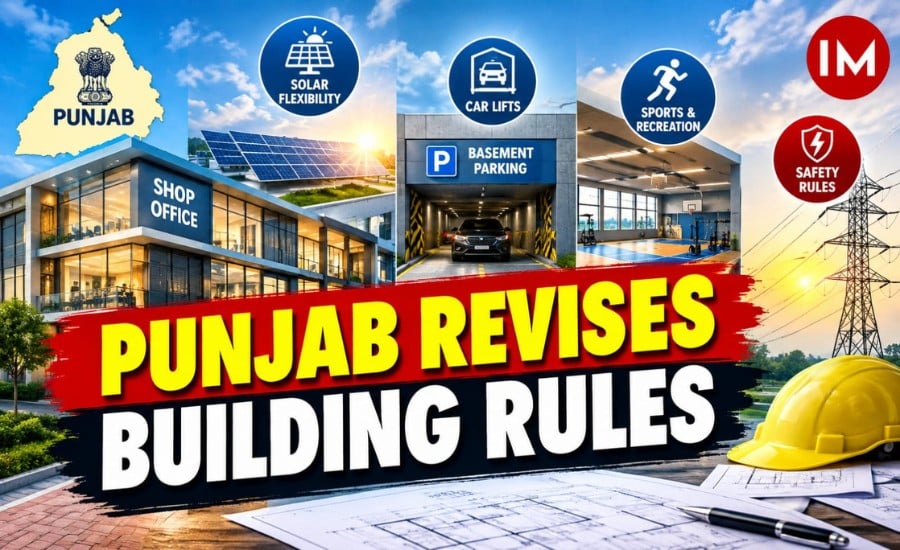
Chandigarh: The Punjab government has amended its building rules to provide greater flexibility for commercial properties, rooftop solar installations, basement parking and indoor recreational facilities, while introducing stricter safety requirements for buildings near high-tension power lines and taller structures.
The changes were notified through the Punjab Urban Planning and Development Building (Second Amendment) Rules, 2026 on September 7 by the Department of Housing and Urban Development. The amendment modifies the Punjab Urban Planning and Development Building Rules, 2021.
Key Changes in Punjab’s Building Rules
Higher Height Limit for Shops
The maximum floor-to-floor height permitted for booths, shops and shop-cum-offices has been increased to 5 metres, from the earlier 4.27 metres.
Read Also: Punjab Power Output Dips Despite 117% Coal Stock at PSPCL Plants, Centre Says Supply Isn’t the Issue
The amendment also makes changes concerning mezzanine floors in booths.
Rooftop Solar Structures Get Height Flexibility
Structures supporting rooftop photovoltaic solar panels can now have a clear height of up to 2.4 metres above the terrace without this additional height being counted towards the building’s overall height or Floor Area Ratio (FAR).
Terrace Toilets Excluded From FAR
The amended provisions also permit a terrace toilet measuring up to 6 square metres, with a maximum height of 2.75 metres, without counting it towards the prescribed FAR or overall building height.
Car Lifts Permitted for Basement Parking
The rules have been revised to permit car lifts for basement parking, subject to prescribed conditions.
The provisions also address parking arrangements for specific commercial uses, including car showrooms and workshops.
FAR Concession for Indoor Sports Facilities
Certain common indoor sports, games and fitness facilities on podium floors can receive an FAR concession.
For eligible buildings, 50% of the built-up area of such facilities will be counted towards FAR, subject to the categories and conditions specified under the rules.
Safety Rules Tightened
Alongside the relaxations, the amendment introduces stricter requirements for structures located near overhead high-tension electrical lines.
The required vertical and horizontal clearances will vary according to the voltage of the power line and will also account for the maximum deflection of the line caused by wind.
For overhead lines above 650V and up to 33kV, the prescribed minimum vertical clearance is 3.7 metres, while higher-voltage systems have progressively higher clearance requirements. The rules also specify clearances for high-voltage direct-current systems.
Fire-Exit Requirements for Taller Buildings
The amendment also strengthens fire-safety provisions.
Buildings exceeding 21 metres in height must have all required staircases as fire-exit staircases, adding a specific safety requirement for taller structures.
What the Changes Mean
The amendments combine regulatory relaxation in areas such as commercial building design, rooftop solar and parking with tighter safety requirements.
The changes are intended to provide greater flexibility within the state’s building framework while retaining prescribed standards for structural safety, electrical clearances and fire protection.
Read Also: Punjab Proposes DA Hike to 60% for 85,000 Employees Amid Fresh Agitation Call