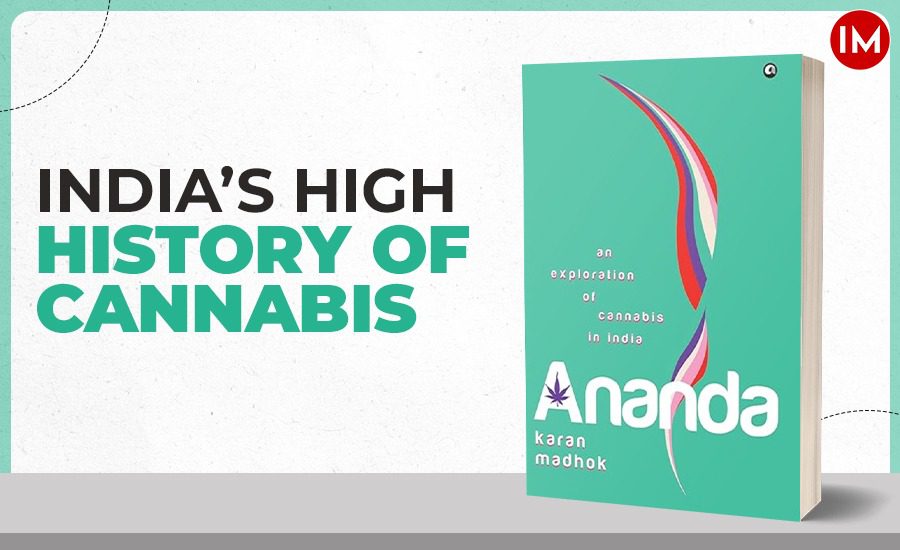
In his search for ‘cannabis in India and India in cannabis,’ Karan Madhok (born 1984) began his wanderlust after quitting his Times of India job in Varanasi when he was in his twenties. Over an eighty-six-day Bharat Darshan across dozens of cities in eleven states, staying in ashrams and inexpensive guest houses, he saw firsthand the ‘gravitational force’ and sheer diversity in the origin, use, and supply chain logistics of ganja. Charas, marijuana, weed, vijaya, bhang, pot, grass, hemp, maal, opium, and other derivatives — known by different names in different regions — Malana Cream, Idukki Gold, Sheelavathi, Blue Curly, Black Gold, and many more: Mary Jane grows by itself in many climes, is cultivated in other places, is smuggled across borders, and is available in government-licensed shops, with itinerant monks, in ashrams, in ayurvedic spas, and on the dark web through a channel called the Silk Route!
In his second travelogue after a gap of twelve years, Madhok’s purpose was clearer: the exploration of our country’s rich history and cultural relationship with this ancient plant. So he trekked up the grand ganja valleys in the highlands of Uttarakhand, the hamlet of Malana in Himachal, ayurvedic spas in Kerala, the coastal cities and the tribal belt of Andhra and Orissa, besides Manipur and Nagaland in the Northeast, the metros of Delhi and Bengaluru, and multiple cities along these routes. Looking out of railway compartments, he found a ‘carpet of naturally growing ganja’ as ubiquitous as the train tracks. It left him wondering how the hastily legislated NDPS 1985 could be enforced, especially when the use of ‘ganja,’ ‘charas,’ and ‘bhang’ had Shiva’s own sanction in the holiest of the holy cities of India – his own hometown of Kashi. Incidentally, the NDPS – an amalgamation of two colonial-era laws in the Opium Act of 1878 and the Dangerous Drugs Act of 1930 – had kept ‘bhang’ out of its purview, for this was also the elixir for the Vaishnavites and the followers of the Shakta cult. The sixth hymn of the Atharva Veda calls it ‘the food of, and for, the gods.’ It is an offering in many a Vishnu temple and is part of the ritual bathing of Sri Krishna’s elder brother, Balarama. Another variant, the ‘Sukha,’ is partaken by the Nihangs on Hola Mohalla (the day after Holi), and its use is prevalent in the Shimoga festival of Goa, the Rang Panchami in Maharashtra, and the Dol Jatra in Bengal.
Let’s now share some insights from his journey of exploration, starting with Malana, 8700 feet above MSL, whose inhabitants claim to be direct descendants of Alexander. Their dialect, Kanashi, is an amalgam of Tibetan and Sanskrit. The gram devata of Malana is Jamadgini Rishi, a.k.a. Jamlu, who came here as Shiva’s own plenipotentiary. From these Himalayan heights, Madhok travels to the Andhra Odisha Border (AOB), where the marijuana plant grows in natural abundance. Before the current dominance of Central Armed Police Forces (CAPFs) over the Maoist insurgents, this was also one of the main revenue sources for their finances. In his northeast sojourn, he comes across an organisation that celebrates the use of cannabis in its ritual and devotional practice – the Huyen Langlon Sintam Shanglen – also known as the Universal Friendship Organisation – with a followership of five to six lakhs. They have their own dragon god, Pakjangba. The body of the cult’s founder, RK Manisana, has been kept ‘uncremated, unburied, and unembalmed’ here for the last sixteen years, waiting for a miraculous resurrection. Among those who come and pay homage are legislators and ministers from the dominant Meitei community.
What makes the book much more than anecdotal recall are his incisive conversations with lawyers in Delhi, connoisseurs in Mumbai, and a diverse range of people around the country, including start-up entrepreneurs, scientists and botanists researching this plant, and activists trying to legalize the production and promote the consumption of hemp in myriad ways, besides entrepreneurs hoping to create a profitable value chain. A framework for this is the celebrity scandals around Sushant Rajput and Aryan Khan, documentaries like M Cream and Goonj: The Empty Cell, as well as iconic songs like the Zeenat Aman-Dev Anand classic Dum Maaro Dum.
The book is replete with information that is well-researched and referenced. We learn that wild cannabis grew 28 million years ago in high plateaus like Qinghai Lake in modern Tibet. Written texts and inscriptions in Chinese, Greek, Roman, Persian, and Egyptian talk about this ‘silver bullet’ for all maladies. Madhok quotes extensively from I.C. Chopra and R.N. Chopra’s work on the subject for the UN Office on Drugs and Crime. The current official data by the WHO is that in 2021, about 4.3% of the adult population in the world was consuming cannabis, thereby making it the world’s most widely used, cultivated and trafficked substance in the world.
In 2016, Uttarakhand became the first state to introduce a policy for industrial hemp. A milestone indeed, even if the process of obtaining permission from six different departments (forest, revenue, excise, panchayat, horticulture, and co-operatives) is Kafkaesque, with the final seal of approval from the Plant Protection and Quarantine department of the Union Agriculture Ministry at Faridabad. But a good beginning has been made with the Alaknanda Ghati Shilpi (AAGAAS) federation, supported by the Uttarakhand Bamboo and Fibre Development Board. Madhok discusses the pioneering initiative of Yash Kotak, founder of the Bombay Hemp Company (BOHECO), which is working in close collaboration with the NBRI in the cannabis genetic breeding project, and also Varun Rungta and Viki Vaurora, who established the Pan India Medical Cannabis and Hemp Association’s Great Legislation (GLM India) Movement to decriminalise the production and use of this plant.
Madhok also shares the stories of Amrit Vaidya, who cured his stomach cancer, gastric adenocarcinoma, with regulated doses of cannabis while living in a Karnataka gaushala for two years, as well as Hempwati founder Priya Mishra, who tried every other treatment for TB until cannabis came to the rescue. There is also a note of academics like Khagesh Gautam who have highlighted the potential of this plant in the medical, industrial, tourism, and pharma sectors. Fortunately, many voices cutting across party lines in Himachal Pradesh, Uttarakhand, Uttar Pradesh, MP, Orissa, and Gujarat — including Menaka Gandhi of the BJP, Dharamveer Gandhi of AAP, Tathagat Sathapathy of the BJD, and Shashi Tharoor of the Congress — have taken up support for cannabis and hemp. Globally, recognition is dawning that cannabis is a much better option compared to tobacco and alcohol. Adults in 24 states of the US, Canada, Germany, the Netherlands, Georgia, South Africa, and Uruguay have the option of partaking in recreational cannabis, while its use under medical supervision is allowed in over 50 countries, including most of the EU.
It is time that we discuss this issue seriously, especially as the marijuana-rich state of Uttarakhand celebrates its silver jubilee, thereby liberating this ‘divine’ offering to humans in search of Ananda.