In the vast expanse of India’s road networks, a silent epidemic rages on, claiming lives and casting a shadow over the nation’s progress. The National Road Safety Policy, acknowledging the staggering toll, recognizes road accidents as a grave public health crisis, snatching away 80,000 lives annually, amounting to 13% of global fatalities, and inflicting a 3% dent in the country’s GDP, according to the World Health Organization (WHO).
Himachal Pradesh, nestled amidst the majestic Himalayas, bears its own burden, with over 800 souls lost each year, a significant portion belonging to the youthful age bracket of 21-40 years. The perils of road traffic accidents (RTAs) loom large, with Himachal’s statistics surpassing the national average, exacerbated by the rapid expansion of road infrastructure and the burgeoning number of vehicles traversing its terrain.

In the heart of this struggle lies District Una, where urgent action was imperative to stem the tide of tragedy and pave the way for safer journeys ahead. With a small intervention under the leadership of IPS officer, Arjit Sen Thakur, and the then SP of UNA, the number of deaths due to RTAs came down significantly. The officer has also been awarded for his work.

In an exclusive conversation with Indian Masterminds, Mr. Thakur, who is currently posted as SP, SDRF, Junga, Shimla, spoke about how he & his team identified the root cause and found the solution.
THE PLANNING
In 2022, 2597 accident cases and 1023 deaths were recorded in Himachal Pradesh, and Una was one of the main contributors to such cases. To tackle the issue, the district police initiated traffic management measures, yielding a notable decrease in RTAs and fatalities.
Starting with an in-depth analysis of crash data via RADMS, they identified Police Station Sadar and Police Station Amb in District Una as hotspots for accidents, fatalities, and injuries. The escalating incidents underscored the inadequacy of current interventions, prompting the urgent need for a revamped strategy to safeguard lives on Una’s roads.
METHODS USED
After the identification of the hotspots, the next step was to find the solution. The team developed a strategy that involved aggregating marginal gains through small incremental changes, enhancing police response, resource allocation, and operational efficiency.
Specific heads of challans were closely monitored, and focus on critical issues like overspeeding and helmet violations was prioritized. High-visibility jackets were introduced for nighttime personnel, alongside 21-day awareness campaigns. Data-driven deployment of police personnel targeted CCTV-monitored locations and RTA hotspots. A detailed analysis of RTAs at Police Stations Sadar and Amb revealed insights: head-on collisions and pedestrian incidents accounted for 60% of fatalities, with pedestrians and two-wheeler riders most vulnerable.

Notably, 82% of fatalities occurred on national highways, highlighting areas for focused intervention. “Our approach prioritized incremental steps, recognizing their potential to yield significant changes over time. We are usually looking for major overnight changes and actions to tackle problems, yet they rarely work. Small steps count the most. By stressing behavioral modifications, we realized how important they are in minimizing traffic accidents,” said Mr. Thakur.
Identifying key stakeholders and vulnerable groups was pivotal in formulating a targeted strategy. Four primary stakeholders emerged: young commuters reliant on public transport or motorcycles; NH and PWD authorities overseeing infrastructure; truck operators integral to highway safety; and the traffic police ensuring regulatory compliance.

With resource constraints in mind, a collaborative, multi-agency approach was devised. This strategy engages all identified stakeholders to address road safety comprehensively, maximizing impact despite limited resources.
THE EXECUTION
High-level engagements were conducted to foster multi-agency coordination, vital for effective road safety initiatives. Notable meetings included discussions with the Honorable Governor of Himachal Pradesh, emphasizing the urgency of road safety concerns in comparison to national trends.
Another session was convened with the PWD Minister to enlist support for infrastructure enhancements, focusing on pedestrian facilities and road furniture installation. Additionally, consultations with the Transport Minister centered on proposals for advanced surveillance systems like number plate reading cameras and intelligent traffic management.

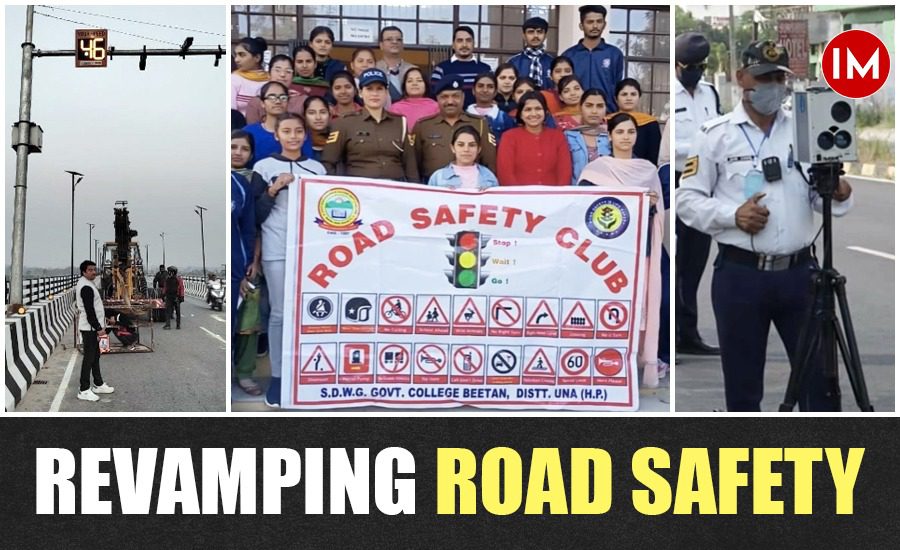
Educational efforts encompassed social media campaigns, school visits, and the establishment of road safety clubs to engage youth and the public. Enforcement strategies targeted major accident hotspots and enforced speed limits, resulting in improved traffic management. Positive outcomes included substantial investment in road infrastructure, correction of identified accident-prone areas, and the installation of advanced ITMS camera systems. Strengthened enforcement measures reduced hit-and-run incidents, supported by allocated funds for police equipment upgrades.
CONCLUSION
Enforcing road safety laws effectively yielded swift improvements in the Una district, notably reducing hit-and-run incidents caused by speeding. Continued enforcement fostered driver discipline, leading to a sustained decrease in road traffic accidents (RTAs), despite fewer Motor Vehicle Act challans.
Implementation of ITMS technology further streamlined enforcement efforts. Purposeful road safety education, particularly targeting vulnerable age groups, complemented enforcement measures. Integrating road safety into school and college curricula proved instrumental in cultivating safer road behaviors among students and young road users. This scalable approach is crucial as population mobility and road connectivity continue to grow, placing increasing pressure on enforcement agencies nationwide.