Wildlife tourism is often associated with the thrill of spotting a tiger, watching elephants near a river or exploring the wilderness on a safari. But what if a forest visit could offer something deeper – a better understanding of wildlife, respect for local communities and the motivation to practise conservation long after returning home?
This is the philosophy behind Jungle Lodges & Resorts (JLR), a pioneering ecotourism enterprise owned and operated by the Government of Karnataka in partnership with the Forest Department. With around 25 properties spread across Karnataka’s diverse landscapes, JLR offers nature-based experiences in and around wildlife habitats, rivers, hills and other ecologically significant areas.
Its approach goes beyond accommodation and wildlife sightings. Guided safaris, nature walks, night trails, stargazing and interactions with tribal communities are designed to help visitors understand the natural world and their responsibility towards it.
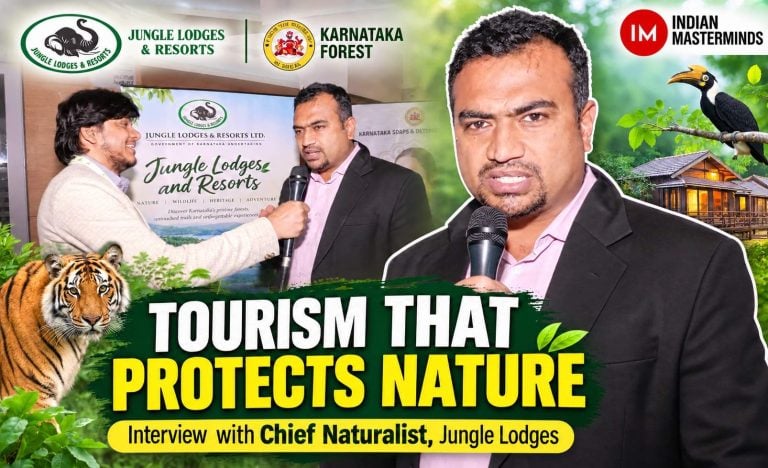
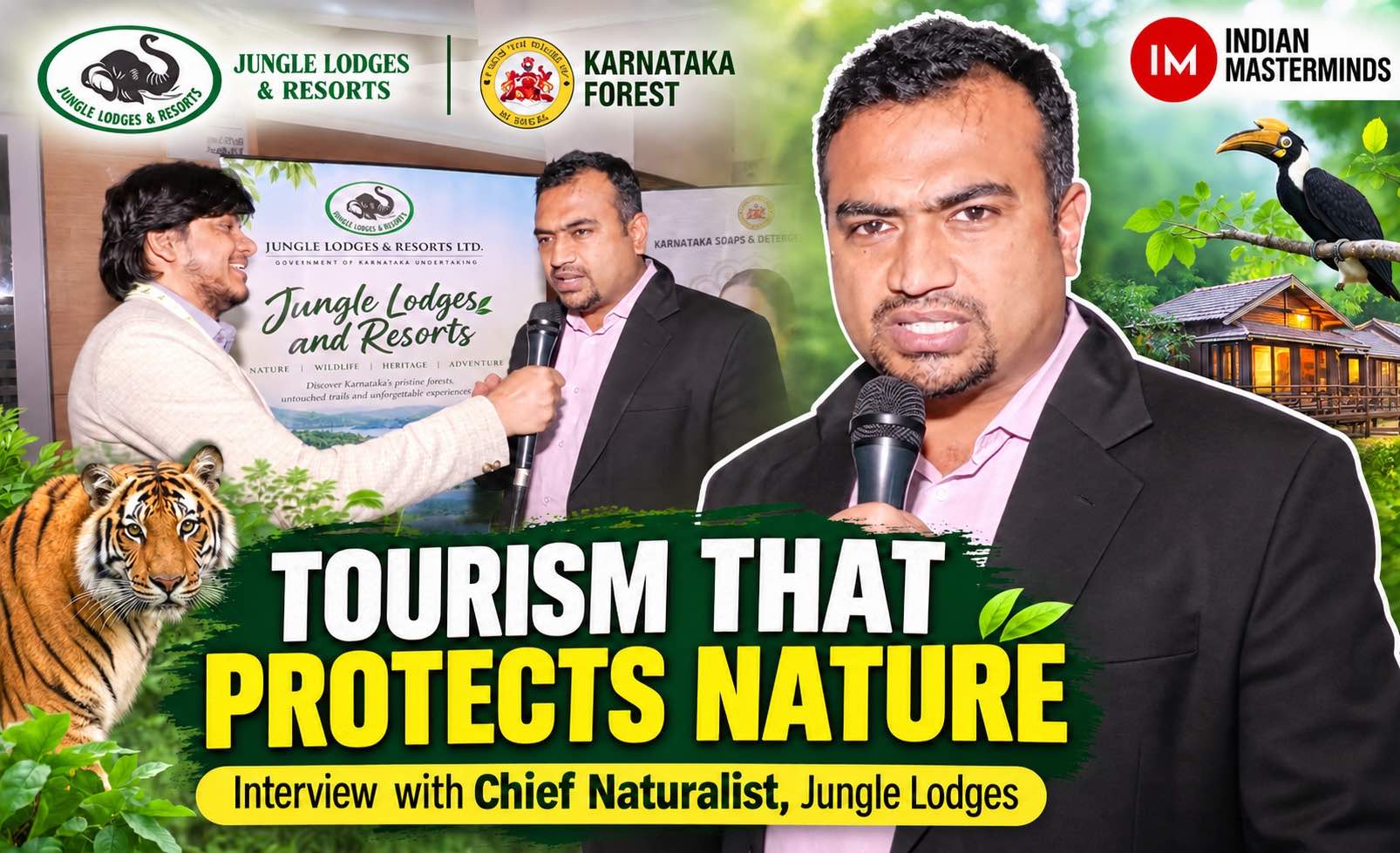
At the recently concluded fourth edition of the Eco Warrior Awards 2026, held in New Delhi on September 29, Indian Masterminds interacted with Anikethan C, Chief Naturalist at Jungle Lodges & Resorts, to understand its ecotourism model, community participation, ecological safeguards and future plans. Anikethan also participated in a panel discussion on the “Role of Corporates in Forest Management”, which explored how sustained partnerships can contribute to forests, wildlife and local livelihoods.
Recognising the People Behind Conservation
Sharing his experience of the awards ceremony, Anikethan welcomed the initiative to recognise officers working on the ground.
“The event was really very good because it’s very important to recognise the officers who are working in the field. When we talk about conservation and don’t recognise their work, it doesn’t really look nice,” he said.
He appreciated the organisers for continuing the initiative into its fourth edition, noting the importance of acknowledging the people whose work contributes to conservation.
A 45-Year Legacy of Responsible Tourism
Anikethan has been associated with Jungle Lodges & Resorts for around 13 years, but his connection with the organisation goes back much further. Growing up in Mysuru, where his father worked as an economics professor at the University of Mysore, he became familiar with JLR during his childhood.
He traced the organisation’s beginnings to 1982, when it was established under the vision of Gundura. The Karnataka government took it over in 1987, helping it develop into a recognised model of wildlife tourism and conservation-oriented hospitality.
Today, JLR operates approximately 25 properties across the state, combining tourism with wildlife management and engagement with communities living around forest landscapes.
Explaining its underlying philosophy, Anikethan said the objective is to provide visitors with meaningful experiences rather than making wildlife sightings the sole purpose of a trip.
“We train our naturalists to ensure that they give an experience to the guest and not just sighting a tiger or charismatic species,” he explained.
Activities such as nature walks, night trails, stargazing, safaris and tribal village visits help visitors explore different dimensions of the natural environment.
For Anikethan, the larger objective is to ensure that guests carry these lessons back home and adopt more responsible practices in their everyday lives.
“Conservation starts from here, but it starts from their house as well,” he said, highlighting how awareness generated through tourism can translate into action beyond the forest.
How Local Communities Become Partners in Conservation
One of the most significant aspects of JLR’s approach is its engagement with communities living near forests.
Anikethan explained that restrictions on entering forests following the implementation of wildlife protection measures significantly affected villagers whose livelihoods traditionally depended on forest resources. Many relied on collecting firewood, gathering forest produce and grazing cattle.
When access was restricted, these communities faced the challenge of finding alternative sources of income.
JLR’s employment model offered a way to connect their livelihoods with the conservation economy. According to Anikethan, local people have been part of the organisation’s workforce since its early days.
This participation, he said, can help build a more balanced relationship between people and wildlife.
When villagers have livelihood opportunities linked to responsible tourism, wildlife can become an asset to the local economy rather than being viewed only as a source of conflict.
Anikethan illustrated this through examples involving elephants and tigers. Communities familiar with elephant movement understand that visitors come to observe these animals, while the presence of tigers can also attract tourists and support local economic activity.
The aim, he explained, is to create a balance in which conservation and community welfare reinforce each other. Although tourism cannot eliminate every instance of human-wildlife conflict, providing communities with economic opportunities linked to wildlife can strengthen local support for conservation.
Keeping the Ecological Footprint Small
Operating close to rivers, forest areas and sensitive habitats comes with the responsibility of minimising environmental impact. For JLR, Anikethan said, one important measure is to keep accommodation capacity limited rather than continually expanding properties.
He cited Galibore, where the property has only 10 rooms, and Bheemeshwari, which has approximately 20 rooms. The organisation does not intend to increase capacity at these locations, he explained.
At K.Gudi, within the Biligiri Ranganathaswamy Temple (BRT) landscape, accommodation includes a small number of tents and other units.
The emphasis is on maintaining a relatively small footprint in ecologically sensitive locations. Rather than treating expansion as the primary measure of success, JLR seeks to preserve the character of the landscapes in which it operates.
This approach reflects an important principle of ecotourism: tourism infrastructure must remain sensitive to the environmental limits of the destination.
Beyond Tiger Sightings: Understanding Wildlife Behaviour
JLR also seeks to change how visitors experience the forest. Instead of focusing exclusively on finding a tiger or another prominent species, the organisation trains naturalists to explain animal behaviour, seasonal changes and the relationships that sustain forest ecosystems.
Anikethan emphasised that this training goes beyond obtaining formal certifications. Naturalists are encouraged to develop the knowledge needed to interpret what visitors encounter in the wild.
For example, when observing a pack of wild dogs, they can explain the animals’ social relationships, behaviour and the development of their pups. They can also discuss seasonal patterns, including breeding and the timing of births, which may vary between locations such as Kabini and Bandipur.
Knowledge of plant life is equally important. Naturalists track the fruiting periods of ficus trees, which can help them identify suitable opportunities for birdwatching as birds respond to seasonal food availability.
Even spiders become part of the experience. Anikethan noted that visitors interested in observing larger spiders may find September, October and November particularly rewarding.
Such details allow JLR to plan experiences around natural cycles and visitors’ interests, making wildlife tourism more educational and less dependent on chance sightings.
Electric Safaris and Solar Energy: The Road Ahead
Looking ahead, Anikethan said there remains considerable scope for making JLR’s operations more sustainable.
One of the ideas under consideration is introducing electric vehicles for safaris. He referred to an electric vehicle initiative being developed by CR and expressed hope that it would become available for potential adoption.
JLR is also looking at expanding the use of solar energy across its properties. Anikethan cited K.Gudi as an example of a location where solar power has been adopted, adding that similar approaches could be explored at other properties.
“We need to reconsider and look at a lot of this energy,” he said, pointing to the importance of examining how energy is generated and consumed across tourism operations.
These proposed measures could further strengthen JLR’s efforts to reduce the environmental footprint of wildlife tourism, subject to their feasibility and implementation.
Making Every Forest Visit Count
For Jungle Lodges & Resorts, responsible tourism is not simply about taking visitors into the wilderness. It is about creating experiences that connect wildlife protection, community livelihoods and environmental awareness.
Through limited accommodation capacity, local employment, trained naturalists and plans to explore cleaner energy and electric safaris, the organisation is seeking to make tourism compatible with the conservation of the landscapes on which it depends.
As Anikethan’s account makes clear, the real value of a forest visit lies not only in the animals a visitor sees, but also in what that visitor learns about the natural world.
When people return home with a deeper understanding of wildlife and a greater willingness to protect nature, the impact of ecotourism can extend well beyond the forest boundary.