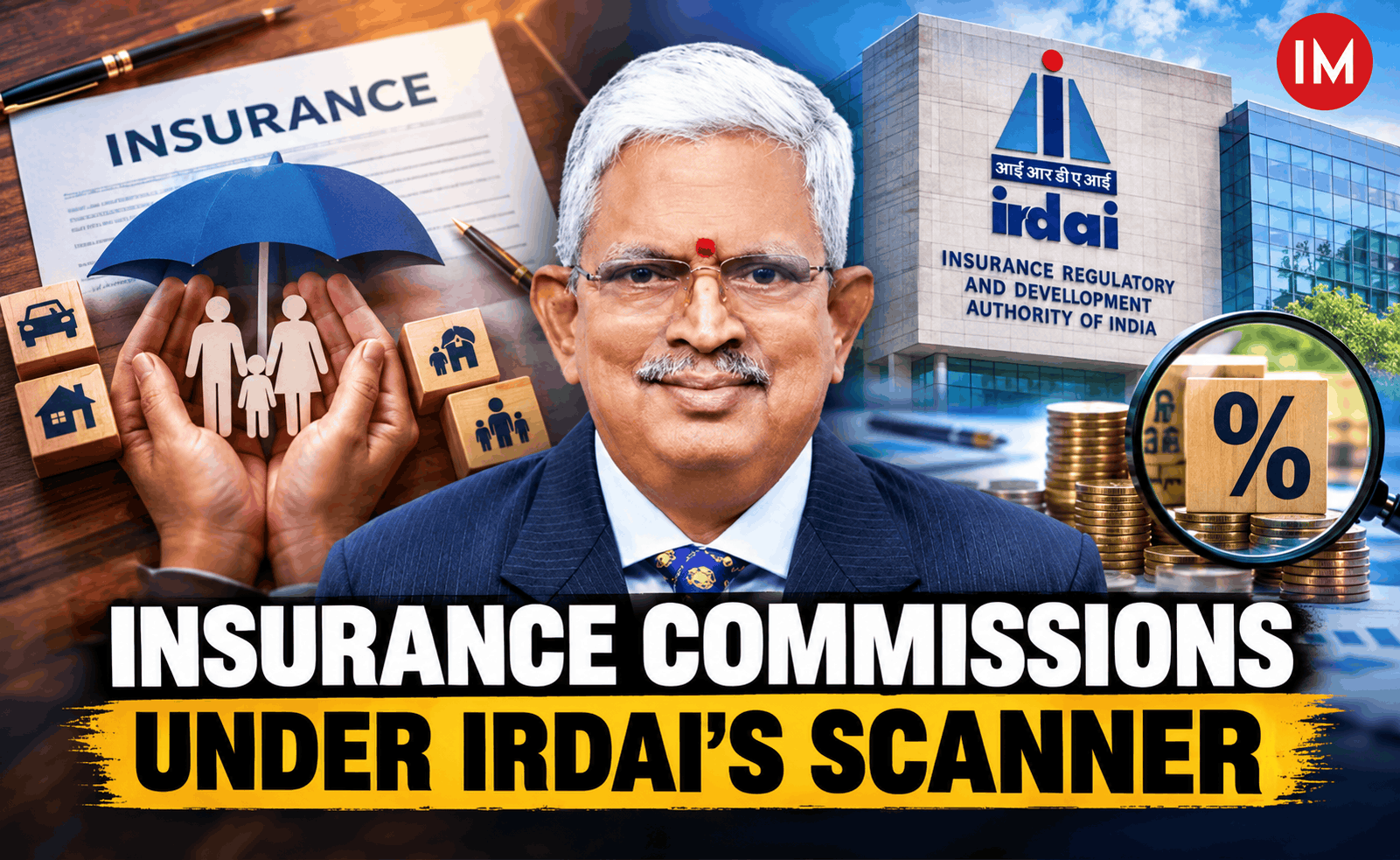
Commissions are the lubricant and the leakage of Indian insurance. For eight decades the law treated them first as a statutory number, then as a regulatory number, and from April 2023 as a matter for insurers’ boards within an overall expense ceiling. On 23 September 2026 the Insurance Regulatory and Development Authority of India (IRDAI) released a two-part consultation paper, “Recalibrating Economics of Insurance Distribution”. Part 1 sets out proposals. Part 2 sets out the evidence on distribution costs and commission structure. Together they conclude that successive reforms in 2016, 2023 and 2024 failed: the cost of doing business rose, commissions outran premium, and the gains after 2016 were wiped out in what the paper calls a “high cost and commission-led business”. The remedy is a return to product- and channel-level commission caps. These come with a five-year glide path that takes general insurers’ expenses of management from roughly 31 per cent of premium to 20 per cent, along with claw backs, persistency escalators, seller-level accountability, a ban on volume-linked incentives for bank and NBFC staff, and a new market infrastructure built around Bima Sugam. This note attempts to trace the history of commissions from the Insurance Act 1938 to the Sabka Bima Sabki Raksha Act 2025. It seeks to weigh the concerns of regulator, industry and policyholder against data on growth, penetration and claims, and compares India with the United States, the United Kingdom, Singapore, the European Union, Japan and China. It steel-mans the industry’s warning that caps will choke distribution in an under-insured country, and then concludes that the reform threatens rents, not growth. It closes with lessons and a calibrated way forward.
Prologue: The Price of a Promise
Insurance is the strangest of commodities. We pay today for a promise we hope never to test. That leaves the buyer almost blind and the seller almost omnipotent. Monika Halan, a member of IRDAI’s Insurance Advisory Committee, put it with a novelist’s economy when she told ThePrint that “a financial product is invisible… it is described by the person selling it.” Commission is the fee for that description. Paid honestly, it is the cost of carrying a promise from a balance sheet in Mumbai to a kirana store in Muzaffarpur. Paid dishonestly, it is a toll that grows fatter each time the promise changes hands, until the policyholder is buying a distributor’s margin wrapped in a policy document.
The September 2026 consultation paper is IRDAI’s verdict that, for much of the market, the second description now fits better than the first. The proposals are open for comment until 25 October 2026. IRDAI’s chairman, Ajay Seth, has said that draft regulations will follow and will “again be placed for public consultation”. Nothing in this note should be read as describing settled law. What is already settled is the diagnosis, and the diagnosis is damning.
From Statute to Board Room: How Commissions Came to Rule
The 1938 architecture
The Insurance Act 1938 was drafted in a colonial market crowded with fly-by-night companies and freelancing agents. It treated commission as something to be fenced in by law. Section 40 barred insurers from paying commission to anyone other than a licensed agent or intermediary. Section 40A wrote numerical ceilings into the statute itself. The best known was the cap of 35 per cent on first-year life premium, with much lower limits for renewals and for general insurance. For three-quarters of a century, commission in India was a number Parliament could amend and an insurer could not.
Nationalisation and the tariff era
Nationalisation then turned distribution into a public utility with a sales force. Life insurance was nationalised in January 1956 and placed in the Life Insurance Corporation (LIC). The general insurance business was nationalised under the General Insurance Business (Nationalisation) Act 1972, which took effect in January 1973, with the General Insurance Corporation (GIC) as holding company over four public-sector subsidiaries: National, New India, Oriental and United India. In general insurance, prices were not competitive at all. The Tariff Advisory Committee (TAC) fixed rates for fire, motor, engineering and other lines, so insurers could not compete on price and agents competed only on relationships. Commission was low, regulated and unremarkable because nothing else could vary. The distortions of that era were of a different kind: poor service, an indifferent claims culture and a monopoly’s lethargy.
Also Read – The IAS Officer Who Put People Before Paperwork: How PK Jena Challenged Corruption and Reformed Governance
Liberalisation and detariffing
The Malhotra Committee’s 1994 report opened the door. The IRDA Act 1999 created a regulator and let private insurers back in. De-tariffing of general insurance in 2007 then removed the TAC’s price grid for most lines. In the decade that followed, the commission ceiling became the one fixed point in a market where prices had been freed. Price competition in fire and engineering became savage, and motor own-damage premiums fell. The fight for distribution moved into a grey zone of “marketing support”, “infrastructure fees” and “rewards” that sat outside the commission line.
The 2015 hand-off, 2016 rules and the grey economy
The Insurance Laws (Amendment) Act 2015 took the hard caps out of the statute and gave IRDAI the power to set them by regulation. IRDAI used that power in the 2016 regulations on payment of commission or remuneration or reward to agents and intermediaries. These kept product-level caps but legitimised a “rewards” add-on on top of commission. Separate expenses-of-management (EoM) regulations limited insurers’ total spending. The architecture leaked anyway.
In September 2022 the Directorate General of GST Intelligence (DGGI) said it had detected ineligible input tax credit (ITC) of Rs 824 crore by 15 life and non-life insurers. The credit was claimed on invoices for services never rendered, and insurers paid Rs 217 crore voluntarily; ICICI Prudential alone reportedly paid Rs 100 crore in cash. DGGI’s case was that insurers were “paying commissions beyond IRDAI’s permissible limit to their corporate agents in the garb of expenses related to marketing and brand activation.” The probe then reached intermediaries. According to the Economic Times in April 2023, show-cause notices went to entities including HDFC Bank, Go Digit and Policybazaar over alleged evasion of Rs 2,250 crore on invoices raised between 2018 and March 2022; Rs 700 crore had been collected as pre-deposit, at least 120 intermediaries were under scrutiny and 12 insurers had been summoned. Prosecution was proposed against a Bengaluru-based online intermediary over roughly Rs 100 crore of allegedly bogus invoices. One trade report said commissions of up to 70 per cent were being routed against a ceiling it put at 15 per cent. That figure comes from a single secondary source, and ICICI Prudential publicly disputed the GST department’s contention. The lesson was not that caps work. It was that caps without enforcement and transparency push money into costume.
The 2023 liberalisation and its unravelling
IRDAI drew its own conclusion and reversed course. From April 2023 it removed product-specific commission caps and let insurers pay commission, now defined to include rewards, under board-approved policies within an overall EoM limit. The framework was consolidated in the IRDAI (Expenses of Management, including Commission, of Insurers) Regulations 2024. The bancassurance tie-up limit was raised, letting a corporate agent work with up to nine insurers per line. Point-of-sale persons (PoSPs) and motor insurance service providers (MISPs) multiplied as low-friction channels. The motor third-party segment, where premiums are fixed by the regulator and cover is compulsory, became an odd battleground: commission was paid on a product nobody needed persuading to buy.
In December 2025 Parliament passed the Sabka Bima Sabki Raksha (Amendment of Insurance Laws) Act 2025, which also opened the sector to 100 per cent FDI and recognised managing general agents. The Act expressly empowers IRDAI to prescribe commission caps. When it passed, law firm Khaitan & Co cautioned that the power “should not automatically be read as a return to the earlier commission-caps regime.” In September 2026 IRDAI proposed precisely that.
What Commissions Are For: The Economics of Pushing a Pulled Product
The case for commissions in India deserves a fair hearing, because it is strong. Insurance is sold, not bought, almost everywhere. In India it is sold against a low-trust, low-literacy, low-income backdrop where the nearest branch may be a bus ride away. Penetration was 3.7 per cent of GDP in 2024-25, with life at 2.7 per cent and non-life stuck at 1 per cent. The world average is 7.3 per cent, and 4.3 per cent in non-life.
Density in non-life was a flat USD 25 per head against a global USD 555. In such a market, distributors do the hard work of creating demand: explaining an exclusion, filling a proposal form, chasing a renewal, walking a widow through a claim. That work costs money. The commission is the price signal that recruits people to do it. Swiss Re’s January 2026 outlook forecasts Indian premiums to grow 6.9 per cent a year in real terms between 2026 and 2030, up from 3.1 per cent in 2025 and the fastest of any major market, with health at 7.2 per cent and motor at 7.5 per cent. That projection assumes someone keeps knocking on doors.
The difficulty is that commission rewards the sale, not the outcome. And in insurance, unlike groceries, the quality of a sale shows up years later. A distributor paid the same for a well-matched policy as for a lapsing or mis-sold one has every reason to sell more and match less. Where distribution is concentrated, as with a bank that owns the customer, a car dealer who owns the showroom or an employer-benefits broker who owns the HR relationship, the commission stops paying for effort and starts paying for access. At that point it is no longer a cost of reach. It is a rent on captivity.
The Charge Sheet: What Part 2 of the Consultation Paper Reveals
The aggregate picture
IRDAI’s Part 2 reads like an audit report, which is a compliment. Its central finding is that successive reforms did not meet their objectives. The cost of doing business rose, and commissions and total payouts grew faster than premium. In general insurance, total expenses ran at 24 per cent of premium in FY19, 29 per cent in FY23, 27 per cent in FY24 and FY25, and 31 per cent in FY26, with some small insurers above 50 per cent and one at 123 per cent in FY26. Excluding the largest insurer, general insurers’ commissions were 17 per cent of total premium in FY26. Private general insurers paid an average commission of 20 per cent in FY26, with a range of 15 to 31 per cent, against 11 per cent for the public-sector insurers. Total payouts by private general insurers averaged 24 per cent, ranging from 14 to 52 per cent. Seth gave the same story in his own numbers in a Business Standard interview: private general insurers’ total expenses rose “from 25-26 per cent in FY19 to about 32 per cent in FY26”, and the 2023 flexibility “did not translate into adequate cost discipline.”
Brokers: the arithmetic of the leap
The broker data is the paper’s most arresting exhibit. In a sample covering about 90 per cent of broker-sourced general insurance premium, premium rose from Rs 74,460 crore in FY23 to Rs 1,01,862 crore in FY25, an increase of 37 per cent. Commission including rewards rose from Rs 6,348 crore to Rs 17,348 crore, an increase of 173 per cent. The average rate doubled from 8.5 to 17 per cent. Retail business made up 54 per cent of the premium but 78 per cent of the commission, and retail commission rose 248 per cent. Motor premium rose 34 per cent while motor commission rose 259 per cent, taking the average rate from 9 to 25 per cent. Third-party motor commission rose from 4.3 to 22 per cent, on a product whose price IRDAI itself fixes. Retail health premium grew 53 per cent and its commission 118 per cent, with the rate going from 10 to 30 per cent. PoSP brokers’ average rates went from under 10 per cent to between 24 and 38 per cent. Large non-PoSP brokers, by contrast, showed commission rates of 6 to 11 per cent but expense ratios of 33 to 60 per cent, and profit after tax of 30 to 60 per cent of revenue. IRDAI describes that as opaque to the corporate clients whose premiums fund it.
Peaks that defy explanation
Averages hide the extremes. Across general insurers, average commissions ranged from 6 to 29 per cent and maximums from 32 to 93 per cent, and peak commissions were paid even on renewals. Group health is the most counter-intuitive case. The industry average was 12 per cent and the highest insurer average 32 per cent, but the peak paid to a single distributor was 93 per cent. That is in a segment whose high claims ratios ought to leave no room for such payouts. Brokers and agents carry 63 per cent of health premium, and IRDAI describes corporate health intermediation as “institutionalised”. In motor, MISPs, OEM-linked brokers and dealers carry 46 per cent of premium. They earn average commissions of 15 to 40 per cent and maximums of 24 to 75 per cent, and new-vehicle own-damage commission through OEM brokers and MISPs runs at 27 to 38 per cent. The paper’s observation here is dry and devastating. Commission on new vehicles is higher than on old ones, even though “no vehicle can leave the showroom without insurance.” In fiscal 2025, OEM-linked brokers and MISPs generated about Rs 29,000 crore of premium and received almost Rs 7,050 crore in commission.
Banks, NBFCs and related parties
In general insurance, bancassurance is only about 5 per cent of premium but earns a 26 per cent average commission. That compares with 17 to 18 per cent for agents and brokers, who carry 63 per cent of premium. Corporate-agent banks average 26 per cent, other corporate agents 31 per cent, and NBFCs 40 per cent with peaks of 88 per cent. Commission paid to group entities rose from an average of 11 to 24 per cent between FY23 and FY25, and the maximum from 23 to 81 per cent.
The life numbers point the same way, and they matter for the non-life story because the same banks and NBFCs sell both. In the life corporate-agent sample, premium rose 28 per cent, from Rs 63,000 crore to Rs 80,000 crore, while distributor remuneration rose 125 per cent, from Rs 9,580 crore to Rs 21,600 crore. Premium sourced through NBFCs nearly tripled, from Rs 3,600 crore to Rs 10,300 crore, with payouts of about Rs 4,300 crore, or roughly 42 per cent. Group credit-life commission climbed from 5 to 28 per cent, an effective payout of about 45 per cent. Banks accounted for nearly Rs 68,000 crore of life corporate-agency premium in the sample. Single tie-up banks paid out an average of 13 per cent of new business premium, against 33 per cent for multiple tie-ups. The largest private life insurer paid 8 per cent to its promoter bank under a single tie-up, while the second-largest paid 42 per cent under multiple tie-ups. Private life insurers paid on average 31 per cent of their commissions to related parties, and up to 95 per cent. IRDAI’s inference is that remuneration is set by “competition for distribution relationships” rather than by effort. That is the language of an auction for shelf space, not a fee for service.
What the policyholder gets
The test of any distribution system is what reaches the customer. In health, the claim settlement ratio on an amount basis was 75 per cent across general insurers in FY25, but it ranged from 29 to 94 per cent. A policyholder who chose the wrong insurer, perhaps because a distributor was paid more to recommend it, could recover less than a third of what was claimed. The top six retail health insurers’ flagship products saw premiums grow 6 to 15 per cent a year, which IRDAI reads as margins spent on commission rather than on cheaper cover.
The grievance machinery is under strain. The Council for Insurance Ombudsmen’s 2024-25 report, as summarised in secondary coverage, records 60,304 complaints handled across the centres, of which 48,898 (81 per cent) were disposed of and 11,406 were outstanding at year-end. Health complaints totalled 37,431. Of the 29,017 health complaints disposed of, 6,126 were resolved in favour of the policyholder and 9,417 were recommended for settlement. One standalone health insurer alone accounted for 12,186 complaints. A different secondary source gives 53,184 complaints for the year, so the exact total should be treated as unsettled until the primary report is checked. IRDAI’s own annual report flags mis-selling as “a significant concern”, and the non-life claims ratio stood at 82.5 per cent in FY24. In life, surrender payouts were 37 per cent of Rs 6.3 lakh crore in benefits paid (Rs 2.33 lakh crore), against death claims of 7 per cent (Rs 0.47 lakh crore). Persistency at the 61st month was 48.4 per cent, and tenth-year persistency was as low as 8 per cent at the weakest insurer. A system that pays more to churn than to protect will churn.
The Proposed Cure: What IRDAI Actually Wants
The proposals are more architectural than the headline caps suggest. Eight forms of distribution licence would collapse into a single Insurance Distribution Entity (IDE) licence: corporate agents, brokers including composite and OEM brokers, insurance marketing firms, web aggregators, common service centres and MISPs. Nine kinds of authorised individual would collapse into four categories of Insurance Distribution Person, and every IDE could choose open architecture. Hospitals could become IDEs for health insurance, non-dealer garages could sell motor cover as an insurer’s associates, and third-party administrators and surveyors would be barred from distribution.
The EoM base for general insurers would shift to gross direct premium income. This strips out inward reinsurance and stops reinsurance commission being netted off. Only a third of crop insurance (PM FASAL BIMA YOJANA-PMFBY) premium would count, and the 2023 carve-outs for technology, awareness, rural and government-scheme spending would be absorbed. From FY2027-28, general insurers would have to reach 25 per cent within two years and 20 per cent within five; life insurers would go to 15 and then 12.5 per cent. Insurers that miss the glide path face graduated sanctions, up to curbs on new business through the channel that caused the overrun. Insurers would also face mandatory cost audits, and IDEs with insurance revenue above Rs 100 crore would too.
The general insurance caps are steep.
- Third-party motor on a new vehicle would carry ‘nil’ commission for IDEs and 2.5 per cent for agents, with own damage at 5 and 10 per cent.
- Old-vehicle third-party would be 2.5 and 5 per cent, and own damage 10 and 15 per cent.
- Individual health would be 15 per cent for IDEs and 20 per cent for agents on first sale, and 5 and 10 per cent on renewal or porting.
- Group health would be 2.5 and 5 per cent, capped at Rs 1 crore per policy.
- Retail property would be 15 and 20 per cent on first sale.
- Large property and engineering risks would range from 7.5 per cent down to 5 per cent by slab of sum insured.
- Marine cargo would be 10 and 15 per cent, and retail miscellaneous 15 and 17.5 per cent.
- Lenders bundling general cover with credit would get nil on third-party motor, 5 per cent on own damage, 5 per cent on health at first sale and 2.5 per cent on renewal.
- Business from towns under 10 lakh people would earn an extra 10 per cent of the first-year cap, and from towns under 50,000 and rural areas an extra 20 per cent.
Commission would become all-inclusive, covering “any payment to a distributor, by whatever name”. It would be clawed back on mis-sold and cancelled policies. Every policy would be tagged to the identity of the individual who sold it, and incidents of mis-selling would be made public. Volume-linked incentives for bank and NBFC staff would be prohibited. Dealers would have to show customers an option to buy motor cover on a market infrastructure institution (MII) platform, and would be barred from denying cashless repair to buyers who purchased elsewhere. MIIs would be capped at 5 per cent of premium to recover platform costs. Bima Sugam, in which all but three insurers are shareholders, would be the first MII. One notable omission, which Khaitan & Co rightly criticises, is that point-of-sale commission disclosure to retail customers is not proposed. Disclosure would apply only to bank-negotiated group health and to commercial policies above Rs 50 crore.
(This is the first part of a two-part series examining IRDAI’s proposed reforms to insurance commissions and distribution costs in India. The second part will follow tomorrow.)
About The Author– Mr. P Sesh Kumar is a retired 1982-batch officer of the Indian Audit and Accounts Service (IA&AS) who served as Director General of Audit at the Comptroller & Auditor General of India.
Disclaimer—(The views and opinions expressed in this article are solely those of the author and do not necessarily reflect the views of Indian Masterminds. For feedback or queries, please write to [email protected].)
Also Read – Children Need a Digital Safety Standard, Not Just a Screen-Time Rule