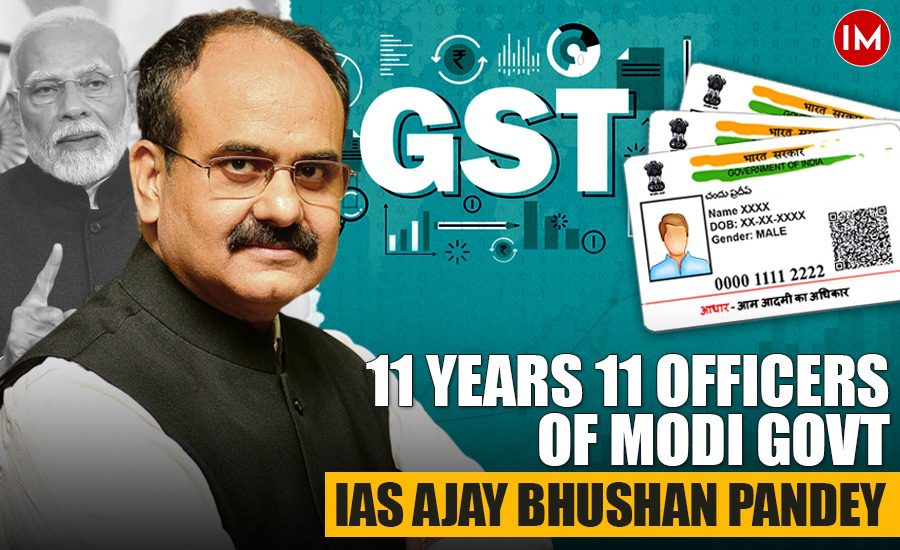
In a government that has made technology the cornerstone of governance, few have shaped India’s digital and financial ecosystem like Dr. Ajay Bhushan Pandey. From building the world’s largest biometric identity system to steering India’s fiscal operations during a global crisis, Pandey’s work under the Narendra Modi government reads like a blueprint for modern nation-building.
A 1984 batch IAS officer of the Maharashtra cadre, Pandey brought a rare blend of technology, governance, and finance to public service. He didn’t just execute ideas; he architected entire systems.
THE ENGINEER WHO WENT FAR BEYOND THE GRID
Before he became a key figure in India’s bureaucracy, Pandey was already a standout in academia. With a B.Tech in Electrical Engineering from IIT Kanpur, followed by an M.S. and PhD in Computer Science from the University of Minnesota under noted professor Jaideep Srivastava, he seemed destined for a high-impact role. But few could have predicted how far his work would reach and how deeply it would impact the daily lives of over a billion people.
His early roles in Maharashtra as Principal Secretary (Information Technology), Managing Director of Maharashtra State Electricity Distribution Corporation, and District Magistrate helped shape his understanding of grassroots challenges. But it was in Delhi where he would help build systems that redefined the scale and speed of public service delivery.
EXPANDING IDENTITY, EXPANDING ACCESS
When Pandey was appointed CEO of the Unique Identification Authority of India (UIDAI) in 2016, Aadhaar had already taken root. What he did was expand it with precision, scale it securely, and defend it legally.
Under his leadership, Aadhaar coverage crossed 1.2 billion people. The system, once viewed with scepticism, became central to India’s welfare architecture, plugging leakages, enabling direct benefit transfers, and opening up access to banking for the unbanked.
It wasn’t just about expansion; it was also about legitimacy. Pandey successfully led UIDAI’s defense of Aadhaar before the Supreme Court of India, pushing back against privacy and constitutional concerns and ensuring that the identity program remained intact and indispensable.
REFORMING INDIA’S TAX SYSTEM WITH GSTN
By September 2017, while still leading UIDAI, Pandey was given additional charge as Chairperson of the Goods and Services Tax Network (GSTN). A high-stakes platform crucial to India’s new indirect tax regime, GSTN was the technological backbone that could make or break GST’s success.
Pandey stabilized the platform, ensured smoother registration and filing experiences for millions of businesses, and introduced critical features that improved transaction reporting and revenue collections. His leadership helped move GST from policy to practice.
Later, as Finance Secretary, he played a pivotal role in improving the faceless assessment and appeal scheme in the Income Tax department, a reform aimed at making tax administration more transparent and efficient.
FINANCE SECRETARY DURING UNPRECEDENTED TIMES
In the corridors of North Block, Pandey took charge as Finance Secretary of India during one of the most complex periods in recent economic history. As the pandemic disrupted economies worldwide, he coordinated policy responses, oversaw fiscal recalibrations, and ensured that the government’s financial engine kept running.
His deep understanding of both technology and economics enabled the smooth rollout of several digital reforms, including enhancements to the Unified Payments Interface (UPI), expansion of the National Infrastructure Pipeline, and further integration of tech into public finance systems.
AT THE HELM OF CORPORATE AND FINANCIAL GOVERNANCE
After his stint in finance, Pandey didn’t slow down. He took over as Chairperson of the National Financial Reporting Authority (NFRA) in March 2022, India’s audit watchdog.
Here, his approach was clear: make financial reporting more accountable. He raised awareness about the roles of statutory auditors and audit committees and initiated disciplinary proceedings against errant audit firms. Pandey ensured NFRA’s voice was heard even in judicial forums like the Supreme Court, defending its powers and bringing audit quality to the forefront.
Concurrently, from April 2024 to March 2025, he also led the Indian Institute of Corporate Affairs (IICA), the Ministry of Corporate Affairs’ apex think tank, driving intellectual and policy debates in India’s corporate governance space.
FROM DELHI TO BEIJING
In April 2025, Pandey’s career took a global turn. He joined the Asian Infrastructure Investment Bank (AIIB) as Vice President, Investment Solutions. Now based in Beijing, he oversees critical departments, sectors, and finance solutions; sustainability and fiduciary solutions; and portfolio management. India is the second-largest shareholder in AIIB, and Pandey’s position there strengthens India’s strategic presence in shaping multilateral investment discourse.
ONE OF THE 11 WHO DELIVERED
As the Modi government marks 11 years in office, Ajay Bhushan Pandey stands among the 11 key bureaucrats who powered its transformation agenda. His journey embodies how deep expertise, when aligned with national priorities, can create lasting institutional change.
From Aadhaar to GSTN, from faceless tax systems to NFRA’s audit reforms, Pandey’s impact has been wide-ranging. Not loud or headline-seeking, but effective, the kind that reshapes systems and redefines governance.
In a country moving rapidly toward digital maturity, the structures he helped build aren’t just surviving; they’re evolving. And in that evolution, his fingerprints remain.