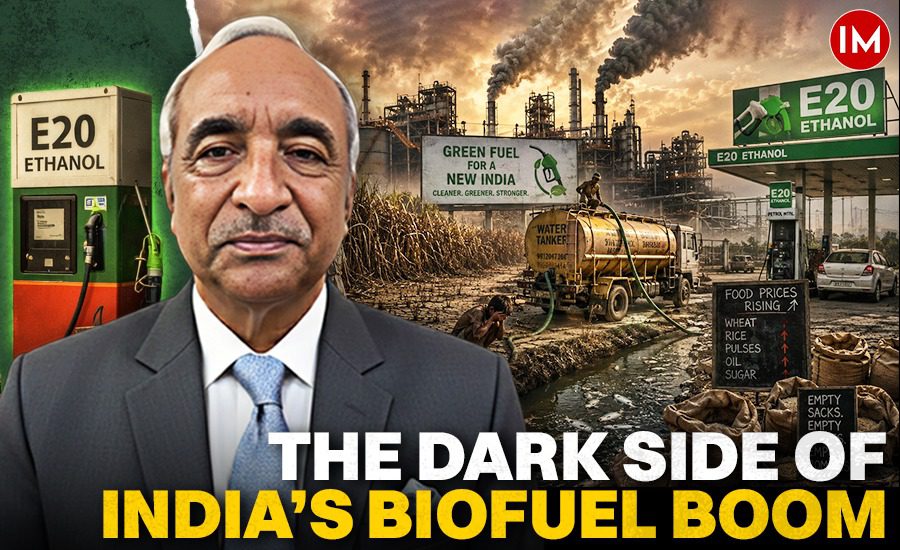
The government that advances energy independence by creating a new form of nutritional dependence — on imported maize, on rising animal feed costs, on a shrinking pulse and oilseed base — will have won one battle while quietly losing another. The ethanol programme deserves to succeed. But it must be governed by a principle that has so far been conspicuously absent from the policy documents: fuel should come from what we cannot eat, not from what we can, writes former IAS officer V.S.Pandey
From 1.5% blending in 2014 to 20% by 2025, India has built one of the world’s most ambitious biofuel programmes. It has saved ₹1.08 lakh crore in foreign exchange and enriched millions of farmers. But as maize floods into distilleries and pulses disappear from fields, a harder question emerges: at what cost to the food on India’s table?
India has pulled off a rare feat in energy policy. A decade ago, the country mixed a barely measurable 1.53 per cent ethanol into its petrol. Today, it has crossed the symbolic 20 per cent threshold — ahead of schedule — becoming the world’s second-largest biofuel blender. The numbers are genuinely impressive: over 1,000 crore litres of ethanol blended in the current supply year, ₹1.08 lakh crore saved in foreign exchange since 2014, and 185 lakh metric tonnes of crude oil kept out of India’s import ledger.
But a policy celebrated in the petroleum ministry’s press releases is now causing anxiety in quite different corridors — among nutritionists watching protein costs rise, agronomists watching groundwater tables fall, and poultry farmers watching their feed bills climb. India’s ethanol story, it turns out, is really two stories. And the second one is far more complicated than the first.
The core logic of the Ethanol Blended Petrol (EBP) Programme is straightforward. India imports roughly 85 per cent of its crude oil. Every litre of ethanol blended into petrol is a litre of crude that does not need to cross an ocean and drain the foreign exchange reserves. At scale, the savings are not trivial — ₹28,400 crore in forex in ESY 2023-24 alone. The programme also routes money directly to farmers: at E20 levels, payments to the agricultural sector are projected at ₹35,000 crore per year, providing a price floor that the market alone rarely delivers.
The environmental case adds further weight. The blending programme has reduced carbon dioxide emissions by 557 lakh metric tonnes over the decade — the equivalent, the government says, of planting 30 crore trees. With India committed to net zero by 2070 and E20 positioned as a ‘bridge fuel,’ the programme fits neatly into the country’s climate diplomacy.
So far, so good. The complications begin when one looks at where the ethanol is actually coming from.
For much of its history, ethanol blending made straightforward financial sense: molasses, the thick byproduct left after sugar extraction, was cheap and genuinely surplus. C-heavy molasses ethanol was priced at ₹46.66 per litre in 2021-22, well below petrol’s ex-refinery equivalent. Blending it reduced fuel costs while disposing of a byproduct that sugar mills were happy to monetise.
That calculus has changed. The government-fixed procurement price for maize-based ethanol stood at ₹71.86 per litre in 2024-25 — materially above petrol’s ex-refinery cost of roughly ₹52–58 per litre. Officials in the petroleum ministry acknowledge this openly, but argue the premium is justified by the transfer of income to farmers, the foreign exchange saving at a macro level, and the carbon benefit. What they do not say, but what the numbers make clear, is that the programme now runs on an implicit subsidy. India is paying more per litre for some of its ethanol than it would pay for the petrol it replaces.
This is not automatically wrong — governments subsidise many things for good reasons. But it does reframe the debate. Blending ethanol is no longer a straightforward cost-saving measure; it is a policy choice with winners, losers, and trade-offs that deserve honest accounting.
The sharpest of those trade-offs involves maize. Before the ethanol push, India produced 32–33 million tonnes of maize annually, with a domestic surplus available for export. In just two years, ethanol demand for maize has surged from 0.8 million tonnes to 12.7 million tonnes — a sixteen fold increase. Maize now accounts for nearly half of all ethanol produced in India.
The consequences have rippled quickly through the food system. India, a country that once exported maize, imported the grain in 2024 at volumes 7,940 per cent higher than the previous year. The poultry and dairy industries, which depend on maize for 60–70 per cent of animal feed, have seen input costs surge. The price of chicken, eggs, and milk — proteins that lower-income households depend on — has risen accordingly.
The land story is equally troubling. Maize acreage in Kharif 2025-26 expanded by around nine lakh hectares compared to the previous year. That land largely came from pulses and oilseeds — two crop categories where India already runs chronic deficits and relies heavily on imports. India imports 60–70 per cent of its edible oil requirement. Growing more maize for fuel while shrinking the land under mustard and soybean moves in precisely the wrong direction.
Sugarcane, the original backbone of the programme, brings its own complications. India’s cane cultivation covers 5.45 million hectares, and the crop is extraordinarily thirsty: in Maharashtra, sugarcane occupies just four per cent of cropped area but consumes over 60 per cent of the state’s irrigation water. In Karnatak , the figure is even starker — over 80 per cent of surface water goes to the crop. This in a country where 54 per cent of groundwater wells are already in decline.
When the government diverts sugarcane juice and syrup — rather than just leftover molasses — for ethanol, it reduces the sugar available for domestic consumption. India has imposed an indefinite ban on sugar exports since 2022, partly for this reason. The next target of 30 per cent blending would require even greater sugar diversion, with implications for prices that reach every household in the country.
None of this means the programme should be abandoned. The foreign exchange savings are real, the farmer income transfers are real, and India’s dependence on crude oil is a genuine strategic vulnerability. The question is not whether to blend ethanol, but how — and from what.
The sustainable answer lies in second-generation (2G) ethanol: fuel made not from food crops but from the agricultural waste that India currently burns in fields or dumps in landfills — paddy straw, sugarcane bagasse, bamboo, and municipal organic waste. The government has recognised this, commissioning five 2G bio-refineries and launching the PM JI-VAN Yojana. But these plants remain commercially unproven at scale, and 2G ethanol costs 40–60 per cent more to produce than first-generation grain ethanol. The technology exists; the economics need work.
The government that advances energy independence by creating a new form of nutritional dependence — on imported maize, on rising animal feed costs, on a shrinking pulse and oilseed base — will have won one battle while quietly losing another. The ethanol programme deserves to succeed. But it must be governed by a principle that has so far been conspicuously absent from the policy documents: fuel should come from what we cannot eat, not from what we can.
(Vijay Shankar Pandey is former Secretary Government of India)