There is a photograph that the football world has been talking about all week.
In 2007, Lamine Yamal then a baby was held in a charity photoshoot by Lionel Messi. On 19 July that baby, now 19 years old, walks onto the same pitch as Messi at MetLife Stadium in New Jersey. Messi is 39, possibly playing his last match in an Argentinian jersey. Yamal is the player the world has already crowned as his heir.
The King and the Prince. Farewell and arrival. On the same pitch, in the same final, on the same night.
It is the kind of story sport occasionally produces to remind you why you fell in love with it in the first place.
And then you remember that India is watching this from a sofa.
What the Numbers Say
At 39, Messi has scored eight goals and provided four assists in the 2026 World Cup alone – becoming the tournament’s all-time leading scorer, surpassing a record that had stood for over a decade. He is not just playing. He is dominating.
Yamal, at 19, has already made nearly 200 senior appearances for club and country, with more goals and assists than Messi and Ronaldo had between them at the same age. He turned 19 on the eve of Spain’s semi-final against France. His manager Luis de la Fuente told him before that match: relax, enjoy it. He did — and Spain won 2-0.
These are not just football statistics. They are the product of systems. Argentina’s football culture. Spain’s La Masia academy. Decades of grassroots investment, coaching development, and competitive pathways that run from seven-year-olds on neighbourhood pitches to 39-year-olds on the world’s biggest stage.
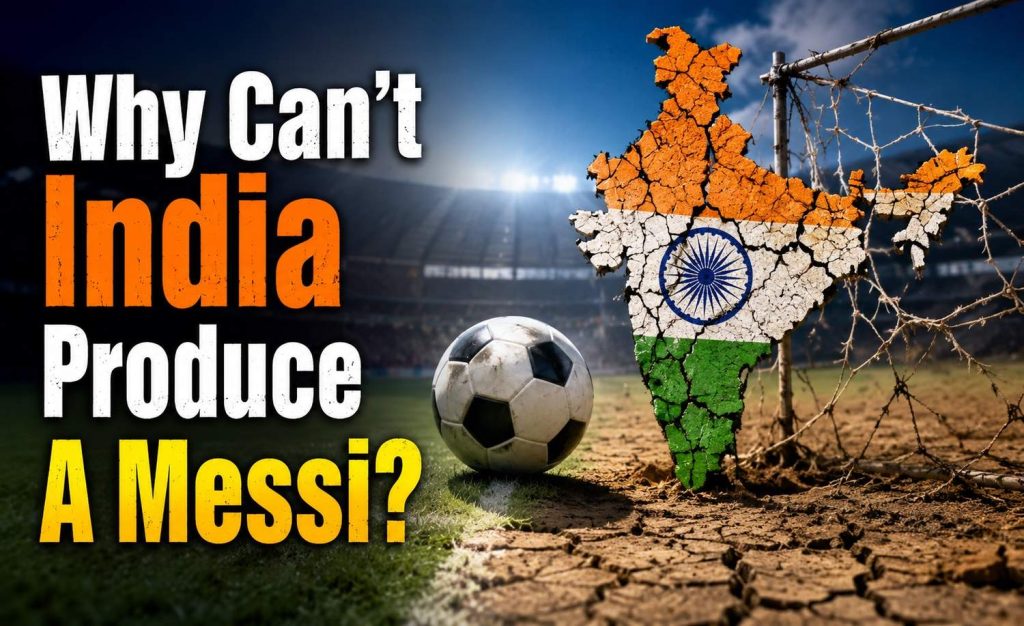
India has none of that, at scale, for football. And tonight, with 150 million Indian fans watching, that absence hangs in the air like an unasked question.
A Soldier’s Observation
I have spent a career in uniform understanding the difference between a force that wins and one that watches others win. The difference is rarely talent. Talent is abundant. What is rare and what is genuinely difficult to build and easy to lose is the system behind the talent.
Every country on that pitch in New Jersey built their football system over generations. They invested in youth academies when no one was watching. They hired coaches who developed players rather than selected them. They ran domestic leagues that were competitive enough to sharpen young talent rather than comfortable enough to blunt it. They kept politics out of selection and administration, at least enough to allow merit to breathe.
India has been doing the opposite for most of football’s modern era. The AIFF – our national football federation — was suspended by FIFA in 2022 for government interference. Our national ranking stands at 124th in the world. Our best player, Sunil Chhetri, retired last year and he left a vacuum that nothing in our current system is equipped to fill.
The Indian Super League has brought glamour. It has not yet built a national team. The grassroots remain thin. The coaching pipeline remains underdeveloped. The state-level youth infrastructure remains concentrated in a handful of traditional football states- Goa, West Bengal, Kerala, parts of the Northeast while the rest of the country, with its enormous untapped athletic talent, goes largely un- scouted and undeveloped.
The Poetic Irony
What makes Sunday’s final so particularly sharp for an Indian observer is its precise symmetry. The story of Messi and Yamal is a story of generational continuity- one great footballer handing the baton to the next, within a system that was always building toward that handover. Argentina produced Messi. Spain produced Yamal. Both countries will produce whoever comes after them, because the systems that produced Messi and Yamal are still running, still scouting, still coaching, still competing.
India has not yet built the system that would produce our Messi. We do not yet know the name of that player. We may not know for another generation unless the AIFF, the ISL, the Ministry of Sports, and the state governments decide together to make grassroots football a national priority rather than a local passion.
The Last Whistle
Messi may win tonight. He may lose. Either way, this is almost certainly his last World Cup – the culmination of a career that stretched from a teenager in Rosario to the greatest footballer the world has ever seen.
Yamal may win tonight. He may lose. Either way, he is just beginning. The next fifteen years of world football will carry his name.
India will have watched both. And Monday morning, the real question will not be which country lifted the trophy. It will be the same question we face after every World Cup, every Olympics, every Asian Games where we fall short of what our size and passion should produce.
When do we decide that watching is not enough?
(Col. M V Shashidhar (Retd.) is a Defence and Strategic Affairs Expert, IICA-Certified Independent Director, ESG Advocate and a Governance Thought Leader.)