By Ajay Gupta
“Bhaiya, I couldn’t clear Prelims again this year. I don’t know why I keep failing despite working so hard.”
These were the words of a UPSC aspirant who had already exhausted four attempts. He is not an exception. He represents a large number of aspirants who repeatedly fall short despite putting in long hours of effort. I asked him a simple question.
“How many times have you read M. Laxmikanth for Polity?” “None,” he replied. “But I have completed the entire Polity course through online lectures from one of the top coaching institutes in Delhi.”
I asked the same question about other subjects. His answer remained almost identical. Most of his preparation had happened through lectures rather than through reading and studying on his own.
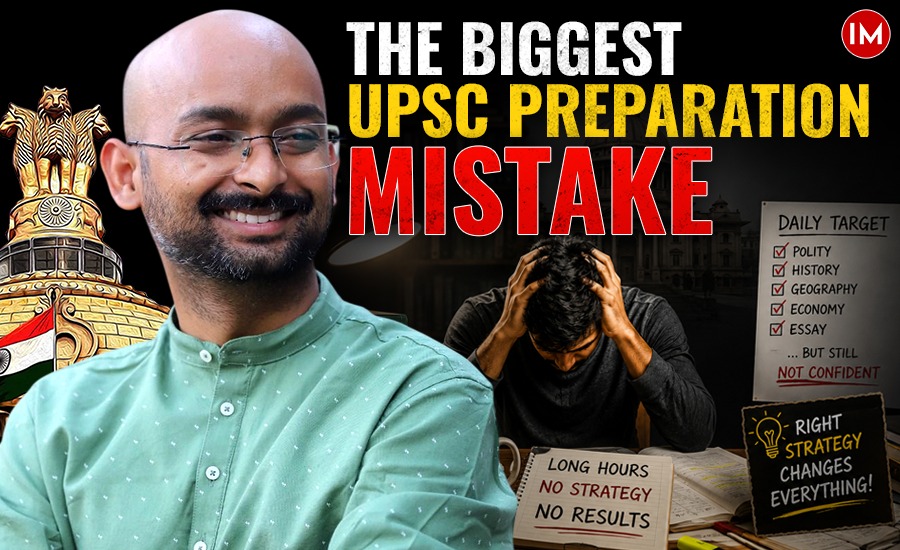
This, in my opinion, is one of the biggest mistakes many UPSC aspirants make. They begin to believe that attending classes is preparation. They confuse listening with learning.
LECTURES ARE A STARTING POINT, NOT THE DESTINATION
The problem is not with coaching or lectures.
Good teachers provide conceptual clarity, simplify difficult topics and save valuable time. Coaching has helped countless successful candidates build a strong foundation.
The problem arises when lectures become the primary mode of preparation instead of a starting point.
Many students spend six to eight hours every day attending classes but very little time reading standard books, revising notes or analysing concepts independently. Gradually, they begin to feel productive simply because they are constantly consuming content.
Unfortunately, consumption is not the same as learning.
UPSC DOES NOT TEST MEMORY ALONE
The reason lies in the very nature of the UPSC examination.
Unlike many competitive examinations, UPSC does not reward mere memorisation or superficial understanding. Questions are rarely direct. In many state examinations or recruitment tests, a question may simply ask, “What is the method of calculating GDP?” or “What was the role of Mahatma Gandhi in India’s freedom movement?”
If UPSC followed that pattern, lectures and memorisation alone might be sufficient. But it does not. Instead of asking, “What was Gandhi’s role?”, UPSC may ask: “How different would the achievement of Indian independence have been without Mahatma Gandhi? Discuss.”
Such questions demand analysis, judgement, interlinking of ideas and a deep understanding of history. They cannot be answered merely by recalling what a teacher said in class.
Students who rely almost entirely on lectures often struggle to develop this depth of understanding. Their thinking remains confined to what was covered in a one- or two-hour classroom session.
Naturally, no classroom—however good—can explore every dimension of every topic.
REAL LEARNING BEGINS AFTER THE CLASS ENDS
There is another limitation.
In a classroom, students are primarily listeners. Their minds are engaged, but mostly in following the teacher’s explanation. They are not forced to question, analyse, connect ideas or discover answers independently.
Since coaching institutes also have to complete the syllabus within fixed timelines, discussions often prioritise coverage over depth. Real learning begins only after the class ends.
It begins when a student sits alone with a book, struggles with a concept, rereads a paragraph, connects it with current affairs, relates it to another subject and gradually builds an independent understanding. That quiet struggle is where real preparation takes shape.
THE DANGER OF BECOMING DEPENDENT ON EXPLANATIONS
There is yet another consequence of excessive dependence on lectures. Students become accustomed to receiving explanations for every topic. Over time, they stop training their minds to derive answers on their own.
As a result, when UPSC frames a familiar topic in an unfamiliar way, they often lose confidence because they have never practised thinking independently. The examination is designed precisely to test this ability. It rewards those who can reason, connect ideas and apply concepts—not those who merely remember classroom notes.
ONE DECISION THAT MADE ALL THE DIFFERENCE
This became very evident to me recently. A group of five students who had already completed a degree programme integrated with UPSC coaching appeared for the Civil Services Preliminary Examination in 2026. Later, all five joined our mentorship programme.
Four of them decided to enrol once again in year-long classroom coaching. They spent another year attending lectures on subjects they had already studied. The fifth student made a different choice.
She did not join another classroom programme. Instead, she focused on reading standard books, revising her notes repeatedly, solving questions and strengthening concepts through self-study.
While the others were listening to lectures on the same subjects again, she was actively learning. When the Preliminary Examination results were declared, she cleared. The other four did not.
Of course, this is only one example. It is not statistical evidence, nor does it prove that classroom coaching is ineffective. Many successful candidates have benefited immensely from coaching.
Yet after multiple UPSC attempts of my own, mentoring more than a thousand aspirants and closely observing friends and students who eventually cleared the examination, one pattern has repeatedly stood out.
THE WINNING FORMULA
Those who succeed treat coaching as a support system—not as a substitute for self-study. Lectures can introduce a topic. Books deepen it. Revision strengthens it. Practice tests validate it. Reflection transforms it into understanding.
If a concept is difficult to understand from a book, read it again. Read it a second time. Read it a third time. Force your mind to wrestle with it. Only after making a genuine effort should you seek help from a teacher, mentor, video lecture or even AI.
That struggle is not wasted effort. It is precisely the process through which independent thinking develops. And independent thinking is what UPSC ultimately tests.
THE REAL PREPARATION HAPPENS WHEN YOU STUDY ALONE
Attending classes is important, especially in the beginning. But clearing UPSC is rarely about the number of lectures you attend. It is about the number of hours you spend reading, thinking, questioning, revising and solving problems on your own. The classroom can show you the path. Walking that path is your responsibility. That is where real preparation happens.
About the Author– Ajay Gupta secured AIR 452 in the UPSC Civil Services Examination (CSE) 2025 and AIR 91 in the UPSC Indian Forest Service (IFS) Examination 2025. Having written four UPSC Mains examinations and appeared in three UPSC personality tests, he brings extensive first-hand experience of the examination process. A former development professional, he is now a UPSC faculty member and mentor, guiding aspirants with practical insights and a deep understanding of the exam.
Disclaimer – (The views and opinions expressed in this article are solely those of the author and do not necessarily reflect the views of Indian Masterminds. For feedback or queries, please write to [email protected].)