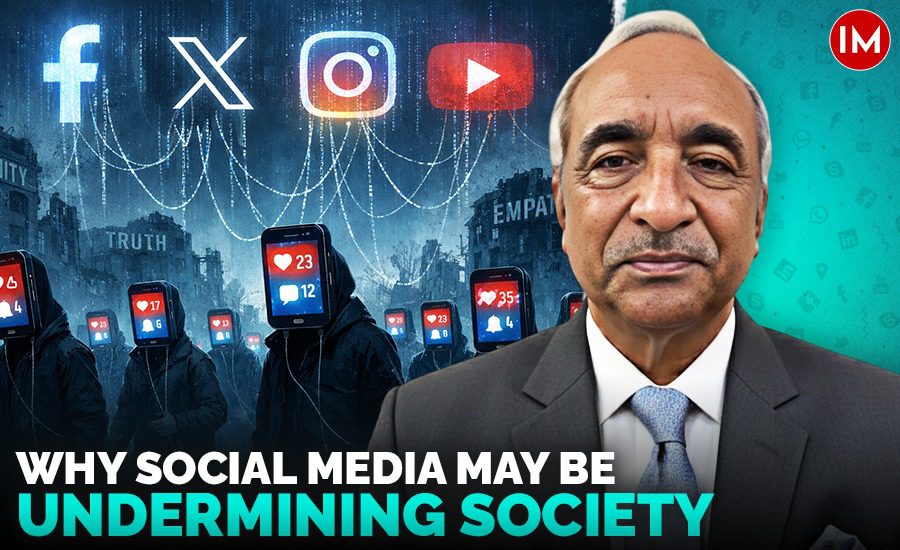
While social media platforms are often defended as tools of connectivity, creativity, and democratization, growing evidence suggests that their net social impact is proving more harmful than beneficial, particularly when measured against public health, democratic stability, and the wellbeing of children. This raises a legitimate and uncomfortable question: do these platforms still deserve to exist in their present form—or at all?, writes former IAS officer V.S.Pandey
What is good or harmful for people? What is essential and what is non-essential or artificial demand? Should people be allowed unbridled freedom to make money at the cost of people’s well-being? These three critical questions have been perilously ignored for decades by the “free market” votaries. The ill effects of these policies are visible universally.
The rise of social media platforms such as Facebook, Instagram, micro-blogging applications, and online gaming ecosystems is one of the most consequential social transformations of the 21st century. These platforms have reshaped communication, politics, commerce, culture, and even human psychology. While they are often defended as tools of connectivity, creativity, and democratization, growing evidence suggests that their net social impact is proving more harmful than beneficial, particularly when measured against public health, democratic stability, and the wellbeing of children. This raises a legitimate and uncomfortable question: do these platforms still deserve to exist in their present form—or at all?
The supporters of social media platforms advance several arguments in their favour. First, they claim that these platforms democratize expression by giving ordinary citizens a voice. Marginalized groups, small entrepreneurs, artists, and activists have indeed found visibility through digital platforms that traditional media denied them. Second, social media is credited with enabling rapid information exchange, disaster response coordination, and global connectivity. Third, digital games are defended as sources of recreation, cognitive stimulation, stress relief, and even professional opportunities through e-sports.
These utilities, however, are largely individual and exceptional, not structural. They depend on a user exercising self-control, critical thinking, and time discipline—capacities that platforms systematically erode rather than strengthen. The core business model of social media and most digital games is attention extraction. Platforms are not neutral tools; they are engineered systems optimized through behavioural psychology, neuroscience, and algorithmic reinforcement to maximize time spent.
Features such as infinite scrolling, autoplay, intermittent rewards (likes, notifications), and social validation loops exploit the same neurological pathways as gambling addiction. Children and adolescents—whose prefrontal cortex is still developing—are particularly vulnerable. Unlike alcohol or tobacco, these platforms are marketed aggressively without age-appropriate safeguards, despite clear evidence of irreparable harm.
If a product knowingly exploits cognitive vulnerabilities at population scale, calling it “entertainment” becomes ethically indefensible. A growing body of research links excessive social media use with anxiety, depression, loneliness, body image disorders, and reduced self-esteem, especially among young users. Instagram’s internal studies—later leaked—confirmed that the platform worsened mental health outcomes for teenage girls, yet no meaningful corrective action followed. In a recently published well researched book “The Anxious Generation”, the deep ill effects of these so called “utilities” have been thoroughly exposed. The book clearly validates-scientifically- that Social media also corrodes real social capital. Superficial digital interactions replace deep human relationships. Families sit together physically while remaining mentally isolated. Community bonds weaken, empathy declines, and social trust erodes.
Digital games, particularly those with aggressive monetization and immersive mechanics, contribute to similar isolation, sleep deprivation, academic decline, and behavioral issues. The gravest harm lies in the distortion of public discourse. Micro-blogging platforms incentivize outrage, simplification, and polarization because emotionally charged content generates higher engagement. Truth becomes secondary to virality. These platforms are also responsible for facilitating large -scale misinformation and propaganda, election interference and mob mobilization, trial-by–social-media replacing due process and character assassination without accountability. In effect, social media has weakened institutions without building credible alternatives. The promise of “democratized speech” has devolved into algorithmic mob rule.
From an economic perspective, the time cost is staggering. Billions of productive hours are diverted into passive scrolling and compulsive gaming, with minimal long-term value creation. While a small minority monetizes content or gaming skills, the overwhelming majority become unpaid data producers for corporations that convert attention into profit. Societies, especially ours, struggling with unemployment, skill deficits, and educational gaps cannot afford mass distraction as a default lifestyle.
The most compelling argument for banning social media and gaming platforms concerns children. Children cannot meaningfully consent to addictive systems. Exposure during formative years alters attention spans, emotional regulation, learning capacity, and social development. Many teachers report declining concentration, reading ability, and patience among students raised on short-form content. A society that prohibits child labour, alcohol, and narcotics on the grounds of developmental harm cannot logically permit unrestricted access to psychologically engineered addiction machines.
Despite these pernicious effects, an outright blanket ban raises legitimate concerns. Authoritarian misuse, black-market platforms, technological evasion, and free-speech implications must be acknowledged. Moreover, the internet is now embedded in economic and informational infrastructure so a sudden prohibition could create disruption without solving underlying demand.
However, the absence of perfect enforcement is not an argument against regulation. No one argues for legalizing dangerous drugs simply because prohibition is difficult. Undoubtedly, in their current avatar, social media platforms and many digital games cause more harm than utility at a societal level. Their design incentives are fundamentally misaligned with human wellbeing and democratic health. Whether they deserve a total ban is a policy question, but they unquestionably deserve prohibition for children below a certain age. Severe limits on addictive design features, algorithmic transparency and accountability , legal liability for mental health and societal harm, recognition as public-health and social-risk products is a critical necessity now for these deceptively labelled neutral technologies.
If such reforms are politically or commercially not possible, then a ban becomes not an extreme response—but a rational one. Civilizations are judged not by how advanced their technologies are, but by whether they serve human dignity and promote well being rather than exploiting and mining human weaknesses. By that yardstick, social media and addictive digital gaming currently fall dangerously short. As the famous quote goes –“The most basic question is not what is best, but who shall decide what is best.”
(Vijay Shankar Pandey is former Secretary of Government of India)