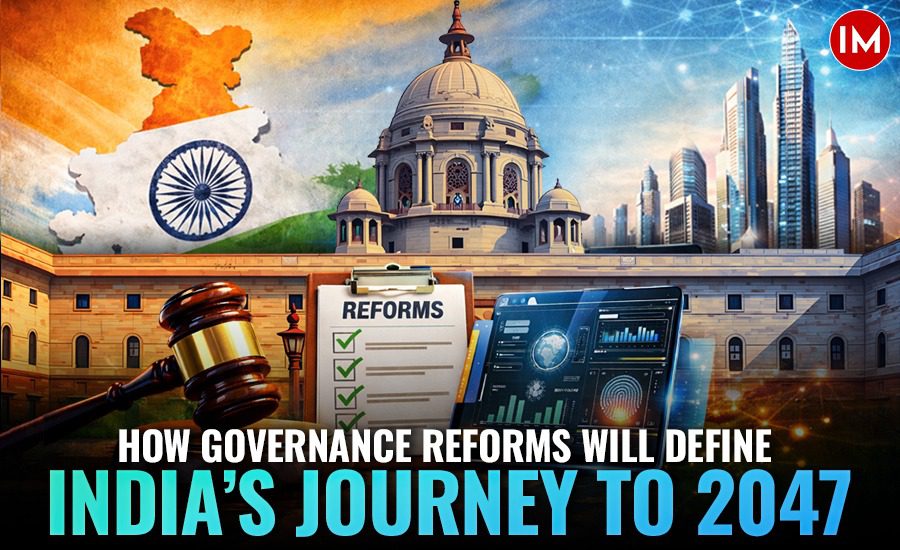
As India stands on the cusp of its centenary of Independence, the vision of Viksit Bharat 2047 has moved beyond rhetoric into the realm of actionable expectation. The aspiration is not merely to become the world’s third-largest economy; it is to evolve into a nation where governance is transparent, institutions are future-ready, and every citizen experiences the dividends of efficient administration. Achieving this demands a fundamental re-engineering of bureaucratic processes, judicial efficiency, regulatory systems, fiscal federalism, and the digital architecture of governance. Ten core reforms form the backbone of this transformation.
1. CUT THE FLAB: India must reduce its heavy regulatory burden—a legacy of the licence-permit Raj that still persists despite decades of liberalisation. Even today, firms navigate 1,536 Acts and rules, nearly 70,000 compliances, and more than 6,600 annual filings. MSMEs spend between ₹13–17 lakh a year simply to stay compliant. While the Jan Vishwas Act, IBC and labour law rationalisation improved the landscape, the maze continues. India must now move decisively toward a digital and risk-based regulatory architecture. This requires unified filing portals, automated approvals, elimination of redundant rules through periodic audits, and an empowered Regulatory Productivity Commission. Regulation must shift from suspicion to trust, cutting costs and unlocking entrepreneurial energies.
2. Laws and Schemes must have Expiry Dates: The statute books need decluttering through sunset clauses in laws and government schemes. India continues to carry the weight of archaic laws and outdated programmes because nothing ever formally ends. Automatic expiry dates, combined with mandatory performance reviews, would ensure that legislation remains contemporary and useful. Such periodic pruning would reduce bureaucratic clutter, contain rent-seeking opportunities, and give investors clarity on the duration and purpose of government interventions.
3. Introduce Regulatory Impact Assessment: India’s policy ecosystem must embrace Regulatory Impact Assessment (RIA) as a formal, institutionalised process. Too many laws and rules are framed without rigorous economic, social, or environmental evaluation. RIA—backed globally by the OECD and World Bank—can prevent policy missteps and ensure that new regulations deliver measurable value. Making RIA mandatory, setting up an independent agency, and equipping officials with analytical and digital tools will inject transparency, evidence, and accountability into the rule-making cycle.
4. A bureaucracy for 21st Century: The bureaucracy itself must transform from a colonial-era control apparatus into a modern, specialised, citizen-centric force. India’s civil services remain over-centralised, generalist, and resistant to innovation. While Mission Karmayogi has made major strides in capacity-building, lateral entries have been sporadic and career incentives remain skewed. The future requires a Civil Services Board insulated from political interference, mandatory specialisation in areas like technology and climate, structured lateral entry with safeguards, and 360-degree assessments for promotions. A 21st-century bureaucracy must become an enabler, not an obstacle.
5. Judicial Reforms: The judicial system—plagued by the infamous culture of tareek pe tareek—requires radical overhaul. Over five crore cases are pending, judicial vacancies exceed 30 per cent, and delays are estimated to cost the country up to two per cent of GDP. While the e-Courts initiative, mediation law, digital filings, and new court complexes mark serious progress, the scale of judicial arrears demands more. India needs more judges, more benches, faster filling of vacancies, performance-based incentives, specialised courts for environment and cybercrime, and the use of AI for case triaging. Timely justice is not merely a legal ideal—it is an economic imperative.
6. Zero tolerance against corruption: The fight against corruption must move from rhetorical emphasis to systemic rigor. Despite measures like the amended Prevention of Corruption Act, the Lokpal, Government e-Marketplace, Direct Benefit Transfers and digital grievance systems, corruption remains widespread. The next stage requires 100 per cent electronic procurement, open contracting standards, legally protected whistleblowers, AI-driven fraud analytics, machine-readable asset disclosures, and time-bound vigilance clearances. Anti-corruption is the foundational reform that determines whether every other reform succeeds.
7. Clean up Election Funding: India must bring transparency to political funding. Elections remain opaque, expensive, and vulnerable to quid pro quo arrangements. While the ECI has improved disclosure norms and technology-driven monitoring, the overall political finance ecosystem still lacks accountability. A new architecture should include state funding of elections, a National Election Fund open to public contributions, real-time digital disclosure of party finances, mandatory transparency for corporate donations, and bringing political parties under the RTI framework. Clean elections are the bedrock of clean governance.
8. Deliver e Governance Version 2047: India’s digital public infrastructure—already a global model with Aadhaar, UPI, DigiLocker, ONDC and widespread access—must now expand into e-Governance 2047. This implies a unified citizen-services portal, integration of AI and advanced analytics for predictive policymaking, real-time service delivery, and stronger data privacy and cybersecurity frameworks. Remote regions must be fully integrated, and digital literacy must grow alongside technological ambition. India can demonstrate to the world how digital tools can democratise services and create a genuinely citizen-centric state.
9. Federate the Fisc: Fiscal federalism—already strengthened by GST and higher tax devolution—must evolve into deeper cooperative federalism. States today struggle with unfunded Centrally Sponsored Schemes, shrinking fiscal space, and non-shareable cess and surcharge collections. Future finance commissions should address these asymmetries, create mechanisms for climate-responsive and demographic-specific transfers, and reward good governance through performance-based grants. States should also gain more freedom to mobilise their own resources, innovate with local taxes, and participate more directly in national budget planning. Greater transparency in Union–State finances, perhaps through a unified public fiscal portal, will foster mutual trust.
10. One India, One KYC: India needs a seamless “One India, One KYC” architecture. Even with CKYC and e-KYC systems in place, citizens repeat the KYC process across banks, insurers, mutual funds and government services. Streamlining this into a universal, real-time, privacy-protected system using blockchain, masked identifiers and secure APIs would dramatically improve ease of living. This reform ties directly into India’s broader goal of deep financial inclusion—reflected in the extraordinary growth of Jan Dhan accounts, pensions and digital transactions.
Each of these reforms is individually important, but their true power lies in being pursued together. Regulatory reform without judicial speed will not work. A modern bureaucracy without clean elections will falter. Digital governance without strong privacy laws risks exclusion. Fiscal federalism without accountability can breed new inefficiencies.
India’s journey to 2047 is thus not a collection of isolated administrative improvements, but a holistic project of nation-building. Governance must become simpler, faster, more transparent, and deeply citizen-centric. Institutions must be insulated from ad hocism. Technology must become a bridge—not a barrier. Political processes must be cleaned, markets must be freed, and justice must be delivered without delay.
If India succeeds, it will offer the world a new governance model—one rooted not only in economic growth but in institutional integrity and democratic depth. A developed India in 2047 is not merely an economic destination; it is a civilisational aspiration. The ten reforms outlined above form the scaffolding upon which that future can be confidently built.
( The article is by Suresh Misra, Brigadier K Anand, Ganesh A Bakade. Dr Suresh Mishra is a Professor at Indian Institute of Public Administration (IIPA) and his co-authors participated in 51st Advanced Professional Programme in Public Administration (APPA). This is an abridged version of their article on Governance & Bureaucracy published in November 2025)
Read More : Good Governance Possible Through Transparency, Accountability & Rule Of Law