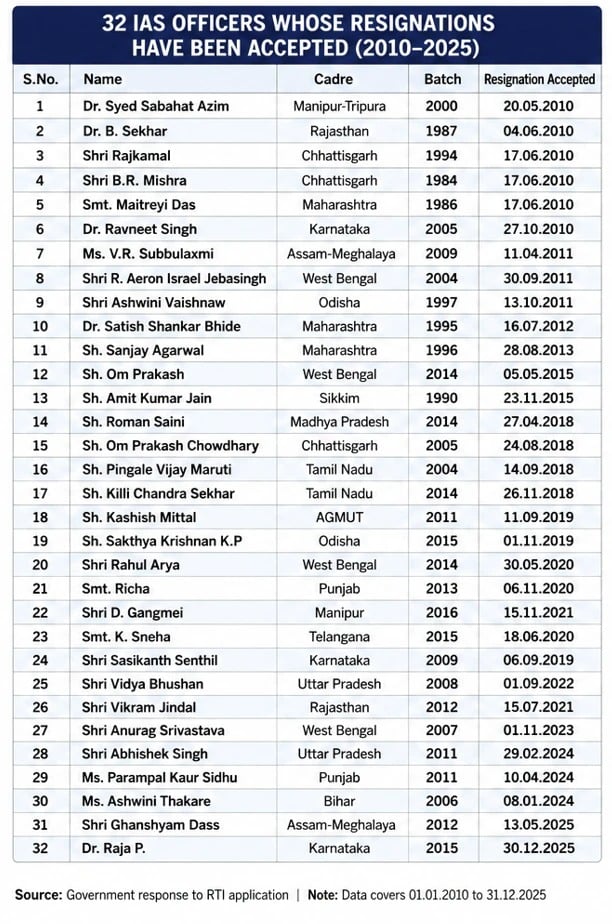
New Delhi: At least 32 IAS officers had their resignations accepted between 2010 and 2026, with West Bengal recording the highest number of exits among cadres, according to an RTI response obtained by India Today.
The data provides the names of the officers, their respective cadres and the dates on which their resignations were accepted. It offers a rare snapshot of officers who have formally exited the prestigious civil service through resignation over the 16-year period.
However, the government data comes with an important caveat: the Centre said it does not maintain centrally compiled information on IAS officers who submitted resignations but subsequently withdrew them.
As a result, the figure of 32 represents resignations that were ultimately accepted and resulted in an officer leaving the service. It does not include cases where officers submitted resignations but withdrew them before acceptance.
2010 Recorded Highest Number of IAS Exits
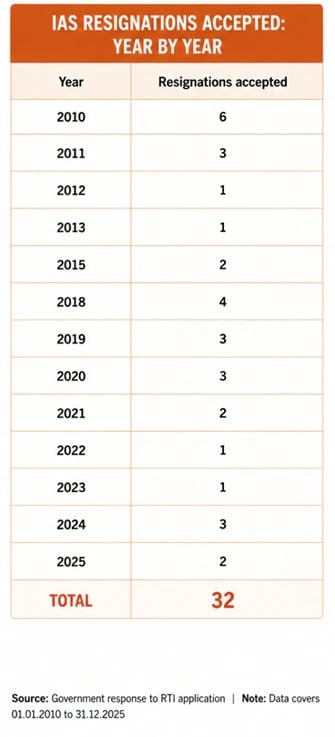
The number of accepted resignations varied considerably from year to year.
Six IAS officers had their resignations accepted in 2010, making it the year with the highest number of exits during the period covered by the RTI response.
In most of the subsequent years, the number of accepted resignations remained relatively low, generally ranging between one and four.
There were a few smaller clusters during the period. Four resignations were accepted in 2018, while three officers resigned in 2024.
The figures indicate that resignation from the IAS remains relatively uncommon when considered against the overall size of the service and the number of officers serving across the country.
West Bengal Records Most IAS Resignations
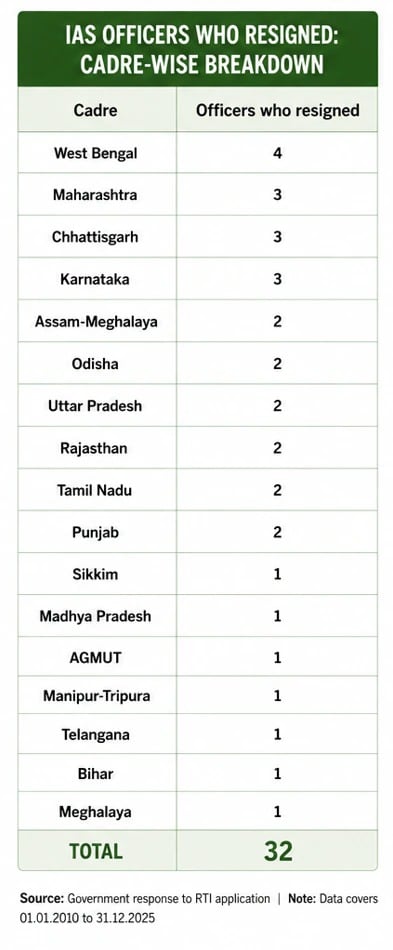
At the cadre level, West Bengal recorded the highest number of accepted IAS resignations since 2010, according to the RTI data.
West Bengal was followed by Maharashtra, Chhattisgarh and Karnataka, which also accounted for a significant share of the exits recorded in the data.
The cadre-wise breakup provides an indication of where accepted resignations have occurred, although the reasons behind individual decisions vary considerably.
The officers who left the IAS went on to pursue different paths, including politics, activism, entrepreneurship and other professional or public-facing careers.
Thus, the data does not point to a single reason for officers choosing to leave the civil service.
Resignation Submission Does Not Mean Final Exit
One of the most significant aspects of the RTI response is the distinction between submitting a resignation and having it formally accepted.
An IAS officer does not cease to be a member of the service merely because a resignation has been submitted.
The resignation has to be accepted by the competent authority before the officer’s exit from service becomes final. Until that stage, the officer remains in service and may, subject to applicable rules and circumstances, withdraw the resignation.
This distinction is particularly important when examining public announcements by serving officers about quitting the IAS.
A resignation that is announced or submitted may therefore not necessarily result in an officer leaving the service.
Government Does Not Centrally Track Withdrawn Resignations
The RTI response also highlights a gap in the government’s central data.
The government stated that it does not maintain centrally compiled information on IAS officers who submitted resignations but later withdrew them.
Therefore, the 32 officers listed in the RTI response should not be interpreted as representing every IAS officer who has attempted to resign since 2010.
Instead, the figure covers cases in which the resignation process ultimately resulted in formal acceptance.
Officers who submitted resignations but subsequently withdrew them before acceptance are not reflected in the centrally compiled figure.
This distinction becomes particularly relevant in cases where resignation announcements attract public or political attention but do not eventually lead to an actual exit from the service.
Divya Mittal’s Resignation Highlights the Distinction
The issue of IAS resignations has recently drawn attention following the announcement by 2013-batch IAS officer Divya Mittal, who announced her resignation this year after describing her 13-year stint in the civil service as an “unforgettable” journey.
Her announcement became a subject of discussion and also triggered a political controversy in Uttar Pradesh.
However, her resignation has not yet received final acceptance at the state government level.
Her case illustrates why the announcement of a resignation and an actual departure from the IAS need to be treated as two separate developments.
Until the resignation is formally accepted, the officer remains in service and the resignation cannot be counted among completed exits from the cadre.
The RTI data, on the other hand, records resignations that have crossed that final administrative stage.
Shah Faesal Shows Why Withdrawn Resignations Matter
Former IAS officer Shah Faesal provides another example of how an announced resignation can ultimately disappear from the record of accepted resignations.
A 2010-batch IAS officer and UPSC topper, Faesal resigned from the service in January 2019 and subsequently entered politics.
However, an RTI response obtained by India Today in 2020 showed that his resignation had remained pending for a prolonged period, with the government stating that the matter was “under consideration”.
His resignation, therefore, had not become final at that stage.
Faesal eventually withdrew his resignation. In April 2022, the government accepted his request to withdraw it and reinstated him into the IAS.
He was subsequently posted as deputy secretary in the Tourism Ministry in August 2022.
Because he ultimately withdrew his resignation and returned to the IAS, Faesal does not form part of the 32 accepted resignations recorded in the latest RTI data.
How Resignation Rules Shape the Official Data
Faesal’s case demonstrates the difference between an officer expressing an intention to leave the service and an officer actually exiting through resignation.
An officer may announce a resignation, formally submit it and then remain in service while the competent authority considers the matter.
If the officer subsequently withdraws the resignation and the withdrawal is accepted, the person does not become part of the final count of officers whose resignations were accepted.
This means that the government’s central list of accepted resignations represents only one part of the broader picture of IAS officers who have considered leaving the service.
What the RTI Data Reveals
The RTI response provides several broad takeaways about IAS resignations between 2010 and 2026.
The most notable is the relatively small number of officers who have formally exited through resignation over the period. Only 32 accepted resignations were recorded.
The data also shows that resignations have not followed a consistent annual pattern. While six officers exited in 2010, most subsequent years recorded between one and four accepted resignations, with 2018 and 2024 seeing smaller increases.
At the cadre level, West Bengal recorded the highest number, followed by Maharashtra, Chhattisgarh and Karnataka.
At the same time, the government’s inability to provide centrally compiled data on withdrawn resignations means that the number of officers who considered leaving but eventually remained in service cannot be established from this dataset.
Accepted Resignations vs Announced Resignations
The distinction assumes particular significance whenever an IAS officer publicly announces plans to resign.
A public announcement can generate considerable attention, particularly if the officer has taken a controversial position, entered into a dispute with the government or indicated an intention to pursue politics or another career.
But administratively, the decisive point is whether the resignation has been accepted.
The latest RTI data therefore provides a count of completed exits, rather than a comprehensive count of every resignation submitted or publicly announced by IAS officers during the period.
IAS Officers Have Taken Diverse Paths After Resignation
The officers included in the accepted-resignation data have followed different career trajectories after leaving the service.
Some have entered politics, while others have pursued activism, entrepreneurship or other professional and public roles.
The varied post-service paths underline that resignation from the IAS does not necessarily represent a single trend or motivation.
For some officers, it may mark a transition into electoral politics or public life outside the bureaucracy. For others, it may be a move towards private-sector opportunities, social initiatives or independent professional careers.
The RTI data establishes the number of formal exits but does not, by itself, establish the reasons behind individual resignations.
A Rare Exit from India’s Civil Services
With thousands of officers serving in the IAS across the country, the acceptance of only 32 resignations over the period covered by the RTI response reinforces the fact that voluntary resignation remains relatively rare in the service.
The figures also demonstrate why individual cases often attract significant public attention.
At the same time, cases such as those involving Divya Mittal and Shah Faesal show that a resignation announcement does not automatically translate into a permanent departure.
The RTI response thus offers both a numerical picture of IAS exits and an important insight into the administrative process governing resignations: only accepted resignations constitute final exits, while withdrawals are not centrally captured in the government’s data.
Read also: Gujarat Shuffles Senior IAS Officers; Rajkumar Beniwal Moves to Surat Municipal Corporation