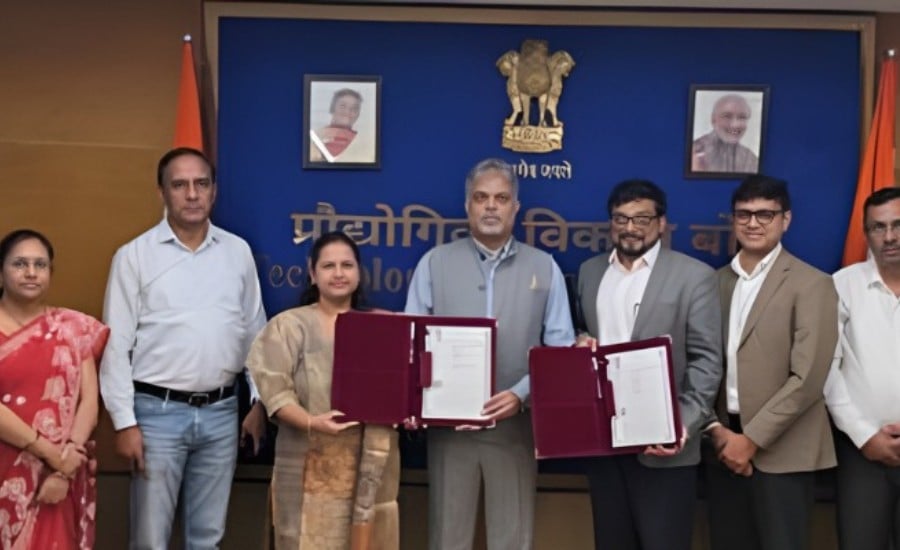
New Delhi: The Technology Development Board (TDB) under the Department of Science and Technology (DST) has extended financial assistance to Maharashtra-based Ceramat Private Limited for commercialising 3D-printed bone grafts tailored to individual patients.
The project will combine indigenously manufactured calcium phosphate-based bioceramics with 3D-printing technologies to develop both standard and customised bone grafts for medical applications.
Project to Combine Bioceramics With 3D Printing
Ceramat, based in Palghar, Maharashtra, develops bio-ceramic and advanced ceramic materials, including biomaterials used in orthopaedics and other applications.
The company currently manufactures conventional bone graft products such as granules. The new project aims to expand this capability to digitally designed grafts that can be customised according to individual patient anatomy.
The project will use two 3D-printing approaches:
- Digital Light Processing (DLP): For producing complex and customised graft structures.
- Extrusion-based 3D printing: To provide an additional manufacturing route for standard and patient-specific grafts.
The proposed grafts will use calcium phosphate-based materials such as hydroxyapatite and beta-tricalcium phosphate, which resemble the mineral composition of natural bone and are used in bone graft and implant applications.
TDB Highlights Indigenous Medical Manufacturing
The initiative is aimed at developing domestic capabilities in advanced biomaterials and additive manufacturing, while creating an indigenous alternative for specialised bone graft products that are currently available through imports.
TDB Secretary Rajesh Kumar Pathak said, “India’s transition from being a technology consumer to a technology developer requires indigenous capabilities in specialised and high-value areas of healthcare.”
He added that combining advanced bio-ceramics with 3D printing could open possibilities for personalised medical solutions and reduce dependence on imported products. Pathak said TDB would continue supporting technologies that take Indian innovations from development to commercial application and strengthen India’s medical manufacturing capabilities.
Key Areas of the Project
- Development of standard and patient-specific bone grafts
- Use of indigenous calcium phosphate-based biomaterials
- Application of DLP and extrusion-based 3D printing
- Expansion of domestic orthobiological and bioceramic manufacturing
- Commercialisation of advanced medical technology under the Aatmanirbhar Bharat focus
The project reflects the government’s focus on indigenous medical technology, advanced manufacturing and development of domestic supply chains for high-value healthcare products.
Read Also: How India Became A Key Technology Partner In One Of The World’s Biggest Science Missions