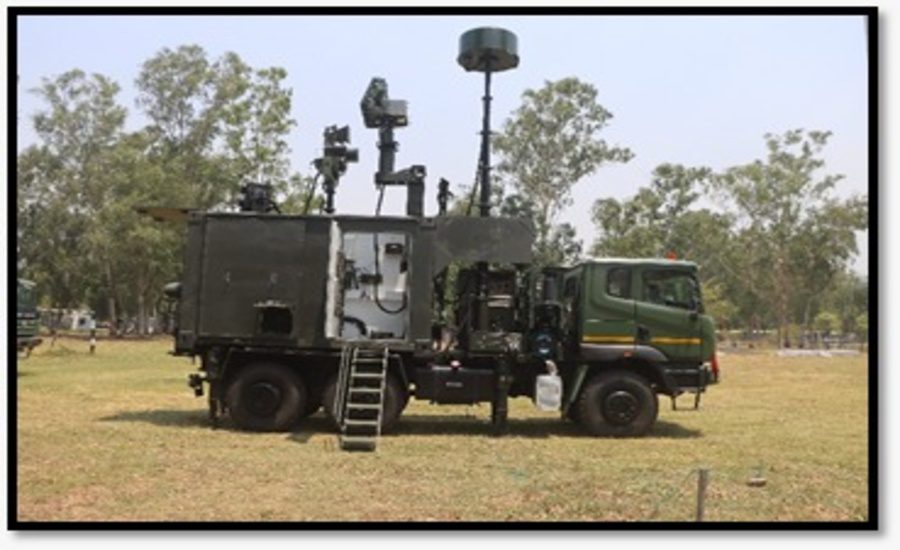
New Delhi: In a landmark display of technological prowess and national resolve, India has revealed the might of Akashteer—an indigenous, automated Air Defence Control and Reporting System—credited with neutralising one of the most sophisticated air assaults on Indian soil during the nights of May 9 and 10.
As Pakistan launched its most coordinated offensive yet—deploying waves of missiles and drones aimed at military and civilian infrastructure—it was Akashteer that quietly, and decisively, stood in the way. Every incoming threat was detected, tracked, and intercepted with precision, ensuring zero damage. This marks a turning point in India’s approach to air defence—an evolution from reactive strategies to autonomous, intelligence-driven warfare.
“By the time the enemy knew they were being watched, they were already being targeted.”
What is Akashteer?
Developed under India’s Atmanirbhar Bharat initiative, Akashteer is a fully indigenous, vehicle-mounted system designed to automate air defence operations. It integrates multiple radar platforms—such as Tactical Control Radar REPORTER, Low-Level Lightweight Radar, and 3D Tactical Control Radars—with communication networks and ground-based air defence weapons. This allows for real-time detection, tracking, and interception of airborne threats.
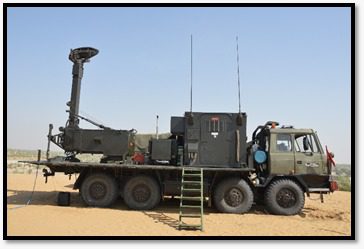
It forms a critical node in India’s C4ISR (Command, Control, Communications, Computers, Intelligence, Surveillance and Reconnaissance) network, enabling faster decision-making and coordinated multi-force response.
Intelligent Combat Over Brute Force
Unlike legacy systems dependent on manual inputs and fragmented radar networks, Akashteer delivers a common operational air picture across all command nodes—radar stations, control rooms, and defence guns. This integrated view eliminates friendly fire risks and enables swift and precise action in high-intensity conflict zones.
Seamless Tri-Force Integration
Akashteer is now the backbone of the Indian Army’s Air Defence (AAD), and interfaces smoothly with the Indian Air Force’s IACCS and the Indian Navy’s TRIGUN systems. Together, they form a unified, tri-service air defence network capable of real-time threat engagement across land, air, and sea.
The result is unparalleled situational awareness, vastly improved survivability for India’s own assets, and seamless coordination for both offensive and defensive operations.
Operation SINDOOR: Proof in Action
During the May 9–10 attacks—now being referred to as Operation SINDOOR—Pakistan deployed Chinese-origin HQ-9 and HQ-16 systems, which failed to counter India’s surgical retaliatory strikes. In contrast, Akashteer intercepted every single incoming projectile on Indian territory, showcasing India’s technological superiority and self-reliance.
A New Era in Defence Manufacturing
Akashteer is one of several cutting-edge platforms born from India’s domestic defence push. Under the Make in India banner, indigenous platforms such as the Tejas fighter jet, Arjun MBT, Dhanush artillery, ATAGS, and Advanced Light Helicopters are reshaping India’s military-industrial landscape.
India now produces 65% of its defence equipment domestically, a reversal of its historical 65–70% dependency on imports. The government aims to achieve ₹3 lakh crore in defence production by 2029, supported by:
1)16 Defence PSUs
2)Over 430 licensed private firms
3)Approximately 16,000 MSMEs in the sector
5)A private sector contributing 21% of total defence production
A Message to the World
Defence analysts have called Akashteer a “seismic shift in warfare strategy.” With it, India joins the elite ranks of nations with fully integrated, automated air defence command systems—alongside the U.S., Russia, and Israel.
“Akashteer is not just a weapon system. It’s India’s statement to the world: We can see faster, decide faster, and strike faster—and we don’t need to import capability to do it.”
As India continues to confront hybrid threats, asymmetric warfare, and the spectre of cross-border terrorism, Akashteer emerges not only as a shield—but as a symbol of strategic autonomy and technological sovereignty.