New Delhi: Oil and Natural Gas Corporation (ONGC) is close to launching a dedicated gas trading company, with around 95% of the work already completed, according to the company’s latest corporate presentation released after its Annual General Meeting on August 31, 2026.
The proposed venture is expected to begin operations by the end of 2026, although ONGC is yet to finalise its partner. Dubai and Singapore are being considered as possible locations for the headquarters of the proposed company.
The gas trading initiative is part of ONGC’s broader strategy to strengthen its position across the energy value chain as it simultaneously expands exploration, seeks to increase production from mature fields, accelerates gas monetisation and builds its presence in renewable and new energy.
The company reported a 30% increase in consolidated net profit in FY2026, while also declaring its highest-ever total dividend. At the same time, ONGC is pursuing an aggressive deepwater exploration programme, redevelopment of the Mumbai High field, technology-led production enhancement and a target of reaching 10 GW of renewable energy capacity by 2030.
Gas Trading Company Nears Launch
ONGC said around 95% of the work related to its proposed dedicated gas trading company has been completed.
The company is expected to announce the venture after completing certain pending approvals and contractual clauses. Operations are targeted to begin by the end of calendar year 2026.
However, ONGC has not yet finalised the partner for the proposed company. Dubai or Singapore are being considered as possible headquarters locations.
The proposed trading business could strengthen ONGC’s participation in the natural gas value chain, particularly as the company ramps up production from new developments and works to monetise additional gas resources.
Read Also: ONGC Begins Commercial Crude Oil Production at Ashoknagar, Marking Major Milestone for Bengal Basin
ONGC’s Gas Business Gains Momentum
ONGC is increasing the contribution of gas to its overall business as several new projects move forward.
The company’s gas revenue share increased to 27% from 25%, while gas from new wells now contributes 17% of total production and 21% of nomination gas revenue.
The Daman Upside Development Project (DUDP) achieved gas monetisation in record time, with gas production commencing in March 2026.
ONGC has also been progressing the monetisation of the North Karanpura coal bed methane block and the Chinnewala discovered small field in Rajasthan.
The proposed gas trading company is expected to complement these initiatives by giving ONGC a greater role in gas marketing and trading.
FY26 Consolidated Profit Rises 30%
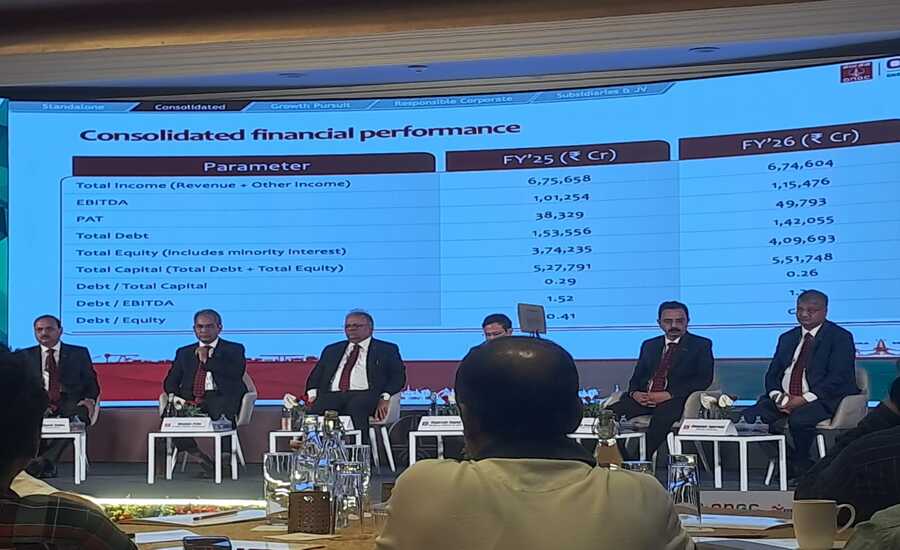
ONGC reported a strong improvement in its consolidated financial performance during FY2025-26.
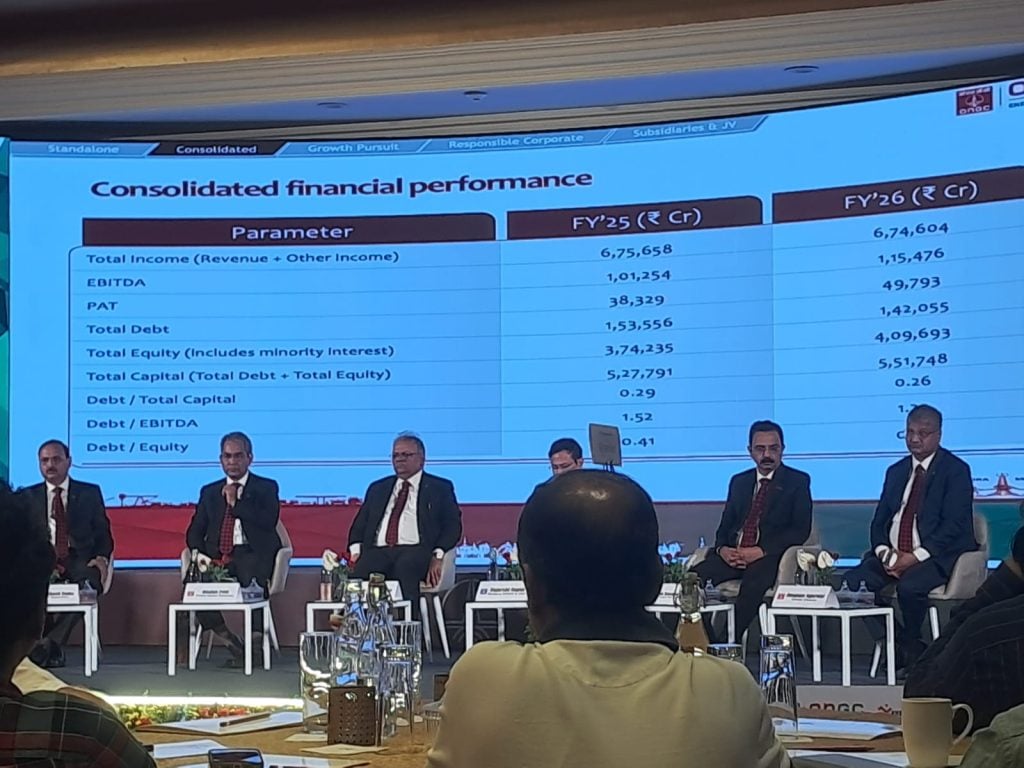
Its consolidated profit after tax (PAT) increased to ₹49,793 crore in FY26, compared with ₹38,329 crore in FY25, representing an increase of around 30%.
Consolidated EBITDA also increased substantially from ₹1,01,254 crore in FY25 to ₹1,15,476 crore in FY26.
Total income stood at ₹6,74,604 crore, compared with ₹6,75,658 crore in FY25.
The company’s balance sheet also strengthened during the year. Total debt declined from ₹1,53,556 crore to ₹1,42,055 crore, while total equity increased from ₹3,74,235 crore to ₹4,09,693 crore.
The debt-to-equity ratio improved from 0.41 to 0.35, while the debt-to-EBITDA ratio declined from 1.52 to 1.23.
ONGC maintained strong credit ratings, including Domestic AAA/A1+ and International Baa3/BBB/BBB- ratings.
Standalone Revenue and Profit Decline Despite Stronger Consolidated Performance
ONGC’s standalone financial performance was comparatively weaker in FY26, primarily because of lower crude oil realisations.
Standalone gross revenue stood at ₹1,32,508 crore, compared with ₹1,37,846 crore in FY25.
Standalone PAT declined to ₹32,894 crore from ₹35,610 crore in the previous year.
The company’s standalone EPS stood at ₹26.15.
Despite the decline in standalone profit, ONGC declared a dividend of ₹13.25 per share, described as its highest-ever dividend per share.
The board had earlier declared interim dividends of ₹6.00 and ₹6.25 per share and recommended a final dividend of ₹1 per share. Total dividend payout for the year stood at ₹16,669 crore, equivalent to around 51% of profit.
Record Quarterly Profit in June 2026
ONGC began FY2026-27 with a strong standalone quarterly performance.
For the quarter ended June 2026, the company reported standalone net profit of ₹17,034 crore, more than double the corresponding period of the previous year.
Profit before tax stood at ₹22,848 crore, which was described as the highest quarterly profit recorded by ONGC.
However, higher crude prices also put pressure on the group’s refining operations, resulting in relatively subdued consolidated performance during the quarter.
ONGC management said its integrated energy structure provides some protection against volatility because price movements in one segment can be partly absorbed by performance in other parts of the business.
Production Remains Broadly Stable in FY26
ONGC managed to keep its production broadly stable during FY2025-26 despite natural declines in some of its mature fields.
During FY26, ONGC’s production including its share from joint ventures stood at:
- Crude oil: 20.501 MMT
- Natural gas: 19.966 BCM
- Value-added products: 2.561 MMT
On a standalone basis, total oil and gas production was 38.86 MMToE in FY26, compared with 39.25 MMToE in FY25 and 39.45 MMToE in FY24.
Standalone crude oil production stood at 19.33 MMT, compared with 19.60 MMT in FY25.
Natural gas production was 19.53 BCM, compared with 19.65 BCM in FY25.
Including joint ventures, oil and gas production stood at 40.47 MMToE, against 41.08 MMToE in FY25.
Value-added product production stood at 2.56 MMT on a standalone basis.
Exploration Activity Remains a Major Focus
ONGC drilled 501 wells during FY26, including 100 exploratory wells, as part of its efforts to expand its resource base and offset natural declines in mature fields.
The company notified three new hydrocarbon discoveries in its operated offshore acreage during the year.
Testing established 55 wells as hydrocarbon-bearing, including wells drilled in earlier years.
ONGC also acquired 957 line kilometres of 2D seismic data and 4,631 square kilometres of 3D seismic data during FY26.
Across its Open Acreage Licensing Policy (OALP) blocks, ONGC has cumulatively drilled 79 exploratory wells and made 13 discoveries, with Vajramani being the latest discovery.
Reserve accretion from ONGC-operated areas stood at 44.01 million tonnes of oil equivalent (MMTOE) on a proved-plus-probable basis.
The resulting reserve replacement ratio stood at 1.17, indicating that the company replaced more than the volume of reserves produced during the period.
Samudra Manthan to Drive Deepwater Exploration
Deepwater exploration is one of the four major pillars of ONGC’s growth strategy.
The company is participating in the Samudra Manthan National Deepwater Campaign, launched in August 2025 by Prime Minister Narendra Modi.
The campaign has been described as the second-largest deepwater campaign globally.
Under the programme, ONGC plans to drill 87 deepwater wells over five years.
The campaign has an estimated potential of around 5,600 MMToE, while the government outlay is pegged at ₹84,084 crore.
ONGC’s target is to increase the number of deepwater wells from four in FY26 to 27 by FY31.
Deepwater expansion is particularly significant because ONGC holds around 68% of India’s deepwater acreage, giving the company a major role in the country’s offshore exploration programme.
Four Pillars of ONGC’s Growth Strategy
ONGC’s long-term growth strategy is built around four broad pillars:
- Exploration expansion, particularly in deepwater areas.
- Production optimisation through technology and the Technical Services Provider (TSP) model.
- Integrated energy across oil, gas, refining and related businesses.
- Green and new energy, including renewables and decarbonisation initiatives.
The strategy is designed to balance ONGC’s traditional role as an oil and gas producer with its transition towards a broader energy portfolio.
TSP Model to Boost Western Offshore Production
Technology-led production enhancement is another major component of ONGC’s strategy.
The company has partnered with bp for the Technical Services Provider model.
The first TSP project covering Mumbai High has been operational since April 2025.
ONGC envisages that TSP-1 could increase oil production by 44% and gas production by 89% from the relevant assets.
The second project, TSP-2, covers the remainder of ONGC’s Western Offshore portfolio.
The TSP-2 contract has been awarded and mobilisation began in August 2026.
The project is expected to deliver an estimated 11% increase in oil production and 32% increase in gas production.
Mumbai High Redevelopment to Boost Oil and Gas Output
The nearly five-decade-old Mumbai High field remains at the heart of ONGC’s Western Offshore redevelopment strategy.
ONGC issued the Notice of Award for the Mumbai High Redevelopment Phase-1 Scheme on December 26, 2025.
UK-based energy major bp is providing technical services for the redevelopment programme.
The project is expected to generate cumulative incremental production of approximately:
- 2.699 MMT of oil
- 2.806 BCM of natural gas
The incremental production is envisaged to be achieved by March 2040.
Following the Mumbai High engagement, bp has subsequently been onboarded as the technical services provider for ONGC’s entire Western Offshore portfolio, while ONGC will continue to retain responsibility for operating its fields.
26 Major Projects Under Implementation
ONGC currently has 26 major projects under implementation, involving investment of approximately ₹57,753 crore.
These projects have a projected lifecycle production gain of around 65.8 MMToE.
The company is also using enhanced oil recovery techniques to improve production from existing assets.
During FY26, ONGC approved 17 enhanced oil recovery pilot schemes aimed at increasing recovery from mature fields.
Capital Expenditure Remains High
ONGC continued to maintain substantial capital expenditure to support exploration, production and infrastructure expansion.
Capital expenditure during FY26 stood at:
- ₹35,878 crore on a standalone basis
- ₹61,131 crore at the ONGC Group level
Two major projects were completed during the year at a combined cost of ₹1,328 crore.
The high capital expenditure reflects ONGC’s efforts to simultaneously invest in exploration, production enhancement, new projects, gas development and energy transition initiatives.
Renewable Energy Portfolio at 2.853 GW
ONGC is also expanding its presence in renewable energy through ONGC Green.
The company’s current renewable energy portfolio stands at 2.853 GW, with a target of reaching 10 GW by 2030.
During FY26, ONGC awarded a 300 MW solar project connected to the inter-state transmission system for captive use.
The corresponding wind tender was awarded on June 5, 2026.
Read Also: ONGC Signs MoA for ₹20 Crore CSR Support to Restore 700 Flood-Hit Schools in Assam
ONGC Green also reported an efficiency improvement of around 4%.
Its subsidiary Ayana commissioned 839 MW, taking the total operating renewable capacity to around 3 GW, with another 1 GW in the pipeline.
Net-Zero Target by 2038
ONGC has set a target of achieving Net Zero for Scope 1 and Scope 2 emissions by 2038.
The company said carbon intensity has declined at a 3% CAGR over the past decade.
During FY26, Scope 1 and Scope 2 emissions declined by 7.26% to 8.81 million tonnes of carbon dioxide equivalent.
ONGC is also advancing its first carbon capture and storage (CCS) pilot project at the Gandhar field.
The pilot envisages injecting approximately 100 tonnes of carbon dioxide per day into depleted hydrocarbon reservoirs.
CSR Spending Crosses ₹900 Crore
ONGC’s corporate social responsibility expenditure stood at ₹943 crore in FY26.
The company has spent an average of more than ₹650 crore annually, with total CSR spending exceeding ₹3,400 crore over the past five years.
The expenditure forms part of ONGC’s broader ESG and social responsibility agenda.
Subsidiaries Deliver Strong Performance
ONGC’s major subsidiaries and joint ventures also reported notable operational and financial performance during FY26.
HPCL Records Strongest-Ever Throughput
Hindustan Petroleum Corporation Limited (HPCL) recorded its highest-ever throughput of 26.04 MMT.
Its market sales stood at 51.45 MMT, while its retail network crossed 25,000 outlets.
HPCL reported a gross refining margin of $8.79 per barrel and standalone PAT of ₹17,175 crore, compared with ₹7,365 crore in the previous year.
MRPL Improves Refining Performance
Mangalore Refinery and Petrochemicals Limited (MRPL) processed 16.774 MMT of crude during FY26, while group-level figures put throughput at around 17.0 MMT.
MRPL achieved its highest-ever xylol production.
Its gross refining margin improved sharply to $9.22 per barrel, compared with $4.45 per barrel in the previous year.
The company reported standalone PAT of ₹1,931 crore.
ONGC Videsh Expands Global Portfolio
ONGC’s overseas arm, ONGC Videsh Limited (OVL), holds participating interests in 29 oil and gas projects across 14 countries.
Its 1P reserves stood at 265 MMToE.
Production from overseas assets during FY26 was 9.671 MMTOE, comprising:
- 6.908 MMT of crude oil
- 2.763 BCM of natural gas
OVL’s PAT improved to ₹1,152 crore.
The force majeure on the Area-1 Mozambique LNG project was lifted in November 2025, with the first cargo targeted for July 2028.
OVL also formalised the acquisition of a 20% equity stake in Sakhalin-1 LLC on December 5, 2025, following engagement with Russia’s energy ministry.
In Venezuela, the company received a specific licence from the US Office of Foreign Assets Control (OFAC) for continued operations in its assets.
OPaL Turns EBITDA Positive
ONGC Petro additions Limited (OPaL) reported a significant turnaround during FY26.
The company’s EBITDA moved from a negative ₹203 crore to a positive ₹1,207 crore.
The improvement followed a major capital restructuring that included an equity infusion of ₹18,365 crore.
OPaL also transitioned from a Special Economic Zone to the Domestic Tariff Area.
ONGC has additionally formed two joint ventures with Japan’s Mitsui O.S.K. Lines:
- Bharat Ethane One
- Bharat Ethane Two IFSC Private Limited
The ventures are aimed at securing long-term ethane transportation for ONGC’s petrochemical operations.
Mitsui JV Signs Shipbuilding Contract for Two VLECs
An ONGC joint venture with Mitsui has signed a shipbuilding contract with Samsung Heavy Industries for two Very Large Ethane Carriers (VLECs).
The vessels are expected to support the company’s broader petrochemical and ethane transportation strategy.
Strategic Petroleum Reserve Expansion
The government has entrusted ONGC with developing an additional 1.75 MMT strategic petroleum reserve at Mangalore.
The project is aimed at strengthening India’s strategic energy security and storage capacity.
ONGC’s Contribution to Government Exchequer
ONGC remains one of the largest contributors to the government exchequer.
The company said its cumulative contribution to the government stood at ₹13,91,712 crore as of March 31, 2026, compared with an initial equity investment of only ₹342.85 crore.
ONGC’s contribution to the government during FY26 alone was ₹55,865 crore.
The figure includes the company’s contribution through taxes, duties, dividends and other payments.
Strong Subsidiary Performance Supports Integrated Energy Strategy
The performance of HPCL, MRPL, OVL, OPaL and ONGC Green highlights ONGC’s increasingly diversified business model.
While exploration and production remain the core of the company, its refining, petrochemical, overseas, gas, renewable and new-energy businesses are becoming increasingly important contributors to the overall group.
The company is therefore seeking to build an integrated energy portfolio capable of absorbing volatility in individual segments.
ONGC’s Production Strategy Looks Beyond Mature Fields
A key challenge for ONGC is the natural decline of its mature oil and gas fields.
The company is addressing this through several parallel initiatives — redevelopment of Mumbai High, technology-led TSP projects, enhanced oil recovery schemes, deepwater exploration and development of new discoveries.
The 26 major projects under implementation, with a projected lifecycle gain of 65.8 MMToE, form an important part of this strategy.
The deepwater campaign is expected to provide another major source of future reserves and production.
From Oil and Gas Major to Integrated Energy Company
ONGC’s latest corporate update indicates that the company is attempting to balance two priorities: maintaining and increasing oil and gas production while simultaneously preparing for a changing energy landscape.
The proposed gas trading company, expansion of new-well gas production, Daman Upside monetisation and deepwater exploration represent the company’s efforts to strengthen its traditional energy business.
At the same time, the 10 GW renewable energy target by 2030, carbon capture initiatives and 2038 Scope 1 and 2 net-zero target demonstrate its push into green and new energy.
What Lies Ahead for ONGC
The immediate focus for ONGC includes completing the remaining approvals and contractual requirements for its proposed gas trading company, which is expected to become operational by the end of 2026.
The company will also continue mobilisation of TSP-2 across the Western Offshore, advance Mumbai High redevelopment, expand deepwater drilling under Samudra Manthan and develop new gas and oil projects.
With ₹61,131 crore of group-level capital expenditure in FY26, a major deepwater drilling programme, 26 large projects under implementation and a growing renewable portfolio, ONGC is pursuing a broad-based investment strategy.
The company’s FY26 performance also reflects a divergence between its standalone and consolidated businesses: standalone revenue and PAT were affected by lower crude realisations, while the consolidated business delivered a substantial improvement in EBITDA and PAT, supported by the performance of its subsidiaries and integrated operations.
Overall, FY26 has been marked by stronger consolidated profitability, record dividend distribution, faster gas monetisation, continued exploration, technology-driven production enhancement, major offshore redevelopment plans and an expanding green-energy portfolio.
With the proposed gas trading venture potentially becoming operational by the end of 2026, ONGC is positioning itself to play a larger role not only in producing India’s oil and gas but also in trading, integrated energy and the country’s transition towards a more diversified energy economy.
About ONGC
Oil and Natural Gas Corporation Limited (ONGC) is India’s largest oil and natural gas exploration and production company. A Maharatna Central Public Sector Enterprise under the Ministry of Petroleum and Natural Gas, ONGC is engaged in exploration, development and production of crude oil and natural gas in India and overseas. The company also has interests in refining, petrochemicals, renewable energy and other segments of the energy value chain.
Read also: ONGC Videsh Plans $200 Million Investment to Revive Venezuela’s San Cristobal Oilfield