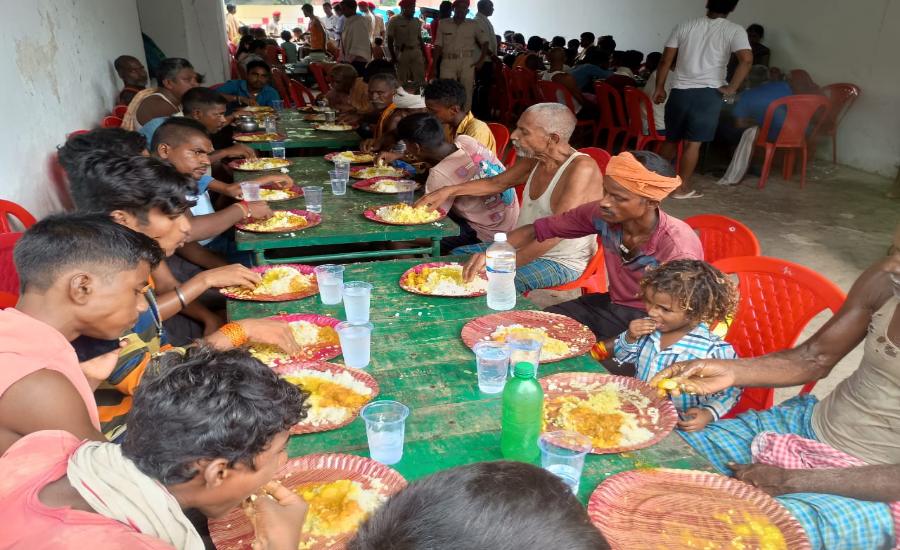
Patna: Bihar continues to scale up rescue and relief operations in flood-affected areas, with more than 1.62 crore affected people receiving morning and evening meals so far.
According to information shared by the Disaster Management Department on September 15, as many as 784 community kitchens are currently operating across flood-hit areas to provide food to people affected by rising river levels and inundation.
The state has also deployed 1,156 government boats to support the evacuation of people and facilitate movement in affected areas. In addition, 27 SDRF teams and 10 NDRF teams have been deployed across Bihar as authorities continue to monitor the flood situation.
49.72 Lakh People Affected Across 15 Districts
The current flood situation has affected around 49.72 lakh people across 15 districts of Bihar.
These include Patna, Bhojpur, Saran, Vaishali, Bhagalpur, Begusarai, Buxar, Samastipur, Munger, Katihar, Lakhisarai, Khagaria, Purnia, Madhepura and Arwal.
The affected population is spread across 88 blocks and 575 gram panchayats, with relief and rescue operations continuing in areas facing inundation.
The rise in water levels of several major rivers has increased the need for evacuation, food distribution, shelter and medical assistance. Authorities are maintaining a close watch on vulnerable locations as the flood situation evolves.
Read Also: Bihar’s New Paddy Playbook: Parboiled Rice in Every District, GPS Tracking on Roads
784 Community Kitchens Providing Food
Food supply remains one of the key priorities in the ongoing relief operation.
So far, more than 1.62 crore meals have been distributed to flood-affected people through relief arrangements. At present, 784 community kitchens are operating across the affected areas.
The kitchens are providing morning and evening meals to people who have been displaced or whose normal access to food has been disrupted because of flooding.
The scale of food distribution is particularly important as thousands of families remain dependent on relief arrangements while floodwaters continue to affect roads, villages and regular transport routes.
The Bihar government has also been monitoring the availability of essential supplies in affected areas. Official state information shows that flood relief and community kitchens remain a major component of the ongoing response.
Relief Camps and Essential Supplies Expanded
Alongside community kitchens, the state is operating 12 relief camps for people displaced by the floods.
According to the Disaster Management Department, these camps are currently providing accommodation, food and medical facilities to 10,353 flood-affected people.
Relief materials have also been distributed among affected families. These include approximately:
- 4.36 lakh polythene sheets
- 84,700 dry ration packets
- 1,400 food packets
These supplies are intended to support families who have either moved to safer locations or are facing difficulties accessing essential goods because of flooding.
1,156 Government Boats Supporting Evacuation
Transportation and evacuation remain another major focus of the flood response.
A total of 1,156 government boats are currently operating in different districts to help people move out of vulnerable areas and maintain connectivity where roads and other transport routes have been affected.
The boat services are particularly important for villages and settlements surrounded by floodwaters, where normal road movement has become difficult.
The state has also taken measures to protect livestock. So far, around 17,731 quintals of animal fodder have been distributed across Bihar to support cattle and other livestock belonging to affected families.
Major Rivers Continue to Flow Above Danger Mark
Information received from the Central Water Commission indicates that several rivers are flowing above their danger marks at different locations.
These include the Gandak at Dumariya Ghat; the Kosi at Baltara and Kursela; the Burhi Gandak at Khagaria; the Ganga at Gandhi Ghat and Hathidah in Patna, as well as Bhagalpur and Kahalgaon; the Punpun at Sripalpur; and the Kamla Balan at Jhanjharpur.
At the same time, water levels have shown stability or decline at some locations.
The Kosi near Birpur Barrage has remained stable, while the water level of the Son near Indrapuri Barrage and the Gandak near Valmikinagar Barrage has declined.
The mixed trend across different river systems means that authorities continue to monitor water levels closely rather than treating the situation as uniform across the state.
SDRF, NDRF Teams Deployed as Rain Forecast Continues
To respond quickly to any further rise in water levels and potential flooding, 27 SDRF teams and 10 NDRF teams have been deployed across the state.
Their deployment is aimed at strengthening rescue, evacuation and emergency response capabilities in vulnerable areas.
Meanwhile, the Bihar Meteorological Service Centre has forecast very light to moderate rainfall at several places across the state during the next two days.
With river levels still above danger marks at multiple locations, the Disaster Management Department is continuing to monitor the situation.
The ongoing response combines food distribution, temporary shelter, medical assistance, evacuation, boat operations, livestock support and specialised rescue teams. For affected families, these measures are aimed at maintaining access to basic necessities while authorities track changes in river levels and weather conditions.
The scale of the operation also highlights the importance of coordinated disaster management in Bihar, where river levels and rainfall can rapidly change conditions across multiple districts. The immediate focus remains on keeping affected communities supplied, supporting evacuation where required and ensuring that emergency response teams remain ready as the flood situation develops.
Read Also: Bihar’s Taekwondo Talent Gets Global Spotlight as Two Players Qualify for Brazil