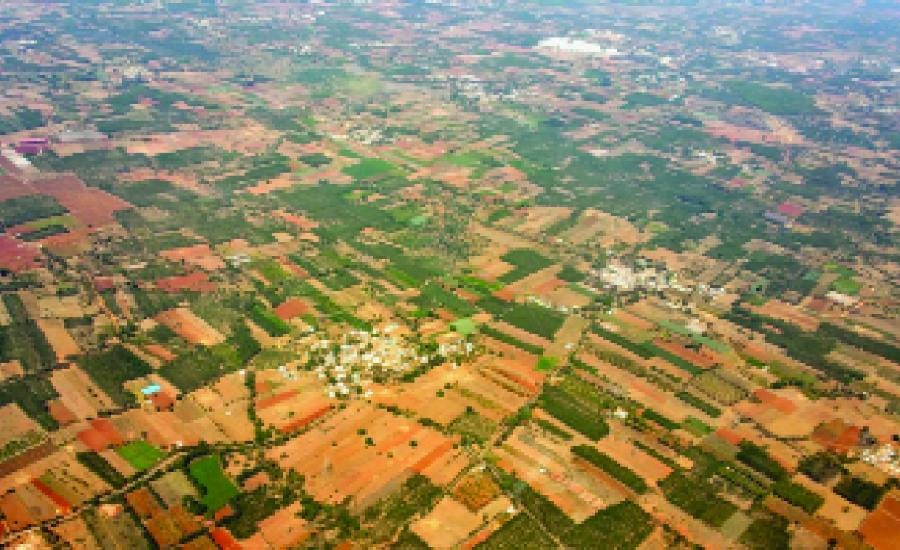
Patna: Bihar’s ongoing Special Survey and Settlement could become the foundation for the state’s next major land reform — consolidating fragmented agricultural holdings into fewer, more compact parcels.
Vivek Kumar Singh, former Principal Secretary of Bihar’s Department of Revenue and Land Reforms and currently Chairman of RERA Bihar, argues that once the Special Survey produces sufficiently settled digital maps and records, Bihar should use this information to tackle land fragmentation.
Why Consolidation Matters
Bihar enacted its consolidation law in 1956 to reorganise scattered parcels belonging to cultivators into compact holdings of broadly equivalent value. Such consolidation can reduce cultivation costs and improve irrigation, mechanisation, road access and connectivity to markets.
Punjab and Haryana have demonstrated the benefits of consolidation, but Bihar struggled because old maps, revenue records and actual possession often differed. Administrative discretion in valuation and re-allotment, along with prolonged objections, appeals, revisions and court proceedings, further delayed the process.
Special Survey Creates a New Opportunity
The Special Survey uses aerial photography, cadastral mapping and ground verification to create updated spatial and legal land records.
Once these records become sufficiently settled, Bihar would not need to repeat the expensive process of mapping the countryside before beginning consolidation. The proposed sequence is to complete the survey, finalise digital maps and records, consolidate and re-allot holdings, and provide statutory closure.
Some field verification would still be needed for irrigation, roads, public infrastructure, orchards, structures and land-use factors affecting land value.
Rules, Technology and AgriStack
A new consolidation system should be designed for the digital age rather than simply revive the old process.
Land value should consider factors such as soil quality, irrigation, road access, market proximity and permanent improvements, with transparent valuation parameters prescribed through law or rules.
Digital systems can help generate compact allotments, while every decision and any deviation from prescribed criteria should remain transparent and supported by recorded reasons.
AgriStack could add useful agricultural information through its Farmers Registry, geo-referenced village maps and Crop Sown Registry. However, the settled record of rights should remain the basis for legal entitlement. AgriStack should support valuation, verification and allotment, not determine title.
Time-Bound Process and Stronger Accountability
Finality could be the most important reform. A future consolidation law should prescribe clear deadlines, while ensuring that landholders receive adequate notice before objection periods begin.
This is particularly important for migrants, elderly citizens and women whose inheritance rights may be missing from records. Draft maps and proposed allotments could be displayed publicly, uploaded digitally and explained through village-level camps.
Objections should have fixed disposal periods, appeals should face strict limits and revisions should ordinarily be limited to one. A public dashboard could track village-wise progress, objections, pending cases and time taken.
Beyond Digitising Land Records
Digitisation alone cannot solve fragmentation. A scattered holding remains fragmented even when every parcel has a precise digital record.
Consolidation could bring wider benefits by reducing boundary disputes, simplifying inheritance and partition, improving access to institutional credit and supporting infrastructure planning and land acquisition.
For Bihar, the Special Survey could therefore become more than a land-record exercise. If reliable surveys are combined with transparent rules, adequate rights protection and firm statutory deadlines, the state could turn its existing digital land infrastructure into a new model of land consolidation for India.
Read Also: Bihar Plans to Expand Financial Support for Women Clearing Competitive Exam Prelims