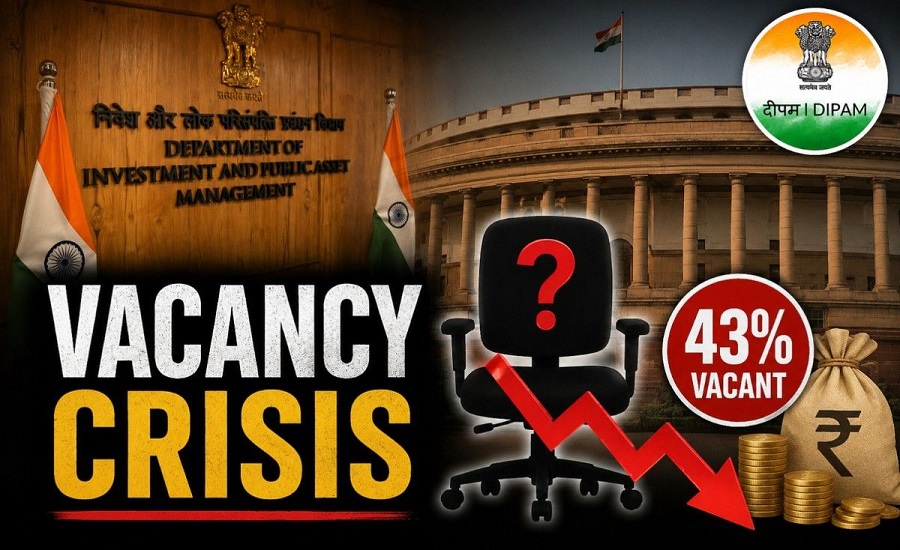
New Delhi: The Parliamentary Standing Committee on Finance has raised serious concerns over the 43 per cent vacancy rate in the Department of Investment and Public Asset Management (DIPAM), warning that the manpower shortage could hamper the department’s ability to manage complex disinvestment and public asset transactions.
The committee has recommended that the Finance Ministry set up a dedicated task force to ensure the early filling of all 38 vacant positions in DIPAM.
The panel expressed disappointment that despite its earlier recommendations, “no tangible progress” had been made in addressing the vacancies since its report was presented in Parliament in March.
DIPAM Operating With Only 51 Officers Against 89 Sanctioned Posts
According to the committee, DIPAM is currently functioning with only 51 officers against a sanctioned strength of 89, leaving 38 posts vacant.
The shortages are particularly acute at key supervisory levels. The department has 11 vacancies at the Director leveland eight vacancies at the Under Secretary level.
The committee had earlier warned that such a shortage “severely jeopardises” DIPAM’s ability to undertake complex transactions, including the proposed IDBI Bank disinvestment and finalisation of Central Public Sector Enterprise (CPSE) MoUs.
The panel noted that DIPAM requires specialised financial, legal and administrative expertise to effectively carry out its responsibilities, making the manpower shortage particularly concerning.
₹42.76 Lakh Crore Public Asset Portfolio Under DIPAM
The committee highlighted the scale of responsibility entrusted to DIPAM, which oversees a public asset portfolio exceeding ₹42.76 lakh crore.
Against this backdrop, the panel expressed concern that even routine administrative work was being affected by the shortage of personnel.
“For a department overseeing a public asset portfolio exceeding Rs 42.76 lakh crore, routine administrative correspondence is grossly inadequate,” the committee observed.
The panel said the existing manpower constraints could undermine DIPAM’s ability to manage the government’s ambitious value maximisation and disinvestment agenda.
Committee Calls for Dedicated Task Force
The Standing Committee has now called for a more focused approach to resolving the manpower crisis and recommended the creation of a task force dedicated to filling DIPAM’s vacant posts.
The recommendation comes after the committee found the Finance Ministry’s response insufficient to demonstrate meaningful progress in filling the vacancies.
The panel said that simply pursuing the matter through routine correspondence with different departments was not adequate given DIPAM’s responsibilities and the scale of assets under its management.
Finance Ministry Says Vacancies Taken Up With DoPT, DoE and DEA
In its action-taken response, the Finance Ministry said DIPAM had been pursuing the issue with the concerned departments on priority.
The ministry stated that vacancies involving Assistant Section Officers (ASOs), Section Officers (SOs), Under Secretaries and Assistant Directors had been taken up with the:
- Department of Personnel and Training (DoPT)
- Department of Expenditure (DoE)
- Department of Economic Affairs (DEA)
However, the committee remained dissatisfied with the progress and reiterated the need for a more effective mechanism to fill the vacant positions quickly.
₹55.92 Crore Budget Also Raises Concern
The committee also drew attention to DIPAM’s relatively modest budget allocation of ₹55.92 crore, despite the department’s ambitious responsibility of maximising the value of government assets.
The panel expressed deep concern that an organisation tasked with overseeing major disinvestment and asset-management initiatives was simultaneously dealing with a 43 per cent vacancy rate and limited financial resources.
It suggested that both manpower and institutional capacity need to be strengthened if DIPAM is to effectively deliver on its mandate.
Shortage Could Affect Major Disinvestment Transactions
DIPAM plays a key role in managing the government’s equity in Central Public Sector Enterprises and implementing strategic disinvestment and other asset-management initiatives.
The committee specifically referred to transactions such as the IDBI Bank sale, besides the finalisation of CPSE MoUs, as examples of complex assignments requiring adequate institutional capacity.
The panel noted that significant manpower shortages in an area requiring specialised financial and legal expertisecould affect the department’s ability to meet disinvestment targets and efficiently recycle prime government real estate assets.
Panel Raises Strategic Autonomy Concerns
Apart from the vacancy issue, the committee had also asked DIPAM to formulate a clear legal strategy to safeguard strategic autonomy in entities where the government’s shareholding could potentially fall below 51 per cent.
In response, the Finance Ministry said that there is currently no proposal to reduce the government’s stake below 51 per cent in CPSEs, except in cases where strategic disinvestment is being pursued.
The response indicates that the government continues to retain the 51 per cent threshold as an important consideration in its approach to public-sector ownership, while strategic disinvestment remains an exception.
Why DIPAM’s Staffing Strength Matters
DIPAM is responsible for important aspects of the government’s management of public assets, including disinvestment and value maximisation of government holdings.
With the department handling a public asset portfolio of more than ₹42.76 lakh crore, the parliamentary panel has stressed that adequate staffing is essential for executing complex financial transactions, managing legal issues and ensuring effective coordination across government departments.
The committee’s latest recommendation for a dedicated task force reflects its view that the 43 per cent vacancy rate requires urgent intervention rather than routine administrative follow-up.
Read also: No Dilution in PSU Strategic Sale List: Centre Sends Clear Message to Ministries