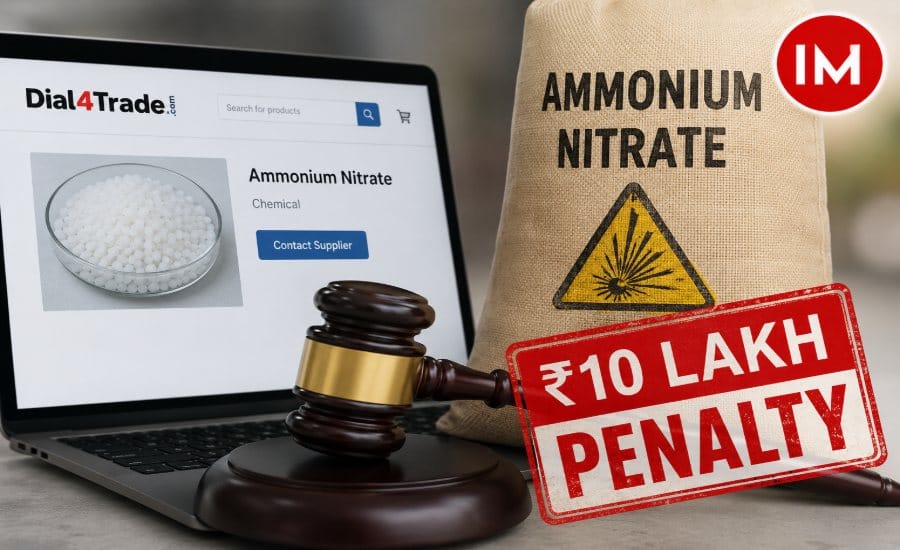
New Delhi: The Central Consumer Protection Authority (CCPA) has imposed a ₹10 lakh penalty on Dial4Trade Technologies Private Limited for facilitating the online listing, advertising and sale of Ammonium Nitrate without the regulatory safeguards required under law.
The authority has also directed the platform to immediately stop listing, hosting, advertising or facilitating the sale of Ammonium Nitrate and any other substance classified as an explosive under the Explosives Act, 1884.
CCPA Finds Gaps in Online Listing Safeguards
During its examination, the CCPA found that Ammonium Nitrate was available on the platform without adequate checks to establish whether sellers and buyers were legally authorised to deal with the regulated substance.
The authority specifically identified the absence of:
- Valid PESO licence details of sellers.
- Verification of buyers’ identity and licensed status.
- Transaction-traceability mechanisms required under the Ammonium Nitrate Rules, 2012.
- Clear warnings about legal restrictions on possession and use.
The CCPA also noted that the product listing used images showing explosions and blast effects. According to the authority, such imagery could attract attention to the product rather than clearly communicate that it is a hazardous and regulated substance.
Online Listing Treated as Advertisement
A key part of the CCPA’s order concerns how regulated products are presented on digital marketplaces.
The authority held that a product listing displayed to the public over the internet falls within the definition of an “advertisement” under the Consumer Protection Act, 2019.
It further observed that presenting a regulated explosive substance like an ordinary consumer product, without informing users that lawful purchase requires prescribed licences, can amount to a misleading advertisement and unfair trade practice.
This places greater responsibility on digital marketplaces to consider the nature of products before allowing them to be advertised or offered for sale.
Dial4Trade’s B2B Defence Rejected
Dial4Trade argued that it operates as a Business-to-Business (B2B) marketplace intermediary and should not be held responsible for content uploaded by third-party sellers.
The CCPA rejected this argument. It noted that the platform allowed the substance to be purchased in quantities as low as a single unit and did not have minimum-order requirements or institutional-buyer verification mechanisms normally associated with a B2B marketplace.
The authority also clarified that the Consumer Protection (E-Commerce) Rules, 2020 apply to marketplace e-commerce entities regardless of how they describe their business model.
Safe-Harbour Claim Also Examined
The CCPA also considered Dial4Trade’s reliance on intermediary protection under Section 79 of the Information Technology Act, 2000.
The authority observed that such protection is linked to compliance with prescribed due-diligence requirements. It found that simply removing listings after they were detected was not sufficient for regulated and hazardous substances.
According to the CCPA, platforms should have appropriate verification mechanisms at the point of listing, rather than relying only on reactive action after a product has already appeared online.
The authority also noted that Dial4Trade had mechanisms to block sellers and remove products from its platform, indicating that it exercised a degree of control over hosted content.
CCPA Examining Other E-Commerce Platforms
The Dial4Trade action forms part of a wider CCPA examination into the online listing and sale of hazardous chemicals, explosive substances and related precursors.
The authority’s examination includes substances such as Ammonium Nitrate, Gun Powder, Picric Acid and Pentaerythritol Tetranitrate (PETN).
The platforms currently under examination include IndiaMART, Justdial, Sigma-Aldrich India, Exporters India, Ibuychemikals, Alpha Chemika and TradeIndia.
The wider exercise signals increased regulatory scrutiny of online marketplaces that allow specialised or regulated substances to be advertised and sold.
Why the Order Matters
The CCPA stressed that Ammonium Nitrate is a regulated substance and that its unauthorised sale or possession without prescribed safeguards can create public-safety risks.
For consumers, the order highlights the importance of clear product information and safeguards when purchasing regulated goods online. For e-commerce platforms, it reinforces that marketplaces cannot necessarily avoid responsibility simply by describing themselves as intermediaries.
The action also indicates that online marketplaces may need stronger seller verification, buyer eligibility checks and traceability systems when dealing with products subject to specific legal controls.
The CCPA said it remains committed to protecting consumer rights, preventing unfair trade practices and strengthening compliance across e-commerce platforms, particularly in relation to hazardous and regulated products.
Read Also: NHAI: Odisha Coastal Highway Attracts 17 Bids for ₹8,300-Crore Rameshwar–Paradeep Corridor