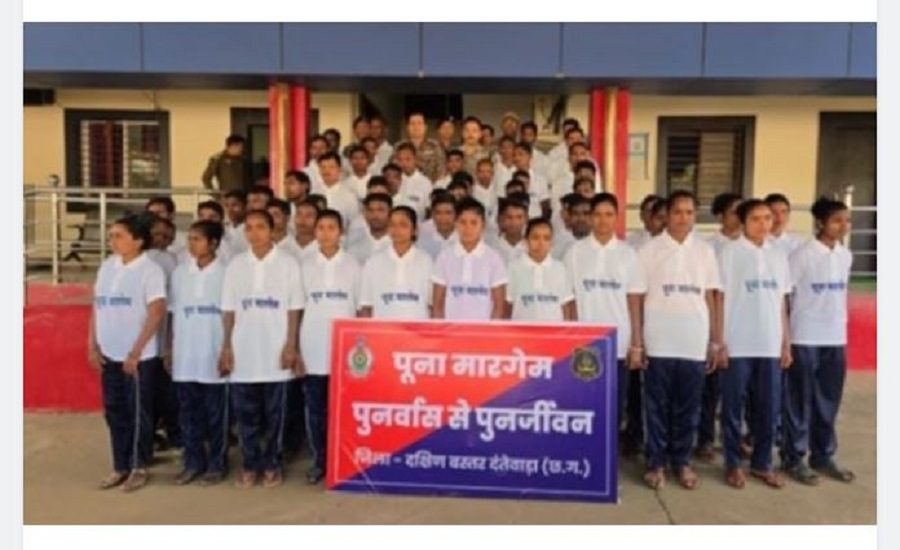
Dantewada, Chhattisgarh: In a significant boost to peace and rehabilitation efforts in Chhattisgarh’s insurgency-hit Bastar region, 63 Maoist cadres surrendered before security forces in Dantewada on Friday under the state government’s ongoing ‘Puna Margam’ (Rehabilitation to Rejuvenation) campaign. The mass surrender is being seen as a major step toward restoring lasting peace, dignity, and inclusive development in the region.
The surrender ceremony was held at the District Reserve Guard (DRG) office in Dantewada, in the presence of senior police and security officials. Inspector General of Police, Bastar Range, Sundarraj Pattilingam, lauded the initiative and described it as a turning point in the government’s strategy to encourage misguided youth to return to the mainstream of society.
Key Details of the Surrender
According to official sources, a total of 63 Maoist cadres, including 18 women and 45 men, laid down their arms. Of these, 36 cadres were carrying cash rewards announced by the government, with a cumulative bounty amounting to ₹1.19 crore.
The bounty distribution included:
- Seven cadres carrying rewards of ₹8 lakh each
- Seven cadres with rewards of ₹5 lakh each
- Eight cadres with rewards of ₹2 lakh each
- Eleven cadres with rewards of ₹1 lakh each
- Three cadres carrying rewards of ₹50,000 each
The surrendered cadres were active across several Maoist strongholds, including the Darbha Division, South Bastar, West Bastar, Maad Division, and bordering areas of Odisha.
Read also: Chhattisgarh Tops Among Large States with 88% APAAR IDs Generated for Students Under NEP 2020
Senior Maoist Leaders Among Those Who Surrendered
The surrender group included several senior Maoist operatives who had been involved in violent activities for years. Among them was Mohan Kadti, a Divisional Committee Member (DVCM), who had been associated with Maoist operations since 2005 and was allegedly involved in multiple ambushes and killings.
Another prominent figure was Sumitra Kadti alias Draupadi, a female DVCM, who was linked to numerous encounters, arson attacks, and acts of violence. Hungi alias Ankita, a Party Propaganda Committee Member (PPCM), also surrendered; she was reportedly involved in Maoist propaganda activities as well as violent incidents.
Several other surrendered cadres were accused of involvement in IED blasts, torching of vehicles, road blockades, extortion activities, and propaganda campaigns aimed at disrupting development work in the region.
Rehabilitation and Reintegration Support
Under Chhattisgarh’s Naxal Rehabilitation Policy, each surrendered cadre will receive comprehensive support to help reintegrate into mainstream society. The benefits include:
- Financial assistance of ₹50,000
- Skill development and vocational training
- Allocation of agricultural land
- Additional support facilities to ensure sustainable livelihoods and social reintegration
Officials stated that these measures are designed to provide former cadres with dignity, economic stability, and a clear path away from violence.
Role of Security Forces
The successful surrender was the result of sustained efforts by security agencies, including the District Reserve Guard (DRG), Bastar Fighters, and the Central Reserve Police Force (CRPF). Through continuous outreach, dialogue, and confidence-building measures, the forces were able to persuade the cadres to abandon violence and embrace rehabilitation.
Senior officials reiterated that the Government of India, the Chhattisgarh government, the Chhattisgarh Police, CRPF, and local administration remain fully committed to restoring peace and accelerating development in Naxal-affected areas.
A Step Towards a Naxal-Free Bastar
Authorities described the mass surrender as a milestone in the mission to make Bastar Naxal-free. They emphasized that the combination of strong security action and humane rehabilitation policies is yielding positive results, encouraging more Maoist cadres to return to the mainstream and contribute to the region’s development and stability.