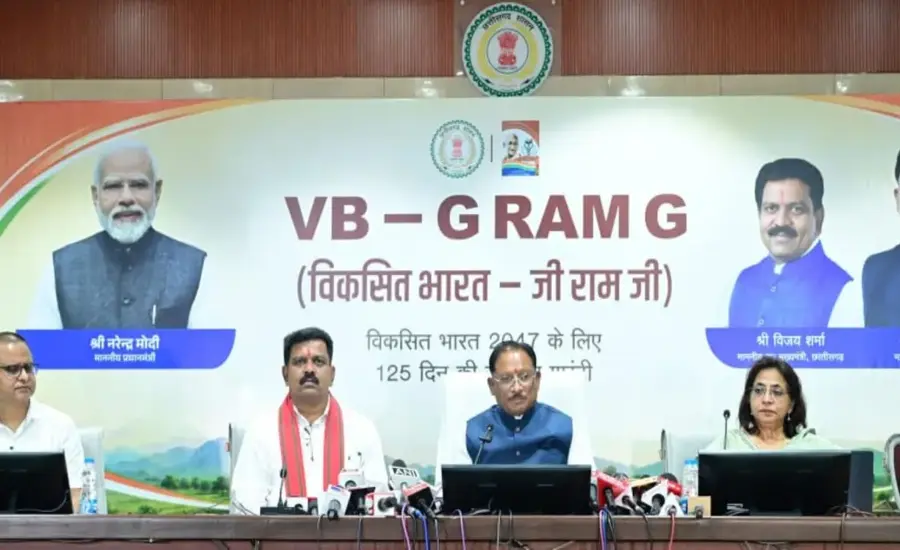
Raipur: Chhattisgarh Chief Minister Vishnu Deo Sai on Thursday launched the ‘Meri Beti-Mera Abhiman’ campaign, a statewide initiative aimed at strengthening rural infrastructure, sanitation and women’s dignity. The campaign, to run from August 15, 2026, to January 26, 2027, will be implemented under the Viksit Bharat – Guarantee for Rozgar and Ajeevika Mission (Gramin) (VB-G RAM G).
The campaign focuses on improving basic civic amenities by constructing girls’ toilets in government schools, crematoriums in villages and groundwater recharge structures while creating employment opportunities in rural areas.
Girls’ Toilets and Crematoriums Planned
Under the campaign, the government will construct 6,671 toilets in government schools located in rural areas at an estimated cost of ₹286.85 crore, with each unit costing around ₹4.30 lakh.
In addition, 6,524 villages will get crematoriums with waiting sheds at a cost of ₹391.44 crore, while 549 more crematoriums will be built separately with an investment of ₹18.22 crore.
The Chief Minister directed officials to give top priority to these projects and complete them within the stipulated timeframe.
Groundwater Recharge and Water Conservation
The state government will also revive 10,027 defunct borewells by installing sand filters and groundwater recharge structures at an estimated cost of ₹52.14 crore.
According to the Chief Minister, the initiative is expected to improve groundwater levels, conserve rainwater and reduce drinking water shortages in rural areas.
VB-G RAM G to Drive Rural Development
The VB-G RAM G scheme, which replaced MGNREGA from July 1, 2026, aims to promote employment while creating durable rural assets.
CM Sai said Chhattisgarh is expected to receive ₹6,855 crore under the scheme during the current financial year, the highest allocation for rural employment and development works in the state’s history. The Centre has already released the first instalment of over ₹1,538 crore.
The scheme covers 318 types of development works, including:
- Water conservation and groundwater recharge
- Rural infrastructure development
- Livelihood enhancement
- Climate adaptation and disaster management
Focus on Rural Economy and Public Infrastructure
The Chief Minister said the programme will support the construction of roads, culverts, Panchayat buildings, Anganwadis, additional classrooms, rural libraries, laboratories, kitchen sheds, solid and liquid waste management systems and veterinary hospitals.
Infrastructure for haat bazaars, agricultural storage, cold storage, dairy, fisheries and animal husbandry will also be strengthened to improve rural livelihoods.
Priority will also be given to flood shelters, cyclone shelters, drainage systems, embankments, forest fire prevention and post-disaster reconstruction under the climate resilience component.
Chhattisgarh Leads in Implementation
CM Sai said Chhattisgarh has emerged as one of the best-performing states in implementing the new scheme.
The state has achieved 98% e-KYC of registered workers, ranked first in the country, and secured 99% geo-tagging of assets, placing it second nationally. It also topped the country in preparing GIS-based Gram Panchayat Development Plans through the Yuktadhara Portal.
The state has proposed a ₹5,591.42 crore budget for implementing the scheme in 2026-27, while development works worth ₹1,264 crore have already been completed during the first quarter of the current financial year.
Why It Matters
The Meri Beti-Mera Abhiman campaign combines rural infrastructure, sanitation, water conservation and livelihood generation under a single framework. By focusing on education, public amenities and sustainable development, the initiative aims to improve the quality of life in villages while creating long-term employment and strengthening rural communities.