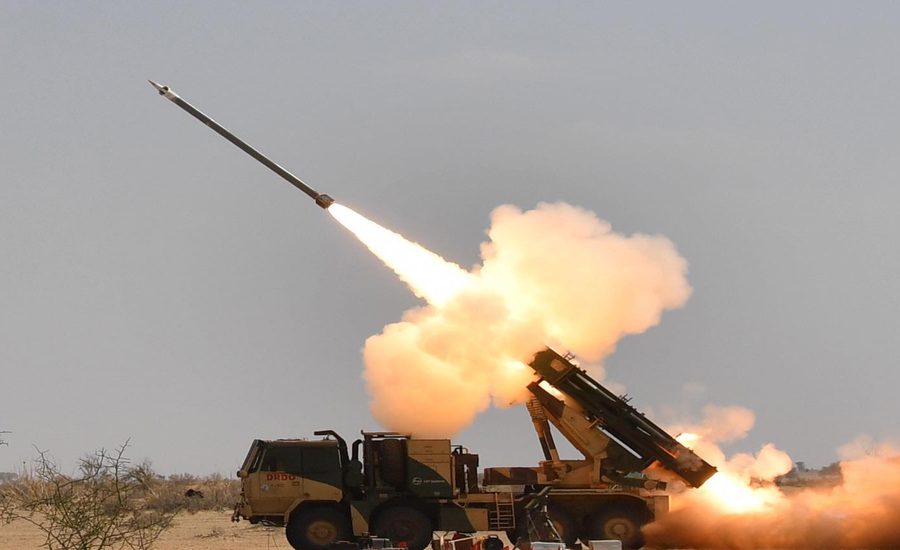
New Delhi: India’s Pinaka MLRS Fire control software programme has entered a new phase as the Defence Research and Development Organisation (DRDO) moves to develop specialised software for integrating long-range guided rockets into the Pinaka Multiple Launch Rocket System (MLRS). The initiative aims to significantly improve the Indian Army’s precision-strike capability and support the evolution of Pinaka from an area bombardment weapon into a highly accurate long-range attack system.
The project is being led by DRDO’s Armament Research and Development Establishment (ARDE), Pune, and is part of India’s broader effort to modernise indigenous artillery systems with advanced digital technologies.
What Is The Pinaka MLRS Fire Control Software
According to the tender issued by ARDE, Pune, DRDO is seeking a qualified organisation to develop customised fire-control software for the integration of the Long Range Guided Rocket (LRGR) with the Pinaka MLRS.
Read also: Why Armenia Wants India’s New 120 Km Guided Pinaka Rocket Without Buying New Launchers
The tender was released on September 15 under Government e-Marketplace (GeM) procedures and focuses on creating a dedicated software solution rather than purchasing an existing commercial product. The software will serve as a critical digital interface between the guided rocket and the Pinaka launcher system.
Key Objectives Of The Pinaka MLRS Fire Control Software Project
- Integrate Long Range Guided Rockets with Pinaka MLRS.
- Enable precise mission planning and targeting.
- Support advanced guidance and navigation functions.
- Improve long-range strike accuracy.
- Enhance battlefield effectiveness of the Indian Army.
How Pinaka Has Evolved Over The Years
The Pinaka Multiple Launch Rocket System is one of India’s most successful indigenous artillery platforms. It gained national recognition during the 1999 Kargil War, where it demonstrated the ability to neutralise enemy positions in difficult mountain terrain.
Originally, Pinaka was designed as an area-saturation weapon capable of firing unguided rockets over large target zones. Over time, DRDO introduced several upgrades, including extended-range and guided variants that transformed the system into a more precise battlefield weapon.
Increasing Range And Accuracy
The standard Pinaka rockets initially offered a range of around 40 kilometres. With continuous development, newer variants have extended operational ranges beyond 75 kilometres, while the Long Range Guided Rocket version can strike targets at distances of approximately 120 kilometres. This increase in range requires advanced software capable of handling complex flight calculations and guidance corrections.
Why Guided Rockets Need Advanced Fire Control Software
Unguided rockets follow a fixed ballistic trajectory after launch. Their fire-control systems mainly calculate launch angles, weather conditions, launcher position, and target coordinates. Guided rockets, however, require significantly more data processing.
They must receive mission-specific flight parameters, navigation inputs, and guidance information before launch to ensure precision strikes.
How Pinaka MLRS Fire Control Software Will Work
The customised software is expected to:
- Calculate advanced mission parameters.
- Transfer guidance data to the rocket.
- Support navigation and targeting functions.
- Communicate with launcher command systems.
- Enable accurate long-range engagements.
This will allow guided rockets to hit targets with much greater precision compared to traditional artillery rockets.
Bridging The Rocket And The Launcher
One of the most important functions of the new software will be acting as a digital bridge between the guided munition and the launcher platform. The software will connect the rocket’s onboard systems with Pinaka’s command, control, and launch architecture. This integration will ensure that critical targeting and navigation data are transferred seamlessly before launch.
Potential Future Capabilities of Pinaka MLRS Fire Control Software
Depending on operational requirements, the software could later support:
- Multiple LRGR configurations.
- Mixed salvos of guided and unguided rockets.
- Simultaneous mission planning.
- Enhanced launcher variants.
- Future Pinaka upgrades.
Such flexibility would make the Pinaka system more adaptable for modern battlefield operations.
Strategic Importance of Pinaka MLRS Fire Control Software
The development of customised fire-control software represents an important step in India’s defence modernisation efforts. As modern warfare increasingly relies on precision-guided weapons, advanced software systems have become just as important as the missiles and rockets themselves.
The integration of guided rockets into Pinaka will provide the Indian Army with the ability to conduct accurate long-range strikes while reducing collateral damage and ammunition expenditure.
Supporting Atmanirbhar Bharat In Defence
The project also strengthens India’s goal of achieving self-reliance in defence technology. By developing indigenous software and system integration capabilities, India reduces dependence on foreign suppliers and builds expertise in critical military technologies.
Read also: Explained: How Agni MIRV, Rudram-II and Pinaka Are Transforming India’s Military Power
FAQs
The Long Range Guided Rocket (LRGR) variant of Pinaka can engage targets at distances of around 120 kilometres.
The project aims to develop customised fire-control software that will integrate Long Range Guided Rockets with the Pinaka Multiple Launch Rocket System and improve precision-strike capability.
Fire-control software provides navigation, targeting, and mission data to guided rockets before launch, enabling accurate and precise strikes against enemy targets.