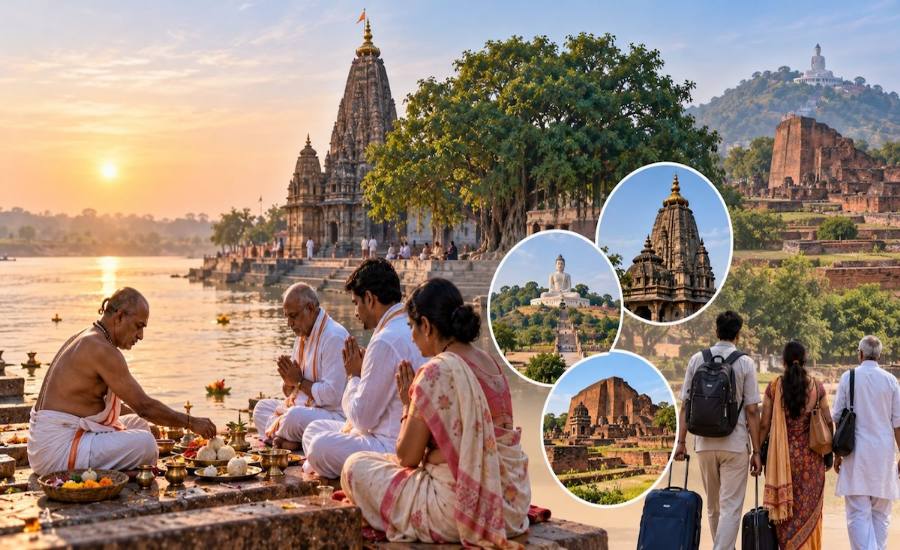
Patna: Gaya, one of India’s most important destinations for ancestral rituals, has witnessed a massive influx of pilgrims during this year’s Pitru Paksha Mela. More than 37.50 lakh pilgrims, devotees and pind daanis have already reached Gaya to perform pind daan and tarpan for the peace of their ancestors.
The annual religious gathering has also drawn visitors from outside India. Thousands of foreign nationals from countries including Russia, France, Germany, Italy, Brazil and Ukraine have participated in pind daan and tarpan rituals in Gaya.
The growing international participation highlights Gaya’s expanding appeal not only as a spiritual destination but also as an important centre of religious tourism.
Foreign Pilgrims Add an International Dimension
The presence of foreign devotees has added a global dimension to this year’s Pitru Paksha gathering. Visitors from different countries have appreciated arrangements at religious sites, traffic management, cleanliness and facilities provided by the administration.
The flow of international pilgrims is also expected to continue. On October 8, around 30–40 devotees from South Africa and other countries are expected to reach Gaya to perform ancestral rituals.
For many visitors, Gaya offers a unique combination of religious tradition, cultural heritage and spiritual experience. The continued arrival of international devotees indicates that the city’s religious significance is reaching audiences well beyond India.
Read Also: Bihar Road Network Gets Push as Samrat Choudhary and Nitin Gadkari Review Key Projects
Gaya’s Religious Tourism Footprint Continues to Grow
The increasing number of visitors over the past few years shows the growing tourism potential of Gaya.
In 2022, around 9.40 lakh tourists visited Gaya, including approximately 9.38 lakh domestic tourists and 1,518 foreign visitors. The number rose sharply in 2023, when the city recorded nearly 29.89 lakh tourists, including about 29.06 lakh domestic and around 82,000 foreign tourists.
In 2024, Gaya welcomed around 30.59 lakh tourists, of whom approximately 29.04 lakh were domestic and 1.55 lakh were foreign visitors.
The city recorded another increase in 2025, when around 34.79 lakh tourists visited. Of these, nearly 34.77 lakh were domestic tourists and 1,807 were foreign visitors.
With more than 37.50 lakh pilgrims already arriving this year during Pitru Paksha, the figures underline the continuing strength of Gaya as a religious tourism destination.
Health and Safety Arrangements for Pilgrims
The large gathering has required extensive arrangements covering healthcare, security, crowd management and emergency assistance.
Medical treatment and health services have already benefited more than 1.12 lakh people during the mela. The administration has also operated a dedicated lost-and-found centre, through which 852 people have received assistance.
A control room has been established to address problems and complaints related to the mela. So far, it has received 1,857 complaints, with necessary action taken on the issues reported.
These facilities are particularly important during a gathering that brings together lakhs of visitors in a short period.
Tent City Provides Accommodation Support
Accommodation remains a major challenge during large religious gatherings, especially for pilgrims arriving from distant parts of the country.
To address this need, a dedicated tent city has been established for visitors. So far, 11,378 people have stayed there.
The administration has also taken measures to help families keep track of children and elderly members in the crowded pilgrimage areas. As many as 10,619 wristbands have been distributed to children and senior citizens.
The wristbands can help identify and reunite family members if they become separated during the mela.
AI Translation Helps Foreign Visitors
Technology has also become part of this year’s arrangements.
An AI-based language translation facility has been introduced to reduce communication barriers for pilgrims. So far, 84,756 pilgrims have used the service.
The facility is particularly useful for foreign visitors who may not be familiar with local languages. By helping pilgrims communicate and access information, the technology adds another layer of support to the large-scale religious gathering.
The use of AI translation also shows how digital tools can support traditional religious and cultural events where visitors from different linguistic backgrounds come together.
‘One Tree in the Name of Ancestors’ Connects Faith With Environment
The Pitru Paksha Mela has also incorporated an environmental component through the ‘Ek Ped Purvajon Ke Naam’ (One Tree in the Name of Ancestors) initiative.
Under the initiative, 482 saplings have so far been planted in the Pitrivatika. The programme connects the remembrance of ancestors with environmental conservation, giving pilgrims an opportunity to associate their religious observance with a lasting ecological contribution.
The initiative adds an environmental dimension to the traditional practices of pind daan and tarpan.
A Growing Religious Tourism Destination
The scale of this year’s Pitru Paksha gathering demonstrates Gaya’s continued importance in India’s religious tourism landscape. The participation of pilgrims from across the country, along with foreign visitors, reflects the enduring appeal of its ancestral rituals.
At the same time, arrangements involving healthcare, accommodation, crowd assistance, AI-based translation, cleanliness, security and environmental initiatives show how a traditional religious gathering is increasingly being supported by modern public services.
With the number of visitors already crossing 37.50 lakh and more pilgrims expected to arrive, Gaya’s Pitru Paksha Mela is emerging as both a major spiritual gathering and an important driver of religious tourism in Bihar.