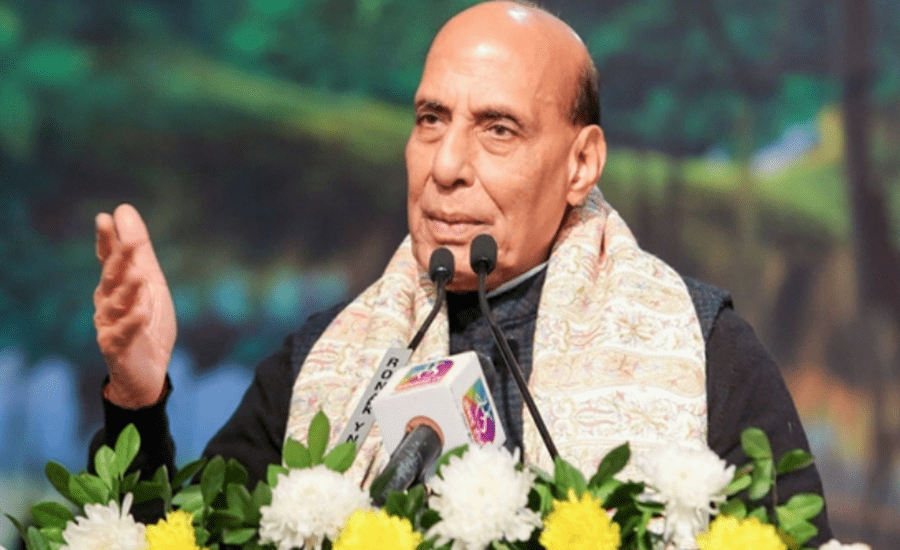
New Delhi: The India defence modernisation programme has significantly strengthened the country’s military capabilities through the successful development and testing of advanced indigenous weapon systems, Defence Minister Rajnath Singh said on the eve of India’s 80th Independence Day.
Speaking through Akashvani, Singh highlighted major achievements including the Agni missile with MIRV technology, Rudram-II missile, Pinaka rocket system, hypersonic technology progress, and record defence production and exports.
India Defence Modernisation Reach New Heights
Defence Minister Rajnath Singh said India has achieved unprecedented growth in defence preparedness through sustained investments in indigenous technologies and military modernisation.
Read also: Rajnath Singh Announces ₹3 Lakh Crore Defence Production Goal After Operation Sindoor
He emphasized that India’s armed forces are becoming more self-reliant due to the successful development of advanced military platforms, warships, aircraft, missile systems, and defence technologies.
India Defence Modernisation: Agni Missile with MIRV Technology Marks Strategic Leap
One of the biggest achievements highlighted by Singh was the successful testing of the advanced Agni missile equipped with Multiple Independently Targetable Re-entry Vehicle (MIRV) technology.
According to the Defence Minister, this capability adds a new dimension to India’s strategic deterrence by allowing a single missile to carry and deliver multiple warheads to different targets. The achievement places India among a select group of nations possessing advanced MIRV capabilities.
India Defence Modernisation: Rudram-II and Pinaka Strengthen Strike Capability
Rajnath Singh also highlighted the successful trials of the Rudram-II Air-to-Surface Missile and the Pinaka Long-Range Guided Rocket System.
He said these weapon systems have significantly enhanced India’s long-range precision strike capability and strengthened the operational effectiveness of the armed forces.
The successful testing of the Long-Range Land Attack Cruise Missile (LRLACM) was also mentioned as a major milestone in India’s indigenous missile programme.
India Defence Modernisation: Tactical Advanced Range Augmentation System Improves Precision
The Defence Minister noted the successful test of the first Tactical Advanced Range Augmentation System (TARAS). This system can convert conventional weapons into precision-guided munitions, improving accuracy and increasing the effectiveness of India’s military arsenal.
India Defence Modernisation: India Advances in Hypersonic Missile Technology
Another major breakthrough came from the successful testing of an Active Cooled Full-Scale Scramjet Combustor for more than 1,200 seconds.
According to Singh, this achievement places India among a limited number of countries capable of developing hypersonic missile technology.
Experts believe hypersonic systems will play a major role in future warfare due to their extremely high speed and ability to evade traditional defence systems.
Indigenous Fighter Jet ‘Kusha’ Adds Momentum
India’s air power capabilities received another boost with the successful first test of the indigenous Kusha Long-Range Surface-to-Air Missile (LR-SAM).
The Defence Minister said such developments reflect the government’s commitment to strengthening defence preparedness through indigenous innovation and self-reliance.
India Defence Modernisation: Record Defence Production and Exports
Rajnath Singh highlighted the remarkable growth of India’s defence industry over the past decade. Domestic defence production increased from ₹46,000 crore in 2014 to a record ₹1.78 lakh crore in 2025-26.
Defence exports also witnessed substantial growth, rising from ₹686 crore in 2013-14 to an all-time high of ₹38,424 crore in 2025-26. He expressed confidence that India would achieve its defence export target of ₹50,000 crore by 2029.
Defence Budget and Modernisation Spending Rise
The Defence Minister said the government has significantly increased spending on military modernisation. India’s defence budget has grown from ₹2.53 lakh crore in 2013-14 to ₹7.85 lakh crore in 2026-27.
Capital expenditure has also increased from ₹94,588 crore to ₹2.19 lakh crore during the same period. He further revealed that the Defence Acquisition Council approved projects worth more than ₹8.75 lakh crore over the last year.
Expert Analysis: Why These Developments Matter
Defence experts believe the combination of MIRV-capable missiles, precision-guided systems, hypersonic technologies, and indigenous defence production is transforming India’s military capabilities.
These advancements reduce dependence on foreign suppliers, strengthen national security, improve strategic deterrence, and support India’s ambition of becoming a major global defence manufacturing hub. The growing defence export figures also indicate increasing international confidence in Indian-made military systems.
Read also: Rajnath Singh Highlights Territorial Army’s Role in Security, Disaster Relief and Nation Building