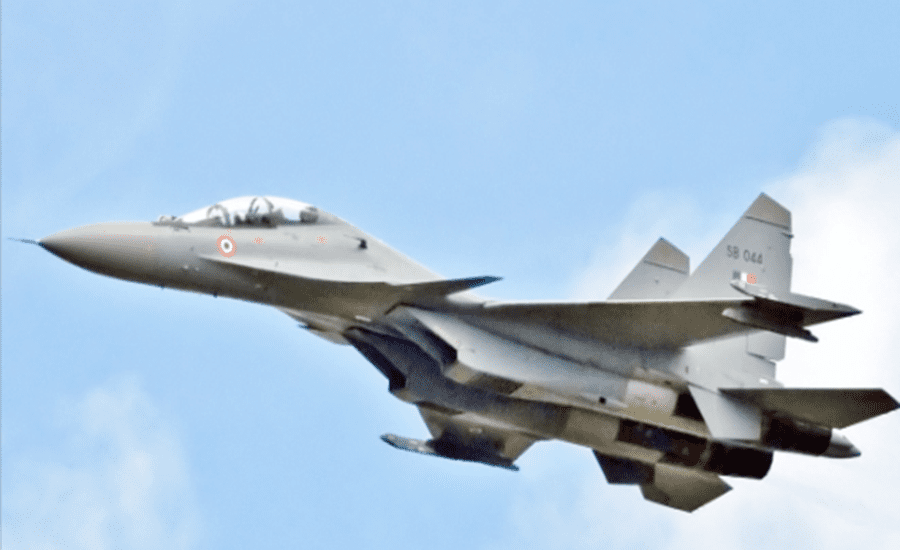
New Delhi: Su-30MKI R-37M Missile Integration is set to become a major capability boost for the Indian Air Force (IAF). Reports indicate that India is moving to integrate the Russian-made R-37M very-long-range air-to-air missile with its Su-30MKI fighter fleet, strengthening its ability to engage high-value aerial targets at extended distances.
The move is aimed at enhancing India’s air superiority capabilities and addressing long-range aerial threats in an increasingly contested security environment.
What Is The R-37M Missile
The R-37M, known by NATO as the AA-13 Axehead, is a Russian long-range air-to-air missile designed to engage airborne targets far beyond the range of conventional fighter missiles. It can be launched from aircraft such as the MiG-31, Su-35, Su-57 and Su-30 variants.
Read also: What Is HAL’s AL-31FP Engine Life Extension? How It Will Benefit the IAF Su-30MKI Fleet
The missile uses inertial navigation with active radar homing guidance in the terminal phase. It can travel at speeds exceeding Mach 6 and carries a 60-kg fragmentation warhead.
Why Is The R-37M Called An AWACS-Killer
The missile is specifically designed to target high-value airborne assets rather than engage in traditional dogfights. Potential targets include:
- Airborne Warning And Control System (AWACS) aircraft
- Aerial refuelling tankers
- Electronic warfare aircraft
- Airborne command-and-control platforms
By threatening these critical assets, the missile can reduce an adversary’s situational awareness and operational effectiveness.
How Will Su-30MKI R-37M Missile Integration Powered Sukhoi
The Su-30MKI is the backbone of the Indian Air Force and remains India’s most numerous fighter aircraft. Ongoing modernization plans include advanced radars, electronic warfare systems and long-range weapons integration.
The integration of the R-37M will significantly expand the aircraft’s beyond-visual-range combat capability. Military experts believe long-range air combat is becoming increasingly important as modern air warfare relies heavily on early warning aircraft, networked operations and stand-off weapons.
Details of Su-30MKI R-37M Missile Integration
India is already pursuing the ambitious Super Sukhoi modernization programme. The upgrade package includes:
- Advanced AESA radar
- Improved electronic warfare systems
- Indigenous and foreign long-range weapons
- Enhanced avionics and sensors
- Integration of missiles such as Astra variants, BrahMos-ER and R-37M.
These upgrades are expected to keep the Su-30MKI operationally relevant for decades.
What is the Importance of Su-30MKI R-37M Missile Integration
The induction of very-long-range air-to-air missiles reflects a broader shift in modern air combat. Instead of focusing only on close-range engagements, air forces increasingly seek the ability to detect and engage targets at the greatest possible distance. For India, this capability can help:
- Extend aerial engagement ranges
- Counter enemy support aircraft
- Strengthen air dominance missions
- Improve deterrence along sensitive borders
- Enhance network-centric warfare capabilities
Impact On Regional Air Power Balance
The addition of the R-37M could improve the Indian Air Force’s ability to challenge high-value aerial assets operating far from the frontline. Such capabilities are especially relevant in regions where surveillance aircraft, airborne command platforms and refuelling tankers play a critical role in military operations.
Indigenous Alternatives Also Under Development
India is simultaneously investing in indigenous air-to-air missile programmes. The DRDO-developed Astra missile family is being inducted into service, while future variants are expected to offer greater range and advanced performance.
The long-term objective is to strengthen self-reliance in advanced missile technology while maintaining operational readiness through a mix of domestic and imported systems.
Read also: How the Su-30MKI Fighter Jets Virupaksha Radar Integration Will Boost the IAF Combat Power
FAQs
The missile is expected to be integrated with the Indian Air Force’s Su-30MKI fighter fleet as part of ongoing modernization efforts.
The R-37M is a Russian very-long-range air-to-air missile designed to destroy high-value airborne targets such as AWACS aircraft, aerial tankers and command platforms.
The missile can engage targets at very long distances, improving India’s air superiority capabilities and enhancing its ability to counter enemy support aircraft.