Nagpur: India is making major progress in indigenous defence manufacturing. Nagastra suicide drones and Pinaka guided rockets are two important examples of this growth. Nagpur, Maharashtra, is emerging as a major defence manufacturing hub, with private defence company Solar Defence and Aerospace Limited producing these advanced weapons.
The Indian Army has received 450 Nagastra-1 systems, while India has also started exporting Guided Pinaka rockets to Armenia. These developments highlight India’s growing defence capabilities and its push towards self-reliance.
Details of Nagastra Suicide Drone
Nagastra-1 is an indigenously developed loitering munition, commonly known as a suicide drone. It is designed to identify and destroy enemy targets, including military vehicles and other important positions.
Read also: Beyond Pinaka: How Private Defence Companies Are Reshaping India’s Future Rocket Force
Unlike ordinary surveillance drones, Nagastra-1 can remain in the air, observe an area and attack a selected target when required. It has been developed by Nagpur-based Solar Defence and Aerospace Limited.
According to the Ministry of Defence, Nagastra drones manufactured by the Solar Group were successfully used during Operation Sindoor. They accurately struck terrorist targets, demonstrating India’s growing capabilities in indigenous drone technology.
In October 2026, the company handed over the first batch of 450 Nagastra-1 systems to the Indian Army. This delivery marks an important step towards strengthening India’s domestic defence manufacturing capabilities.
Nagastra-1 Range And Key Features
Nagastra-1 offers different operating modes depending on the mission requirements. Its reported technical capabilities include:
- Recover And Reuse Mode: Operational range of up to 25 kilometres.
- Fire-And-Forget Mode: Can travel up to 50 kilometres for a one-way attack.
- Flight Endurance: Can remain airborne for up to 60 minutes.
- Target Identification: Designed to observe and identify enemy targets before an attack.
- Precision Attack: Developed to strike selected targets with accuracy.
These features make Nagastra-1 useful for modern battlefield operations, where surveillance and precision attacks play an important role.
Nagastra-2: Advanced Suicide Drone With Anti-Tank Capability
India is also developing more advanced versions of the Nagastra series. Nagastra-2 is designed to improve the ability of the Indian Army to deal with heavily armoured enemy vehicles, including modern tanks.
According to information shared by Solar Defence and Aerospace Limited, Nagastra-2 comes with a 4-kilogram tandem shaped-charge warhead.
The company claims that this warhead can penetrate up to 650 mm of Rolled Homogeneous Armour (RHA), a standard measurement used to assess tank armour protection.
Nagastra-2 Technical Features And Capabilities
Some of its important reported features include:
- Warhead: 4-kilogram tandem shaped-charge warhead.
- Armour Penetration: Up to 650 mm of RHA, according to the manufacturer.
- Day And Night Cameras: Helps identify targets in different lighting conditions.
- Operational Range: Up to 25 kilometres in recover-and-reuse mode and 50 kilometres in fire-and-forget mode.
- Flight Endurance: Up to 60 minutes.
- ECCM Technology: Electronic Counter-Countermeasures technology designed to improve resistance to electronic warfare threats.
ECCM technology is particularly important in modern warfare because enemy forces can use electronic systems to interfere with drone communication and GPS signals.
This technology is designed to help Nagastra-2 maintain its operational capability in challenging electronic warfare environments.
The development of Nagastra-2 represents another step towards strengthening India’s indigenous unmanned weapon systems.
What is Pinaka Rocket System
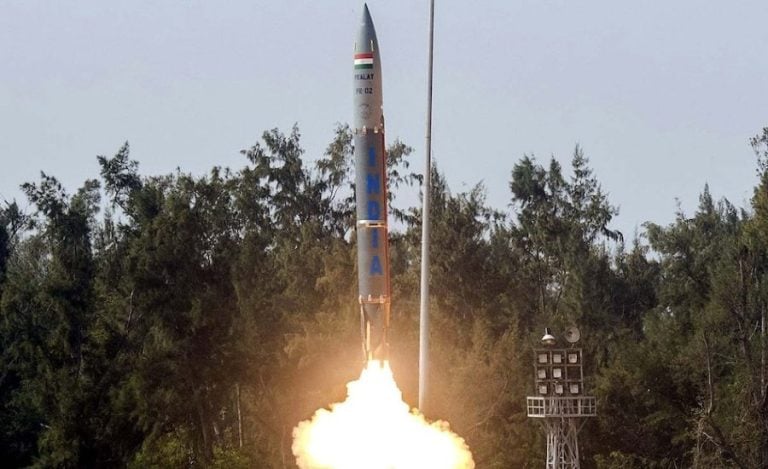
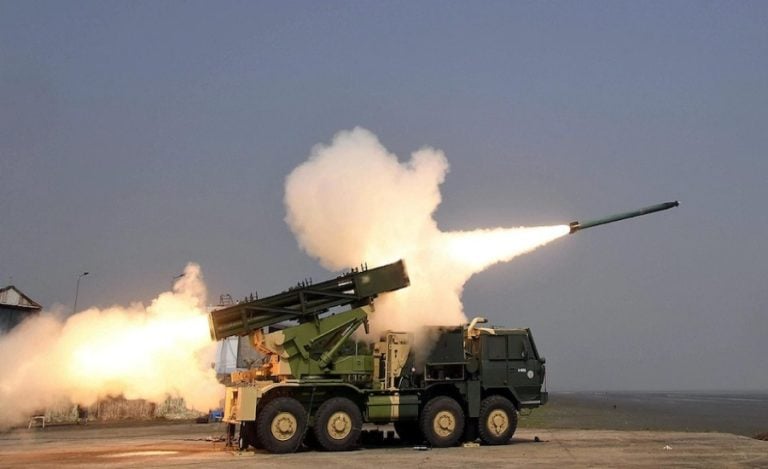
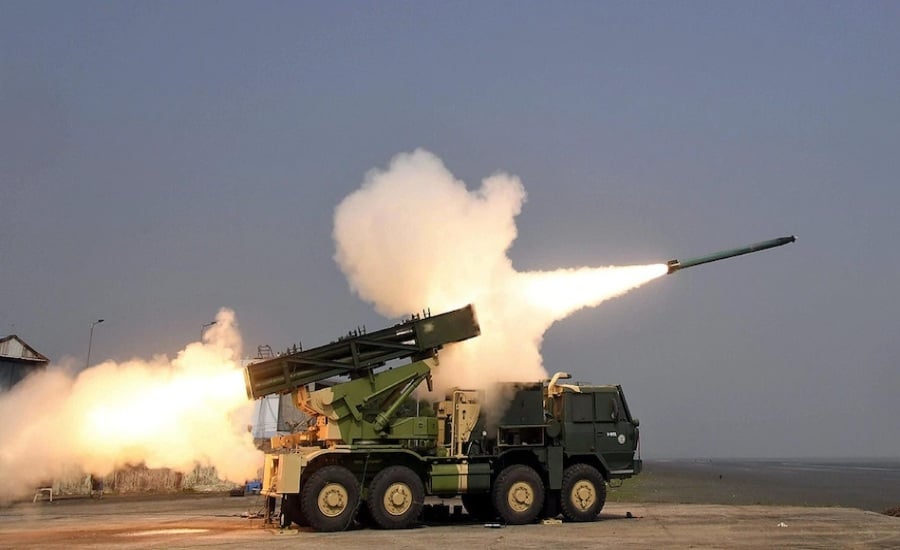
Along with suicide drones, Nagpur is also becoming an important manufacturing centre for India’s Pinaka rocket system. Developed by the Defence Research and Development Organisation (DRDO), Pinaka is a multi-barrel rocket launcher system designed to fire multiple rockets in a short period.
It can be used against enemy positions, military installations and other battlefield targets.
The system has undergone several upgrades over the years to improve its range, accuracy and overall performance.
Pinaka Rocket System Range And Upgrades
The Pinaka system has different versions with different operational capabilities. Its development has included:
- Original Pinaka: An initial reported range of around 37.5 kilometres.
- Extended-Range Version: Improved range of approximately 45 kilometres.
- Pinaka Mk-I Enhanced: Designed to strike targets beyond 75 kilometres.
- Guided Pinaka: An advanced version with improved guidance and navigation systems.
According to the latest report, the advanced Guided Pinaka variant is designed to achieve a range of up to 120 kilometres.
DRDO has also reported the successful completion of important trials of the Guided Pinaka system. These trials assessed parameters such as range, accuracy, consistency and rate of fire. The upgrades are expected to improve the Indian Army’s long-range artillery capabilities.
Nagpur Emerging As A Major Defence Manufacturing Hub
Nagpur is becoming an important centre for India’s growing defence manufacturing industry. Solar Defence and Aerospace Limited is playing a major role in this development by manufacturing Nagastra drones and Pinaka rocket ammunition.
The company has also expanded its manufacturing facilities to support the production of different defence products.
According to the Ministry of Defence, the government is encouraging greater participation from private companies in defence manufacturing and research.
This approach is aimed at reducing dependence on foreign suppliers and increasing domestic production.
The Ministry of Defence also reported that India’s defence production reached approximately ₹1.51 lakh crore, while defence exports reached a record ₹24,000 crore, as announced in January 2026. These developments show the growing contribution of Indian companies to the country’s defence industry.
Why Nagastra And Pinaka Are Important For India’s Defence Future
Nagastra drones and Pinaka rockets represent two different but important areas of modern military technology. Nagastra provides the Indian Army with an indigenous loitering munition capability for surveillance and precision strikes.
Pinaka strengthens the Army’s artillery capabilities through multiple rocket launchers and guided ammunition. Their development and production in India can offer several advantages:
- Defence Self-Reliance: Reduces dependence on imported military equipment.
- Modern Warfare Capabilities: Supports the use of precision weapons and advanced technology.
- Defence Exports: Creates opportunities to supply Indian-made weapons to other countries.
- Private Sector Growth: Encourages Indian companies to invest in defence research and manufacturing.
- Military Preparedness: Strengthens the availability of modern weapons for the armed forces.
India’s growing focus on indigenous defence technology is an important part of its Aatmanirbhar Bharat mission.
Read also: Meet the Batman of Indian Army: This Indigenous Drone Can Hunt Enemies in Nights With Full Precision
FAQs
Nagastra-1 has a reported operational range of up to 25 kilometres in recover-and-reuse mode and up to 50 kilometres in fire-and-forget mode. It can remain airborne for up to 60 minutes.
Nagastra-1 is an indigenous loitering munition developed by Solar Defence and Aerospace Limited. It is designed to identify and destroy selected enemy targets and was successfully used during Operation Sindoor.
Pinaka is an indigenous multi-barrel rocket launcher system developed by DRDO. India flagged off the first batch of 1,000 Guided Pinaka rockets for export to Armenia in January 2026.