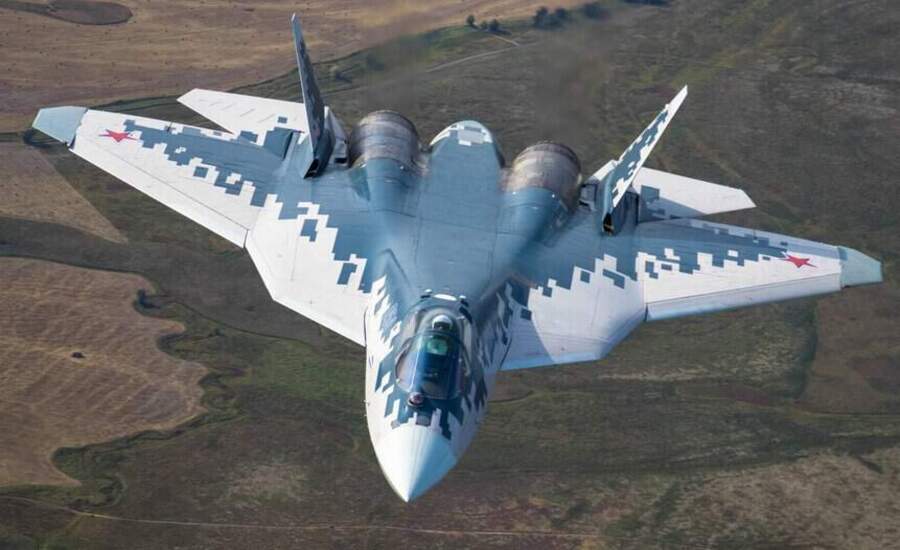
Moscow: Recently, Rostec revealed that the Su-57 fighter jet’s engine can withstand internal temperatures of nearly 2,000°C during extreme aerial maneuvers. The announcement highlights the durability of the Su-57’s powerplant and its ability to maintain performance during demanding combat situations. According to Rostec and United Aircraft Corporation (UAC), this capability plays a key role in helping the aircraft perform advanced maneuvers designed to evade incoming missiles.
Rostec Reveals New Details About Su-57 Fighter Jet Engine Performance
Russia’s state technology corporation Rostec stated that the Su-57’s engine can endure temperatures approaching 2,000°C during some of the aircraft’s most demanding flight maneuvers.
Read also: Explained: Why India Is Considering the Su-57–S-400 Combo After F-35 Hurdles
The company said these conditions occur when the fighter performs extreme low-speed or hover-like aerobatic movements that place enormous stress on the engine. Despite the thermal load, the powerplant continues to operate reliably.
How The Su-57 Fighter Jet Uses Extreme Maneuvers To Evade Missiles
According to Rostec, the capability was demonstrated by renowned Russian test pilot Sergey Bogdan during an Aero India airshow performance.
During the display, the pilot executed a series of advanced aerobatic maneuvers, including a move that brought the aircraft close to a standstill at an altitude of around 600 meters. Such maneuvers require precise engine control and continuous thrust generation.
Why Hover-Like Maneuvers Are So Difficult
When a fighter jet slows dramatically in mid-air, the engine experiences intense thermal and aerodynamic stress. Any sudden loss of thrust can cause instability, potentially leading to a dangerous spin or rapid loss of altitude. Rostec claims the Su-57’s engine is designed to handle these extreme conditions without compromising performance.
Why Engine Reliability Matters In Modern Air Combat
Modern warfare increasingly depends on aircraft being able to rapidly change direction, speed, and altitude. A highly reliable engine allows pilots to perform aggressive maneuvers that may help break an enemy missile’s tracking path. This makes engine durability a critical factor in fighter aircraft survivability.
Super-Maneuverability As A Combat Advantage
The Su-57 is known for its super-maneuverability, enabled by advanced aerodynamics and thrust-vectoring technology. Russian officials argue that these capabilities provide tactical advantages during close-range engagements and missile-avoidance situations.
Current Engine Powering The Su-57 Fighter Jet
Most operational Su-57 aircraft currently use the AL-41F-1 engine, also known as Product 117. This engine is an upgraded design derived from earlier Russian fighter engines and provides the thrust needed for supercruise and advanced maneuverability.
AL-51F-1 Engine Still Under Development
Russia originally planned for the Su-57 to use the next-generation AL-51F-1 engine, also known as Product 30. However, the programme has faced multiple delays. Current estimates suggest the engine could enter wider operational service around 2030 as part of upgraded Su-57 variants.
Russia Pushes Su-57 Fighter Jet Exports In Global Fighter Market
The latest announcement comes as Russia continues promoting the Su-57 in international defence markets. Moscow hopes the aircraft’s advanced maneuverability, stealth features, and engine performance will help it compete against other fifth-generation fighters such as the American F-35 and China’s J-20.
What Makes The Su-57 Fighter Jet Different
The Su-57 is Russia’s first operational fifth-generation stealth fighter aircraft. It combines stealth technology, internal weapons bays, advanced avionics, artificial intelligence-assisted systems, and high maneuverability to perform a wide range of air combat missions.
Strategic Significance Of Rostec’s Announcement
By highlighting the engine’s ability to withstand extreme temperatures, Russia is emphasizing one of the aircraft’s key strengths. The announcement also supports Moscow’s efforts to demonstrate the maturity of the Su-57 programme while development continues on more advanced engine variants for future upgrades.
Read also: Russia’s Su-57 Offer To India Comes With A Deadly Technology Transfer Promise
FAQs
Most operational Su-57 aircraft currently use the AL-41F-1 engine, also known as Product 117.
According to Rostec, the Su-57’s engine can withstand internal temperatures of nearly 2,000°C during extreme combat maneuvers.
The AL-51F-1, or Product 30, is Russia’s next-generation fighter engine being developed for future Su-57 variants.