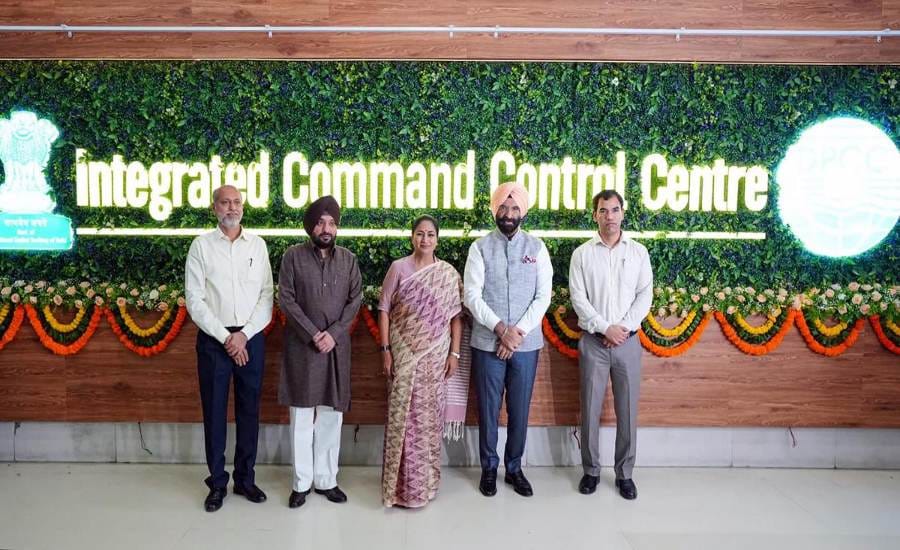
New Delhi: The Delhi government has launched an Integrated Command and Control Centre (ICCC) for the Delhi Pollution Control Committee (DPCC) to monitor pollution sources in real time and connect technology-based alerts with action on the ground.
The centre, inaugurated by Chief Minister Rekha Gupta at the Delhi Metro Rail Corporation’s IT Park in Shastri Park on October 1, will bring pollution data, public complaints, field inspection reports and enforcement activities onto a common platform. The facility will operate round the clock, with officials deployed in shifts.
The system will use AI-enabled CCTV cameras, GPS tracking and body cameras to monitor construction activity, road sweeping, open waste burning and other local pollution sources. Its stated operating principle is “Detect, Analyse, Act, Verify”, linking the identification of a pollution problem with field-level action and subsequent verification.
AI-CCTV to Monitor More Than 700 Construction Sites
One of the key features of the new pollution control system is live monitoring of more than 700 construction sites covering over 500 square metres.
AI and CCTV cameras will track these sites, with automatic alerts sent to the concerned department and site owner if PM10 levels rise. This is intended to allow authorities to respond more quickly to pollution-related violations at construction locations.
The ICCC will also monitor all AQI stations across Delhi and analyse pollution data, including information from previous periods, to help identify local pollution sources and patterns.
Additional cameras will be deployed to monitor open waste and biomass burning, two activities that can contribute to local air pollution.
Read Also: Delhi Launches ₹8,300 Crore Clean Air Programme with World Bank Support to Combat Pollution
78 Teams to Monitor Pollution Hotspots
The Delhi government will deploy 78 sub-divisional teams for monitoring and enforcement during the winter season.
When the command centre identifies a pollution hotspot or violation, information can be passed to the relevant field team for action. GPS-enabled vehicles will allow the movement of these teams to be tracked, helping officials coordinate responses and monitor field deployment.
This creates a direct connection between the information collected by the ICCC and enforcement activity at the local level.
The system will also support the monitoring of pollution caused by road dust, construction activities and open burning.
GPS Tracking of Road-Sweeping Machines
Mechanical road sweeping has also been brought into the digital monitoring system.
GPS-enabled systems will track the location and movement of road-sweeping machines, including whether they are operating in designated areas. Officials will be able to monitor the distance covered and operating hours of the machines.
The objective is to use real-time information to check whether road-cleaning operations are taking place according to their designated routes and schedules.
The monitoring of road sweeping is particularly linked to efforts to control road dust, which the Delhi government has identified as one of the pollution sources requiring continuous field-level attention.
Body Cameras to Record Pollution Violations
Field inspections will also receive a technology upgrade.
DPCC officials inspecting industries and other polluting sites will be required to use body cameras to record enforcement activities. The cameras used by Vayudoot teams, which identify pollution-causing activities, will also be connected to the command centre.
This will allow footage from field operations to reach the ICCC and provide a digital record of inspections and identified violations. The government says the system is intended to strengthen transparency and accountability during enforcement.
‘Jan Suggestion’ Portal Opens Public Participation
Alongside the command centre, Chief Minister Rekha Gupta launched the “Jan Suggestion” portal to involve citizens in pollution-control efforts.
Residents can use the portal to submit suggestions, complaints and information about pollution-related concerns. Citizens can also share information about initiatives they believe are helping reduce pollution.
The government has said public participation will form part of its approach to tackling pollution and supporting sustained monitoring.
Centre to Function as Winter Pollution War Room
Environment Minister Manjinder Singh Sirsa said the ICCC will operate 24×7 and function as a war room during the pollution season.
The centre will have officials and staff working in shifts, with facilities including a kitchen, pantry, mess and bunk beds to support round-the-clock operations.
Sirsa also said the government is seeking to use continuous monitoring and public participation to address pollution before conditions require more stringent restrictions.
The government has reported that 7.2 million trees have already been planted against a target of 7 million, with plantation activity continuing.
Technology Linked Directly to Field Action
The Delhi Pollution Control Committee’s new command centre represents an attempt to bring multiple pollution-monitoring systems onto a single platform rather than treating each source separately.
Construction sites can be monitored through AI and CCTV, road-sweeping operations through GPS, field inspections through body cameras, and pollution hotspots through AQI and other data. Public complaints will also feed into the system.
The broader focus is therefore not only on collecting pollution data but on connecting that information with field enforcement. For residents, the effectiveness of the system will ultimately depend on how quickly alerts translate into action at identified pollution hotspots.
With the winter pollution season approaching, the Delhi pollution command centre gives authorities a central mechanism to monitor multiple sources continuously and coordinate responses across departments. The initiative adds a technology-driven layer to Delhi’s existing pollution-control efforts, with real-time monitoring, field enforcement and citizen participation operating together.
Read Also: Delhi CM Rekha Gupta Approves 1,000 Acres of Southern Ridge for Reserved Forest Notification