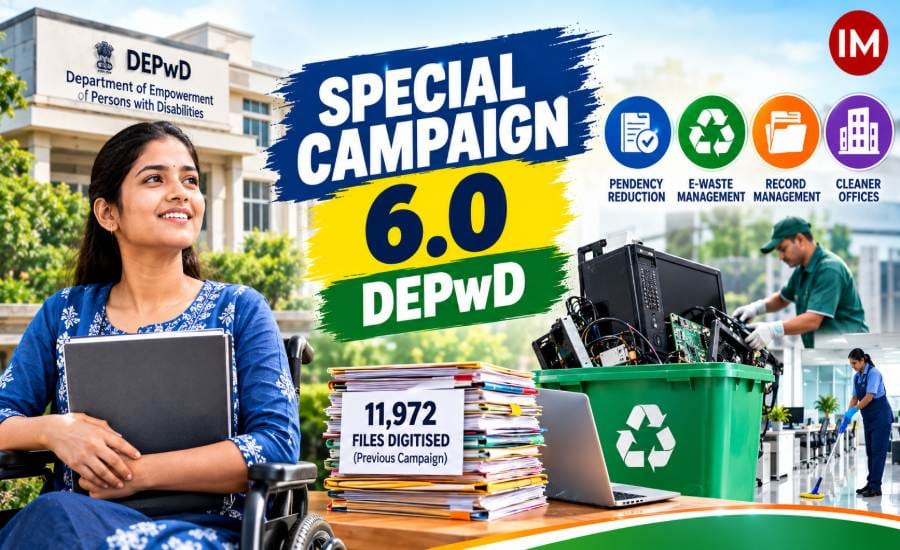
New Delhi: The Department of Empowerment of Persons with Disabilities (DEPwD) is preparing for Special Campaign 6.0, a month-long government drive focused on reducing pendency, improving record management, freeing office space and strengthening the responsible disposal of e-waste.
The campaign will run from October 2 to October 31, 2026, with a preparatory phase already underway from September 16 to 30. The initiative is part of the broader Special Campaign 6.0 being coordinated by the Department of Administrative Reforms and Public Grievances (DARPG) to institutionalise cleanliness and reduce pending work in government offices.
For DEPwD and its organisations, the campaign will combine workplace cleanliness with administrative efficiency, with particular attention to electronic waste and obsolete records.
E-Waste Management Gets Special Focus
One of the key priorities of Special Campaign 6.0 is the effective collection, segregation and disposal of e-waste.
Government offices regularly replace computers, electronic equipment and other IT-related assets. The campaign aims to ensure that obsolete electronic material does not simply accumulate in offices but moves through appropriate disposal channels.
For DEPwD, this focus will form part of a larger effort to improve the use of public resources while maintaining cleaner and better-organised workplaces.
The broader Special Campaign 6.0 framework also places emphasis on scientific e-waste management and responsible disposal practices across government departments.
Read also: ₹285 Crore Push for India’s Indigenous ePlane as Ubifly Targets TRL-9
Preparations Already Underway
DEPwD has begun putting the organisational structure in place for the campaign.
A Nodal Officer has been nominated for the department. Its attached and subordinate offices, public sector undertakings and autonomous bodies have also been advised to nominate their own Nodal Officers.
These organisations are identifying pending matters and other campaign targets according to the parameters prescribed by DARPG.
The preparatory phase is important because departments are expected to identify records, pending matters, sites requiring cleanliness drives and obsolete materials before the main implementation period begins.
This approach allows the October campaign to focus on actual disposal and implementation rather than only identifying problems.
DEPwD Builds on Special Campaign 5.0
The department’s preparations for Special Campaign 6.0 follow the results recorded during the previous edition.
During Special Campaign 5.0 in 2025, DEPwD and its organisations reported digitising and weeding out 11,972 physical files and documents.
The exercise also freed approximately 15,588 square feet of office space and generated ₹14.47 lakh in revenue.
In addition, 64 cleanliness campaigns were conducted across indoor and outdoor spaces by the department and its organisations across the country.
These figures provide the baseline for the department’s preparations for the new campaign.
Cleanliness Efforts Continued Beyond the Campaign
DEPwD’s activities did not stop when Special Campaign 5.0 ended.
According to the department, its offices and organisations have continued carrying out Swachhata and pendency-reduction activities every month since November 2025.
The department has also been uploading achievements on the Special Campaign 6.0 Portal, allowing progress to be recorded beyond the limited duration of an annual cleanliness drive.
This continued approach is significant because the campaign seeks to make cleanliness, record management and timely disposal part of regular office functioning rather than treating them as one-time activities.
Turning Pending Work Into Better Governance
Special Campaign 6.0 links physical cleanliness with administrative efficiency.
Pending files, unresolved matters and outdated records can occupy both staff time and physical space. Systematic review and disposal can help government offices maintain more manageable records while allowing officials to focus on matters that require current attention.
For DEPwD, the campaign will therefore cover more than cleaning office premises. It will also involve reducing avoidable pendency, improving record management and making better use of available workspace.
Focus on Efficient Use of Public Resources
The wider government campaign has similarly been designed around Swachhata, pendency reduction, space management and scientific waste disposal.
The department’s approach also places emphasis on converting redundant material into usable value.
Obsolete records and scrap can take up valuable government space, while properly managed scrap disposal can generate revenue. The previous campaign’s ₹14.47 lakh revenue from DEPwD’s activities illustrates this aspect.
The new campaign aims to build on such outcomes while giving greater attention to e-waste.
This is particularly relevant as government offices increasingly depend on digital equipment. Responsible handling of obsolete electronics can help prevent unnecessary accumulation and support more organised resource management.
A Campaign With a Long-Term Goal
The main implementation phase of Special Campaign 6.0 will run for one month, but DEPwD’s stated objective extends beyond October.
The department intends to use the campaign to strengthen a continuing culture of cleanliness, timely disposal, better record management and efficient use of government resources.
At the national level, the campaign is being implemented across government ministries and their attached, subordinate and autonomous organisations, with e-waste management receiving special attention this year.
For DEPwD, the October exercise will therefore bring together two connected goals: cleaner workplaces and more efficient administration.
By reducing pending matters, digitising and managing records, clearing redundant material and ensuring responsible e-waste disposal, the department aims to make government offices more organised and productive while improving the use of public resources.
Read also: India Expands Patient-Safety Net as Centre Approves Biovigilance Programme