Dehradun: Uttarakhand is looking beyond traditional crops to increase farmers’ incomes, with Haridwar preparing to introduce makhana farming on 120 bighas of land under a pilot project.
The initiative, being planned by the district horticulture department, will encourage farmers to diversify beyond sugarcane, paddy and wheat. Selected farmers will receive financial assistance as well as training to help them adopt makhana cultivation.
Under the plan, the government will provide a 40% subsidy on the estimated cultivation cost. The project is being seen as an opportunity to introduce a high-value crop to the district and create additional income opportunities for farmers.
120 Bighas Identified for the Pilot
The horticulture department has initially set a target of cultivating makhana on 120 bighas in Haridwar. Farmers will be able to cultivate makhana in ponds as well as in fields that can be developed into pond-like structures suitable for the crop.
The scheme will allow an individual farmer to avail the benefit for cultivation on a maximum of one hectare.
The estimated cost of cultivation is around ₹1.31 lakh per hectare. At a 40% subsidy rate, farmers will receive approximately ₹52,400 per hectare as financial support.
The remaining cost will have to be borne by the farmer, making the subsidy an important component in reducing the initial investment required to experiment with the new crop.
Read Also: Uttarakhand CM Reiterates Development Push, Says Champawat to Become Model District
Farmers Receive Training in Bihar
Since makhana cultivation is still a new option for farmers in Haridwar, the administration is focusing on training before expanding the initiative.
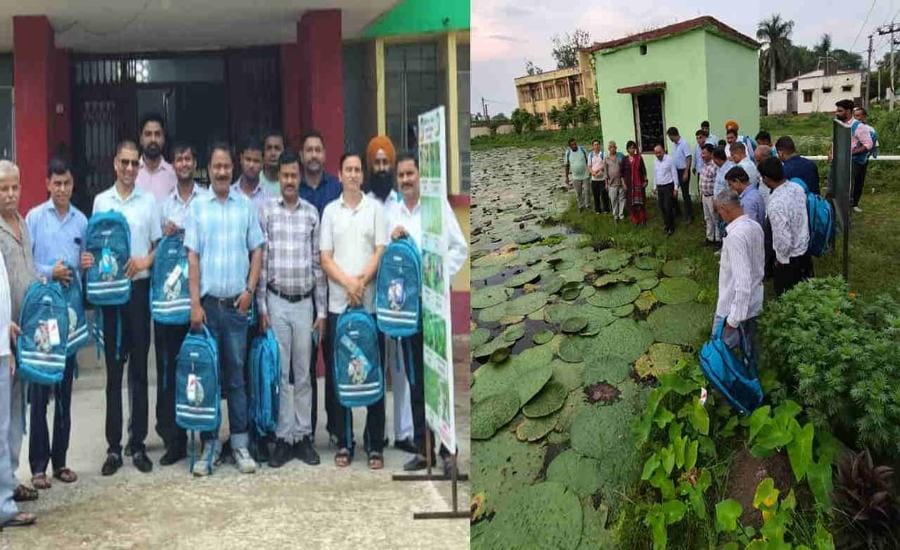
A group of farmers has already undergone a training programme in Bihar, where makhana cultivation has a strong agricultural base. Farmers from Haridwar were sent for a three-day training programme at the Regional Research Institute in Agwanpur, Saharsa.
The training is intended to help farmers understand cultivation techniques and the conditions required for successful makhana production.
The move is significant because makhana generally requires suitable water conditions and specialised cultivation practices. Training can help farmers avoid initial mistakes and improve the chances of success during the pilot phase.
From Traditional Crops to Diversified Farming
Agriculture in Haridwar is largely centred around crops such as sugarcane, paddy and wheat. While these crops remain important, the district administration is looking for additional farming options that can improve returns and reduce dependence on a limited crop basket.
Makhana is being considered as one such alternative.
The pilot project will allow the administration and farmers to assess whether the crop can be successfully cultivated under local conditions. If the experiment produces encouraging results, cultivation could be expanded across more areas of the district.
The approach also reflects a wider effort to encourage farmers to explore modern and diversified agricultural practices instead of depending only on conventional crops.
Makhana Can Create Opportunities Beyond Farming
The initiative is not limited to cultivation alone. The horticulture department is also encouraging farmers to look at value-added makhana products, which can create additional earning opportunities.
Farmers are being trained to explore products such as:
- Makhana snacks and namkeen
- Makhana laddoos
- Makhana kheer
- Makhana powder
- Makhana-mixed flour
Such processing can help farmers and rural households earn from the crop beyond its primary sale.
Officials believe this could also create opportunities for women and young people to participate in small-scale food processing and rural entrepreneurship.
Selection of Farmers Underway
The selection of farmers for the Haridwar makhana farming project has already started. The process is expected to continue through November and December, after which cultivation will be initiated.
The administration plans to closely assess the results of the pilot before moving towards large-scale production.
According to the horticulture department, a successful pilot could provide the basis for expanding makhana cultivation across the district and encouraging more farmers to adopt the crop.
The initiative therefore combines three elements — crop diversification, financial support and skill development — to create a new agricultural model for Haridwar.
A New Agricultural Option for Haridwar
The makhana pilot project could give Haridwar farmers an additional source of income while reducing dependence on traditional crops. The 40% subsidy lowers the initial financial burden, while specialised training gives farmers technical support before they begin cultivation.
If the experiment succeeds, the model could encourage wider adoption of makhana farming in suitable parts of Uttarakhand. It could also strengthen rural livelihoods by linking cultivation with processing and value-added products.
For Haridwar, the initiative is an early step towards exploring whether a crop strongly associated with Bihar can find a productive new base in Uttarakhand.
Read Also: From Parks to Bus Stands: Uttarakhand’s Cities Get a New Development Push