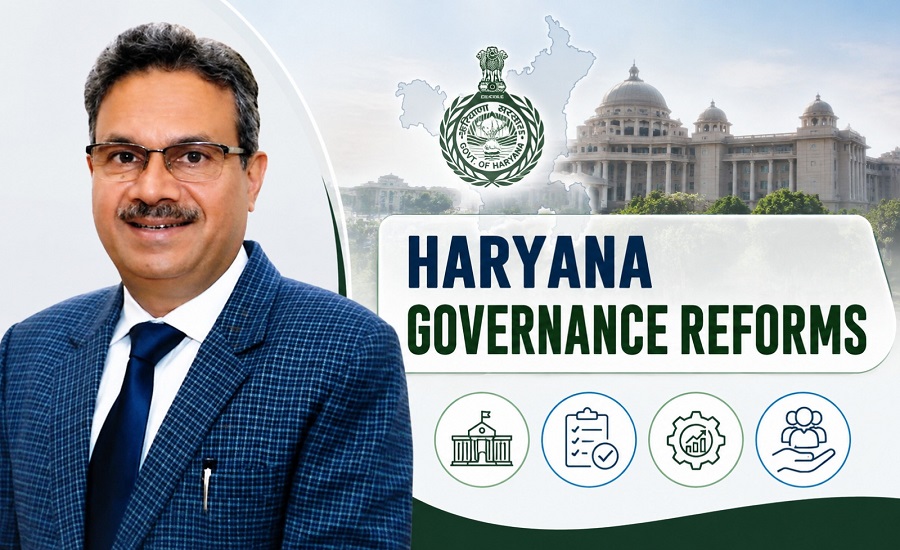
Chandigarh: Haryana has accelerated work on one of its major governance reform initiatives, with 21 of the 28 priority reforms identified under the Centre’s second phase of the compliance reduction and deregulation exercise either approved or already under implementation.
The progress was highlighted by Haryana Chief Secretary Anurag Rastogi (IAS:1990) during a high-level Centre-State review meeting held on Thursday.
The review assessed the state’s progress across 28 priority areas covering land regulations, industrial development, business licensing, labour regulations and administrative reforms, among other sectors.
Departments presented their implementation status as well as action plans for completing the recommendations that are still pending.
CS Anurag Rastogi Directs Departments to Meet Deadlines
During the review, Rastogi directed all concerned departments to adhere to timelines, resolve outstanding issues quickly and coordinate closely with the Government of India wherever central approvals are required.
The Chief Secretary stressed that effective implementation would be crucial to ensuring that regulatory reforms translate into faster and more efficient public services.
The exercise is aimed at reducing unnecessary compliance requirements, simplifying procedures and improving the ease of doing business as well as ease of living for citizens.
Digital Governance at the Centre of Reform Push
Haryana is increasingly relying on digital governance to improve administrative efficiency and make government processes more transparent.
One of the key initiatives is the proposed Digital Repository for State Acts, Rules and Government Orders, which is intended to make important regulatory and administrative information more accessible and easier to track.
The state is also strengthening mechanisms to monitor service delivery timelines.
Another focus area is the Auto-Appeal system under the Right to Services framework, which is being enhanced to improve accountability and ensure that citizens receive notified services within prescribed timelines.
These measures are aimed at reducing delays and making public administration more responsive.
Business Licensing Processes Being Simplified
The reform exercise also covers several measures intended to make it easier for businesses and entrepreneurs to operate in Haryana.
According to the state, work is underway to simplify business licensing procedures, reduce unnecessary regulatory hurdles and streamline processes affecting industries and enterprises.
The reforms are expected to particularly benefit industries, entrepreneurs and MSMEs, which often face multiple approvals and compliance requirements while setting up or expanding operations.
The state is also working on reforms in areas such as legal metrology and other regulatory processes.
Faster Electricity Connections and Building Approvals
Among the areas being addressed are electricity connections and building approvals.
The government is seeking to streamline the procedures involved in obtaining electricity connections and expedite building approval processes.
Faster approvals in these areas are expected to reduce administrative delays for businesses, industries and other applicants.
The reforms form part of the broader effort to create a governance environment where approvals are delivered more quickly and procedures are easier to navigate.
Self-Certification for MSMEs
Haryana is also promoting self-certification mechanisms for micro, small and medium enterprises (MSMEs) as part of the compliance reduction exercise.
The approach is intended to reduce the regulatory burden on smaller businesses while maintaining appropriate oversight.
By shifting from multiple procedural requirements towards greater reliance on self-certification and digital processes, the state aims to allow entrepreneurs to focus more on business operations and expansion.
Reforms Cover Land, Labour and Industrial Regulations
The 28 priority areas being reviewed span several important aspects of governance and economic activity.
These include land-related regulations, industrial development, labour, business licensing, administrative procedures and other compliance requirements.
Departments have been asked to identify pending actions and ensure that the remaining reforms are implemented within the prescribed timelines.
Where reforms require coordination or approval from the Centre, departments have also been directed to maintain close engagement with the Government of India.
Focus on Faster Approvals and Simpler Rules
Rastogi stressed that the reform exercise is ultimately aimed at creating a governance system in which approvals come faster, rules are simpler and public services operate more efficiently.
The state government’s approach is to reduce procedural complexity while increasing transparency and accountability through digital tools.
The Chief Secretary emphasised the need for departments to move beyond policy decisions and ensure that reforms are effectively implemented on the ground.
Reforms Aimed at Citizens, Farmers and Businesses
According to the official statement, the ongoing reforms are intended to benefit a wide range of stakeholders, including industries, entrepreneurs, MSMEs, farmers and citizens.
Simplified regulations and faster decision-making can reduce the time and effort required to access government services and obtain statutory approvals.
For businesses, the reforms are expected to improve the regulatory environment, while citizens could benefit from more predictable and time-bound delivery of public services.
21 of 28 Priority Reforms Already Moving
With 21 out of 28 priority reforms either approved or under implementation, Haryana has reported substantial progress in the second phase of the Centre’s compliance reduction and deregulation exercise.
The remaining recommendations will now require focused departmental action and, wherever necessary, coordination with the Centre.
Mr Rastogi’s directions indicate that the state intends to maintain momentum and ensure that pending reforms are completed within the prescribed deadlines.
The reform push reflects Haryana’s broader attempt to combine digital governance, regulatory simplification and time-bound service delivery to create a more efficient and citizen-responsive administrative system.