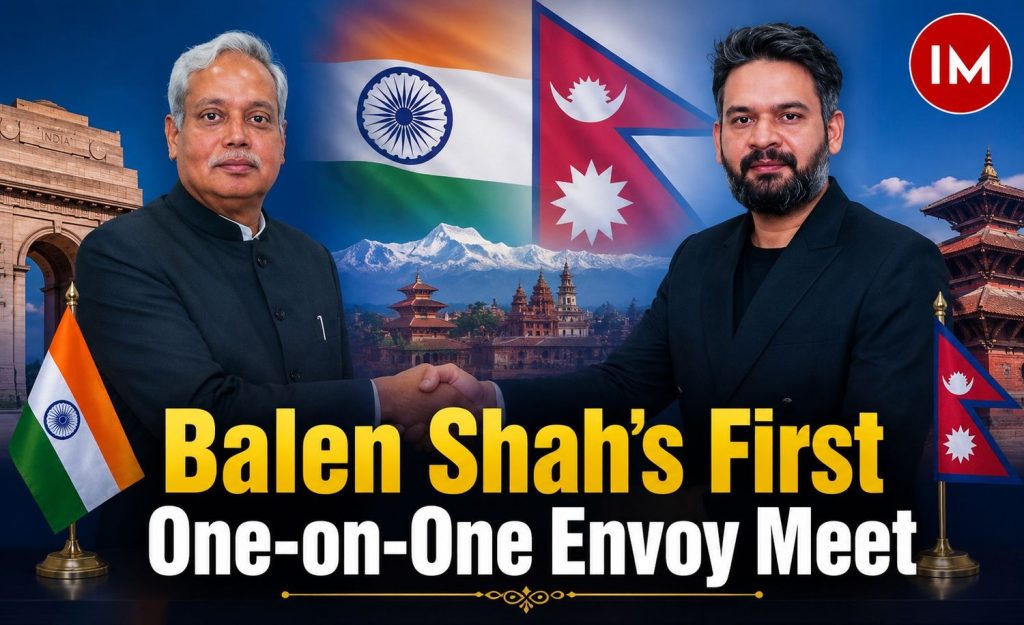
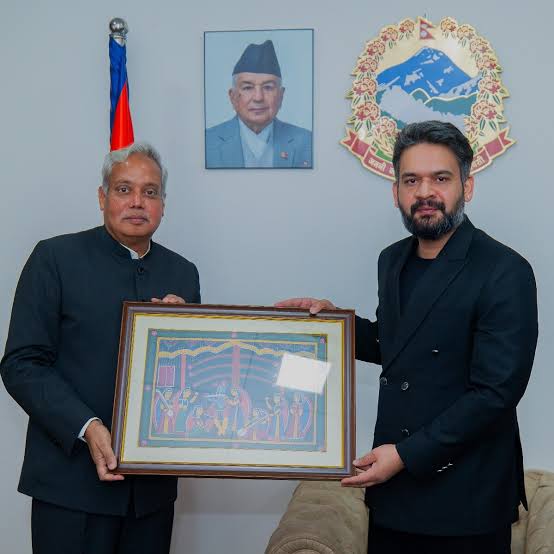
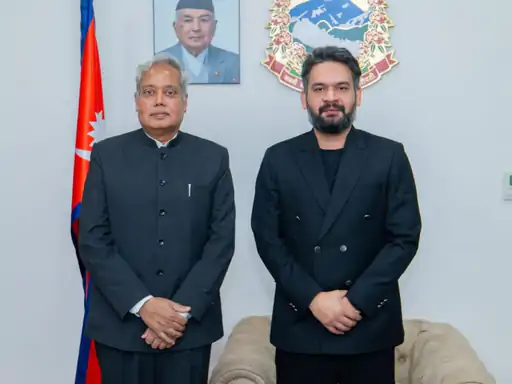
Kathmandu: India’s Ambassador to Nepal Naveen Srivastava, a 1993-batch Indian Foreign Service (IFS) officer, held a one-on-one meeting with newly appointed Nepal Prime Minister Balendra “Balen” Shah on Monday, marking a significant shift in the Nepali leader’s approach to diplomatic engagement.
The meeting was PM Shah’s first individual meeting with a foreign ambassador since he assumed office. During the interaction, Srivastava congratulated Shah on becoming Prime Minister and conveyed India’s commitment to strengthening relations and cooperation with Nepal. The two sides discussed India-Nepal relations, development cooperation and issues of mutual interest.
PM Shah highlighted the longstanding relationship between the two neighbours and stressed the need to expand bilateral trade and cooperation in sectors including power, roads and infrastructure and other development projects.
The meeting is particularly significant because PM Shah had initially adopted a policy of avoiding individual meetings with foreign ambassadors, preferring collective interactions instead.
Who Is Naveen Srivastava?
Mr Srivastava is a career diplomat and a 1993-batch IFS officer who has been serving as India’s Ambassador to Nepal since June 25, 2022.
He was appointed to the Kathmandu post by the Ministry of External Affairs in May 2022, succeeding Vinay Mohan Kwatra, who later became India’s Foreign Secretary. The MEA had described Srivastava as the then Additional Secretary in charge of the East Asia Division when it announced his appointment.
Before taking charge in Kathmandu, IFS Srivastava handled one of the most strategically important divisions in the Ministry of External Affairs, dealing with India’s relations with China, Japan, South Korea, Mongolia and North Korea.
Read Also: Who Is IFS Devesh Uttam? Appointed Ambassador to Ethiopia; Anand Prakash Named Envoy to Eswatini
His career has also included postings in Hong Kong, Beijing, Washington DC, Shanghai and Cambodia, giving him extensive experience in Asian diplomacy and bilateral negotiations.
Why Is Balen Shah’s Meeting With Srivastava Significant?
The meeting comes after PM Shah had initially kept foreign diplomats at arm’s length in terms of individual interactions.
After becoming Prime Minister, Mr Shah preferred meeting ambassadors collectively rather than holding separate meetings with individual foreign envoys.
In April, for instance, ambassadors and heads of diplomatic missions from several countries were received together by Shah at the Prime Minister’s Office. The unusual collective format was seen as a departure from the traditional practice in which Nepali prime ministers would meet individual ambassadors.
Reports in July indicated that Shah was preparing to change this approach and begin holding individual meetings with foreign ambassadors. The first meetings were expected to be with the Indian and Chinese ambassadors.
The meeting with Srivastava therefore marks an important diplomatic departure for the new Nepali government.
Why Did Balen Shah Avoid One-on-One Meetings?
PM Shah’s earlier decision was linked to his broader approach to foreign policy.
As Prime Minister, he wanted foreign diplomatic engagement to be channelled through Nepal’s formal administrative and foreign-policy machinery rather than through direct informal access to the Prime Minister.
He had also argued against practices in which ambassadors of powerful countries could establish direct access to the top political leadership while officials of Nepal’s Foreign Ministry were not necessarily present.
Instead, PM Shah initially chose collective meetings with ambassadors.
A joint meeting with ambassadors and heads of diplomatic missions from several countries in April was seen as an attempt to demonstrate that Nepal would maintain an equal and balanced approach towards different countries.
Policy Shift After 100 Days
The approach began to change after PM Shah’s government completed around 100 days in office.
Reports indicated that advisers encouraged Shah to begin holding individual meetings with domestic and foreign stakeholders. He subsequently began meeting politicians, business leaders and industrialists individually.
Plans were then made for separate meetings with foreign ambassadors, with India and China among the first countries whose envoys were scheduled to meet Shah individually.
The decision was also viewed in the context of concerns that avoiding direct diplomatic dialogue for too long could complicate Nepal’s relations with key partners.
PM Shah Also Meets Chinese Ambassador
Mr Shah’s diplomatic outreach was not limited to India.
He also held a separate meeting with Chinese Ambassador Zhang Maoming, with discussions covering Nepal-China relations, issues of mutual interest and development cooperation.
The decision to meet the Indian and Chinese ambassadors individually is being watched closely because Nepal has traditionally sought to maintain a careful balance in its relations with its two large neighbours.
India and China are both major economic and strategic partners for Kathmandu, and Nepal’s foreign policy often involves balancing its interests between New Delhi and Beijing.
Reports had indicated that Shah intended to meet both ambassadors around the same time, underscoring the importance he attaches to relations with both neighbours.
Naveen Srivastava’s Diplomatic Career
Mr Srivastava joined the Indian Foreign Service in 1993 and began his diplomatic career in Hong Kong.
He subsequently served at the Embassy of India in Beijing, where he handled bilateral relations between India and China.
He later served in Washington DC as Counsellor (Political) from June 2009 to July 2012.
From August 2012 to July 2015, he was Consul General of India in Shanghai, one of China’s most important commercial and financial centres.
He then served as Ambassador of India to Cambodia from August 2015 to May 2017.
His overseas assignments have therefore given him considerable exposure to both bilateral diplomacy and India’s wider engagement with the Asia-Pacific region.
Role at New Development Bank
Between June 2017 and June 2019, IFS Srivastava was on deputation to the New Development Bank (NDB) in Shanghai, where he served as Director General and Corporate Secretary.
During this period, he worked with the bank’s President and Board, gaining experience in multilateral development institutions and international economic cooperation.
The assignment added another dimension to his diplomatic profile, combining foreign-policy experience with international development and institutional management.
Head of East Asia Division
Before his appointment as Ambassador to Nepal, Mr Srivastava was the senior official responsible for the East Asia Division in the Ministry of External Affairs.
The division handles India’s relations with China, Japan, the Republic of Korea, Mongolia and the Democratic People’s Republic of Korea.
This was one of the most strategically important assignments in the MEA, particularly given the complexities surrounding India’s relations with China.
His experience in the division became especially relevant during the eastern Ladakh border standoff.
Role in India-China Border Talks
IFS Srivastava headed the Indian diplomatic delegation in several rounds of talks under the Working Mechanism for Consultation and Coordination (WMCC) between India and China during the eastern Ladakh border crisis.
He was also involved in some rounds of broader diplomatic and military discussions between the two countries.
His experience in dealing with Beijing and negotiating sensitive security issues gave him an important background before taking up the ambassadorial assignment in Kathmandu.
Education: IIT Delhi and University of Maryland
IFS Srivastava has a strong technical academic background.
He holds a Bachelor’s degree in Electrical Engineering from IIT Delhi and a Master’s degree in Electrical Engineering from the University of Maryland in the United States.
His engineering education is somewhat unusual for a career diplomat and complements his later experience in technology, economic and strategic diplomacy. The Indian Embassy in Kathmandu officially lists both qualifications in his ambassadorial profile.

India-Nepal Relations Under His Watch
Mr Srivastava has been India’s envoy in Kathmandu during a period of considerable political change in Nepal.
His tenure has involved engagement on a broad range of issues, including connectivity, infrastructure, energy cooperation, trade, development assistance, digital payments and cross-border relations.
India and Nepal share a unique relationship characterised by an open border and extensive people-to-people, cultural and economic ties. The two countries also share a border with several Indian states, making connectivity, trade and security particularly important areas of bilateral cooperation.
Focus on Connectivity, Power and Development
During the meeting with Srivastava, Shah specifically highlighted the need to increase cooperation in trade, power, roads and infrastructure.
These areas are central to India-Nepal economic relations.
India has been involved in several infrastructure and development projects in Nepal, while cross-border electricity trade and transmission connectivity have become increasingly important elements of bilateral cooperation.
For Kathmandu, stronger trade and connectivity with India are also important because Nepal is a landlocked country and relies heavily on transit routes through India for the movement of goods.
A Diplomat With Deep Regional Experience
IFS Srivastava’s profile stands out because of the breadth of his experience across major Asian capitals.
He has worked on India-China relations from Beijing and New Delhi, served in Washington, headed a major multilateral development institution in Shanghai, represented India as Ambassador in Cambodia and has now spent more than four years as India’s envoy in Nepal.
His current posting therefore places him at the intersection of India’s neighbourhood diplomacy and Nepal’s evolving foreign-policy priorities.
Why the India Meeting Matters
The timing and format of PM Shah’s meeting with Srivastava make it particularly significant.
For several months, Mr Shah had deliberately avoided one-on-one meetings with ambassadors, instead choosing collective diplomatic interactions.
His decision to now meet the Indian ambassador individually indicates a shift towards more conventional diplomatic engagement.
At the same time, Shah’s separate meeting with the Chinese ambassador suggests that Nepal intends to maintain engagement with both New Delhi and Beijing rather than signal an exclusive tilt towards either neighbour.
For Srivastava, the meeting provides an important channel for direct engagement with Nepal’s new Prime Minister at a time when Kathmandu is recalibrating its diplomatic style.
The discussions on trade, infrastructure, power and development cooperation also underline the practical priorities that are likely to shape India-Nepal relations during Shah’s tenure.