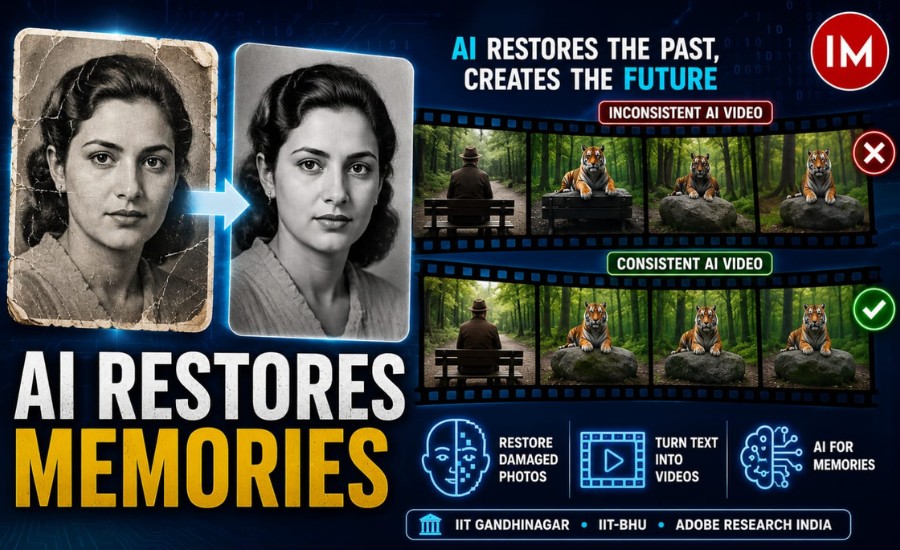
Ahmedabad/New Delhi: Researchers from the Indian Institute of Technology Gandhinagar (IITGN), IIT-BHU and Adobe Research India are exploring how artificial intelligence can help preserve existing visual memories while also creating visual representations of events that were never photographed.
The research focuses on two distinct AI applications. The first, Generative Latent Inversion for Blind Face Restoration (GenR), aims to recover facial details from degraded photographs without relying on paired training images. The second, Video-ASTAR, explores a training-free approach to generating videos from text while keeping objects, their relationships and actions consistent across frames.
The studies highlight the potential of AI in areas ranging from digital heritage preservation and image restoration to forensic analysis and generative video.
GenR Uses AI to Restore Damaged Faces
Researchers from IITGN and IIT-BHU have developed GenR, a blind face restoration framework designed to reconstruct faces from photographs affected by multiple forms of degradation.
Read Also: ‘Gramin Gyan Setu’ App Launched to Connect Village Libraries in Gujarat’s Gandhinagar
Unlike conventional supervised restoration systems that require large datasets containing paired clean and degraded images, GenR does not require such paired training data.
The framework uses a StyleGAN3-based inversion process to identify a plausible clean version of a damaged face and progressively refine it while retaining information available in the original image.
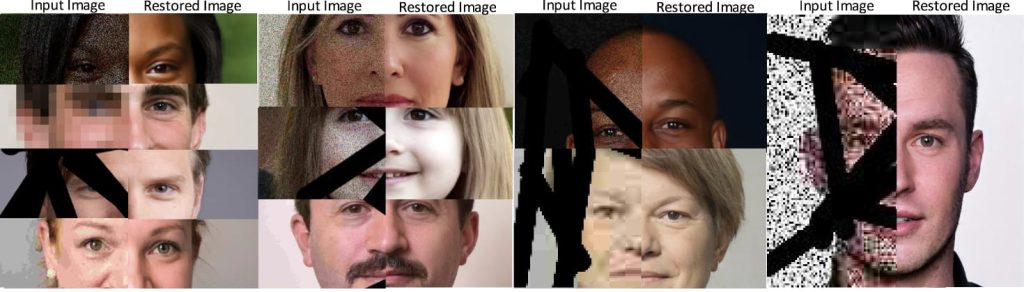
GenR tackles multiple forms of image degradation
The researchers tested the framework across four restoration tasks:
- De-noising: Removing random visual noise from photographs
- Upsampling: Improving low-resolution images
- Inpainting: Reconstructing missing portions of an image
- Deartifacting: Addressing distortions such as blur and pixelation
For single-degradation tasks, the system was reported to produce a restored image in around 30 seconds.
Three-Stage Process Helps Preserve Facial Features
GenR uses a three-stage optimisation process to progressively improve a damaged image.
The process begins by capturing global structures and broad characteristics, including identity and pose. It then refines specific facial features such as the eyes, nose and jawline before working on finer elements such as skin and hair textures.
Explaining the reasoning behind the approach, Akbar Ali, a fourth-year PhD student in the Department of Computer Science and Engineering at IITGN and the first author of the study, said, “A model may try really hard to refine a degraded image and invent details that do not belong to the original face in the process. This is a classic example of overfitting.”
He explained that moving from coarse structure to fine details in a controlled manner is intended to minimise this risk.
“This approach judges an image in a way similar to how a human eye would analyse it. It is an effort to keep the final output sharp, realistic, and perfectly recognisable.”
The staged process therefore allows GenR to progressively refine facial information while attempting to retain the identity and visual evidence present in the original image.
The study has been published in Pattern Recognition Letters.
AI Restoration Could Aid Heritage and Forensics
The researchers said GenR could have applications in areas where damaged or low-quality images need to be restored.
Potential applications include:
- Preservation of historical photographs
- Restoration of archival film footage
- Forensic facial reconstruction
- Improving image quality on video-conferencing platforms
- Enhancing photographs for digital and social media use
However, the technology also has limitations. When an original image is severely degraded, the system may generate realistic facial details that do not accurately correspond to the actual person.
This raises concerns about the reliability of AI-restored images, particularly in forensic and identification-related applications.
Video-ASTAR Tackles Inconsistent AI-Generated Videos
The research also examines another challenge in generative AI: maintaining consistency when creating videos from detailed text prompts.
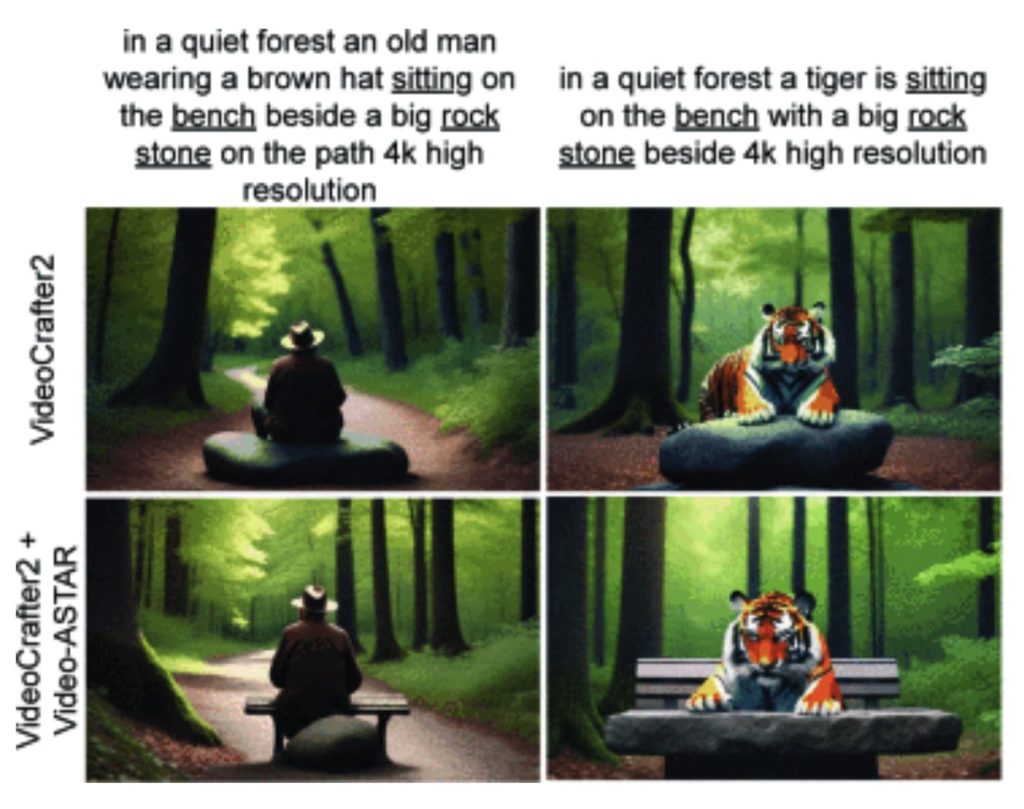
A conventional text-to-video system may generate a visually convincing scene but alter objects or their characteristics between frames. For example, an object described as a pink balloon could change colour, disappear or behave inconsistently as the video progresses.
Researchers from IITGN and Adobe Research India have proposed Video-ASTAR, a training-free approach intended to address this problem.
Keeping Objects and Relationships Consistent
Video-ASTAR is designed to maintain stronger connections between objects and the words used to describe them in a prompt.
For instance, a prompt describing a girl running with a pink balloon while looking at a kitten near a tree requires the system to track multiple objects and their relationships throughout the generated sequence.
The approach aims to ensure that:
- Objects remain visually consistent across frames
- Their characteristics remain linked to the original text
- Relationships between objects are preserved
- Actions remain faithful to the description
- Multiple concepts receive consistent attention during video generation
The study was published in the 2026 IEEE/CVF Winter Conference on Applications of Computer Vision proceedings.
Researchers Explore AI’s Role in Preserving Memories
The two studies approach visual memory from different directions.
GenR works with visual material that already exists, attempting to recover information from photographs that have been damaged or degraded.
Video-ASTAR works in the opposite direction, converting textual descriptions into visual sequences where no original photograph or video may exist.
This could potentially allow AI to help preserve family histories and cultural memories by both restoring inherited photographs and creating visual approximations of memories that were never captured on camera.
Research Connects With Digital Heritage Preservation
The research comes ahead of World Photography Day on August 19 and highlights the potential role of AI in preserving visual heritage.
The work also aligns with broader efforts around the IndiaAI Mission and Digital India, while the researchers noted its relevance to UNESCO’s Memory of the World initiative, which focuses on safeguarding documentary heritage.
The studies received support through academic and research programmes, including the Visvesvaraya PhD Scheme, the Prime Minister Research Fellowship and the Jibaben Patel Chair in Artificial Intelligence. The Video-ASTAR study was also part of researcher Dr Prajwal Singh’s internship at Adobe.
The researchers said future work on GenR could focus on improving its robustness and generalisation, potentially making AI-based restoration more reliable across a wider range of real-world image degradation.
Read Also: Reimagining Governance in the Age of Artificial Intelligence