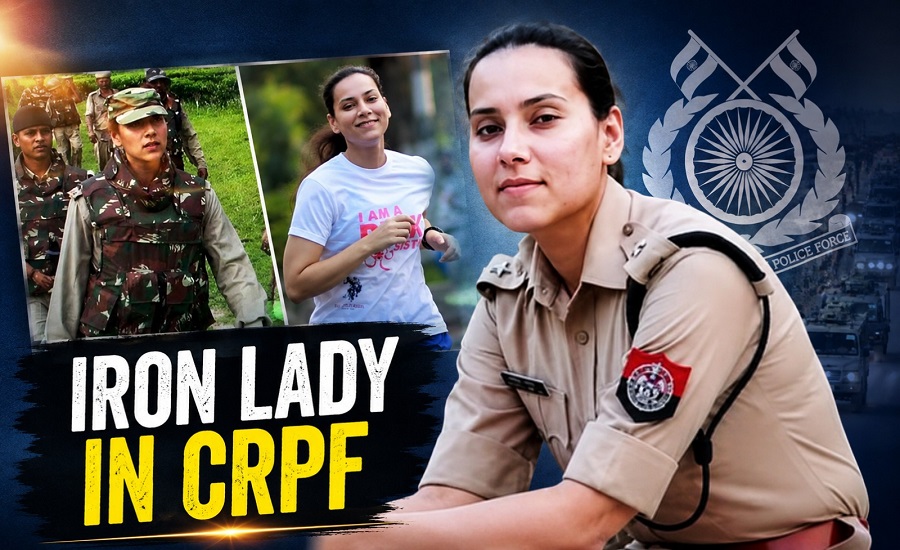
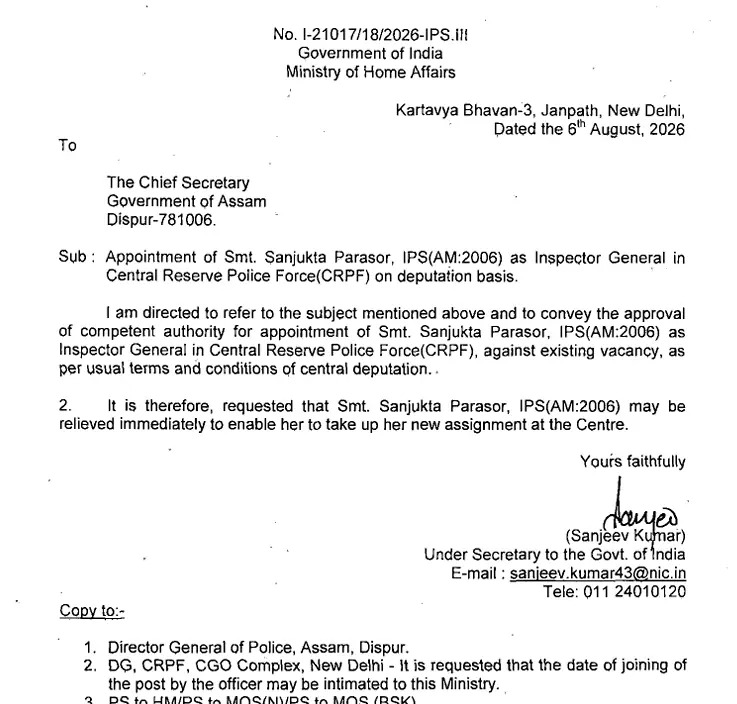
New Delhi: Dr. Sanjukta Parashar, a 2006-batch Indian Police Service (IPS) officer of the Assam-Meghalaya cadre, has been appointed as Inspector General of Police in the Central Reserve Police Force (CRPF) on central deputation.
The Ministry of Home Affairs issued the appointment orders on August 6, marking another significant milestone in the career of the officer who has earned nationwide recognition for her frontline work against insurgency in Assam.
Known popularly as the “Iron Lady of Assam”, Ms Parashar became widely known for personally leading counter-insurgency operations in the state’s difficult forest terrain. During her tenure as Superintendent of Police (SP) in Sonitpur district, she led 16 counter-insurgency encounters in 15 months, in which 16 militants were killed and 64 insurgents were arrested, according to the details provided.
Her career has since taken her to the National Investigation Agency (NIA) in New Delhi, where she served in senior investigative roles, and to other important policing assignments. She was promoted to the rank of Inspector General (IG) in January 2024.
Who Is IPS Sanjukta Parashar?
Dr Parashar is a highly decorated 2006-batch IPS officer of the Assam-Meghalaya cadre. She cleared the UPSC Civil Services Examination in 2005 with an All India Rank of 85 and chose the IPS, despite having a rank that could have opened the way to other prestigious services.
She joined the service on August 29, 2006, and was allotted the Assam-Meghalaya cadre.
She is widely known for her fearless field leadership and her work in counter-insurgency operations. She is also known for combining security operations with community outreach, particularly in areas affected by militancy and ethnic conflict.
She has been described as the first Assamese woman IPS officer to be posted directly in Assam under the Assam cadre, and her frontline work against militants earned her the popular title of the “Iron Lady of Assam.”
Early Life and Education
Born in Assam on October 3, 1979, Ms Parashar grew up in a family connected with public service.
Her father, Dulal Chandra Barua, was an engineer in the Irrigation Department, while her mother, Meena Devi, served as an officer in the Assam Health Service.
She completed her early schooling in Guwahati and later pursued higher education in Delhi. She studied at Holy Child School, Guwahati, up to Class 10 and completed Class 12 from Army School, Narengi.
She subsequently earned a bachelor’s degree in Political Science from Indraprastha College for Women, University of Delhi. She then pursued an M.A. in International Relations from Jawaharlal Nehru University (JNU), New Delhi.
Her academic journey did not end there. She went on to obtain an M.Phil. and Ph.D. in American Foreign Policy from JNU’s School of International Studies, with research work that also involved study in Indonesia.
Her academic background in international relations and foreign policy later complemented her work in national security and counter-terrorism.
UPSC Success and Choice of IPS
She cleared the UPSC Civil Services Examination in 2005, securing All India Rank 85.
Despite securing a high rank, she chose the Indian Police Service, reflecting her preference for a career involving direct field-level work and policing.
She joined the IPS in 2006 and began a career that would take her through sensitive field postings, counter-insurgency operations, intelligence investigations and central deputation.
First Field Assignment in Makum
Her early field career began with her posting as an Assistant Commandant in Makum, Assam, in 2008.
Her initial years in the service exposed her to the complexities of policing in Assam, a state that has historically faced ethnic tensions and insurgency-related challenges.
One account of her early career states that within hours of taking charge, violence erupted between Bodo groups and local communities in the nearby Udalguri area. She was immediately dispatched to handle the situation and played a role in restoring law and order.
She was subsequently posted to other important field assignments, including the role of Superintendent of Police in Jorhat district, where she worked on policing, community relations and district-level law-and-order issues.
The Sonitpur Posting That Made Her ‘Iron Lady of Assam’
It was her tenure as Superintendent of Police (SP), Sonitpur district, particularly during 2014–2015, that established Ms Parashar’s reputation as one of Assam’s most prominent frontline police officers.
Sonitpur was among the areas affected by insurgency involving the National Democratic Front of Bodoland (NDFB).
Rather than limiting herself to office-based supervision, she was known for accompanying security personnel into difficult forest terrain and personally leading operations against militants.
Armed with an AK-47 and wearing protective gear, she participated in operations in dense forests and difficult terrain along areas affected by insurgency.
During a period of approximately 15 months, she led 16 counter-insurgency encounters.
The operations resulted in 16 militants being killed and 64 insurgents being arrested, according to the details provided. During her tenure, the authorities also reported significant numbers of militants being arrested and jailed, with 172 militants jailed in 2013 and 175 in 2014.
Her willingness to operate from the front rather than remain confined to the command room contributed significantly to her reputation among personnel and the public.
The nickname “Iron Lady of Assam” became associated with her approach to policing and counter-insurgency.
Leading From the Front
Parashar’s operational approach was based on visible leadership and a combination of intelligence gathering and field action.
She personally led security teams into rugged forest areas and used a combination of human intelligence and technical surveillance to identify insurgents and their networks.
Her operations were aimed not merely at engaging armed militants but also at disrupting the wider ecosystem supporting insurgency.
This included targeting insurgent sympathizers, financial support networks and illegal arms-smuggling channels, thereby attempting to weaken the supply chains that sustained militant activity.
Her approach also emphasised avoiding unnecessary harm to civilians and ensuring that security operations remained focused on identified targets.
Community Policing Alongside Counter-Insurgency
While IPS Parashar earned recognition for her combat operations, her policing approach also included a strong emphasis on community engagement.
She worked to rebuild public confidence in areas affected by insurgency by organizing medical camps, community meetings and relief distribution programmes in remote locations.
The objective was to establish the police not simply as an enforcement agency but as an institution that could provide protection and assistance to local communities.
As relations between the police and villagers improved, residents began voluntarily sharing information about insurgent activities.
Parashar also reached out to families of youths who had been influenced by militant groups, encouraging them to surrender and return to the mainstream.
Her engagement with women and young people was another important component of her community-oriented policing.
She encouraged local youth to focus on education, sports and careers in the civil services, while simultaneously seeking greater participation from communities in maintaining peace and security.
Move to the National Investigation Agency
After her important field assignments in Assam, IPS Parashar moved to the National Investigation Agency (NIA) in New Delhi on central deputation.
She served with the agency from 2017 to 2023, initially as an SP and subsequently as a Deputy Inspector General (DIG) of Police.
At the NIA, she was involved in investigating complex national-security and counter-terrorism cases.
Her responsibilities included investigations involving terror networks, terror financing, cross-border links and insurgency-related activities.
The move to the NIA marked a shift from frontline district policing to complex national-level investigations, allowing her to apply both her field experience and academic background in international relations and foreign policy.
Promotion to Inspector General
Parashar was promoted to the rank of Inspector General of Police in January 2024.
Her elevation to the IG rank followed years of experience spanning district policing, counter-insurgency operations, intelligence investigations and national-security assignments.
She has also served in senior policing and intelligence-related roles, including responsibilities associated with the Assam CID.
Awards and Recognition
Ms Parashar’s career has been recognized through several awards and honours.
She has been awarded the President’s Police Medal for Distinguished Service and the Union Home Minister’s Medal for Excellence in Police Training (2022).
She has also received the Rani Gaidinliu Zeliang Award for women’s empowerment.
These recognitions have highlighted not only her work in internal security but also her contributions to policing, training, community engagement and women’s empowerment.
New Role as CRPF Inspector General
With the latest appointment, Dr Parashar will now serve as an Inspector General in the Central Reserve Police Force (CRPF) on central deputation.
The CRPF is India’s largest central armed police force and plays a major role in maintaining internal security, assisting state police forces and conducting counter-insurgency and counter-terrorism operations.
Parashar’s extensive experience in counter-insurgency operations and national-security investigations makes her latest assignment particularly significant.
Her career has already included direct experience of operating in insurgency-affected areas as well as handling complex cases at the national level through the NIA.
The new CRPF role will add another important chapter to her career in internal security.
Family and Personal Life
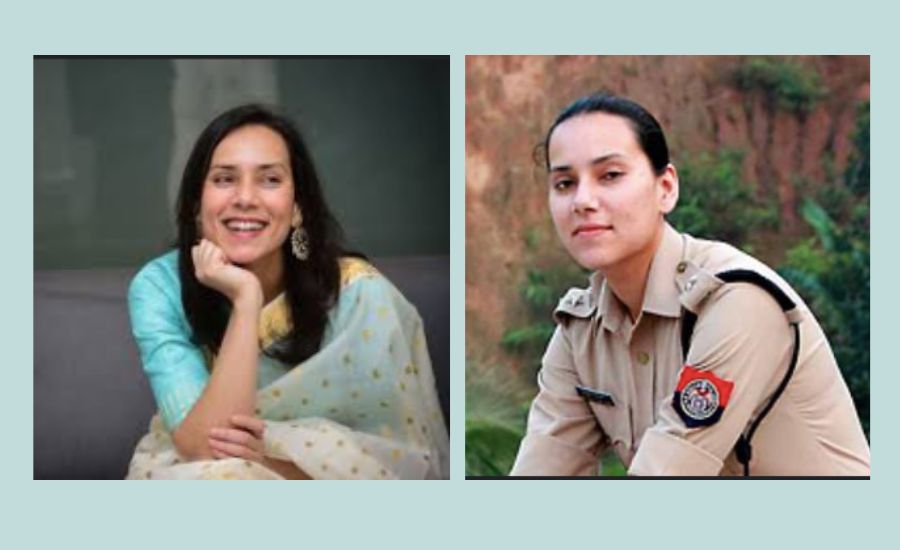
Sanjukta Parashar married IAS officer Puru Gupta, a 2006-batch officer, in 2008.
Both officers have held important administrative responsibilities during their careers. Due to their postings in different districts and locations, they have often had to spend extended periods living and working separately.
The couple has a son.
Her mother, Meena Devi, has played an important role in supporting the family and helping with her son’s upbringing while Parashar pursued demanding professional assignments.
IPS Sanjukta Parashar: Career at a Glance
- Name: Dr. Sanjukta Parashar
- IPS Batch: 2006
- Cadre: Assam-Meghalaya
- Date of Birth: October 3, 1979
- UPSC CSE: 2005
- All India Rank: 85
- Current Position: Inspector General, CRPF, on central deputation
- Previous Major Assignment: National Investigation Agency (NIA), New Delhi
- Major Field Posting: SP, Sonitpur, Assam
- Counter-Insurgency Operations: 16 operations in around 15 months
- Militants Killed: 16
- Insurgents Arrested: 64
- Major Awards: President’s Police Medal for Distinguished Service, Union Home Minister’s Medal for Excellence in Police Training, Rani Gaidinliu Zeliang Award
- Popular Title: “Iron Lady of Assam”
A Career Defined by Field Leadership
From confronting insurgency in Assam’s dense forests to investigating complex national-security cases at the NIA, IPS Parashar’s career has combined frontline policing with intelligence-led investigation.
Her approach has also extended beyond conventional enforcement, with community engagement, public outreach and efforts to encourage young people to move away from insurgency and toward education and mainstream opportunities.
Her appointment as CRPF Inspector General now places her in another key role within India’s internal-security architecture.
For an officer whose career has been defined by leading from the front, the latest assignment marks a significant continuation of her work in the field of national and internal security.
Read also: Who is IPS Viswanadh R? Kerala Cadre Officer Appointed as SP in National Investigation Agency (NIA)