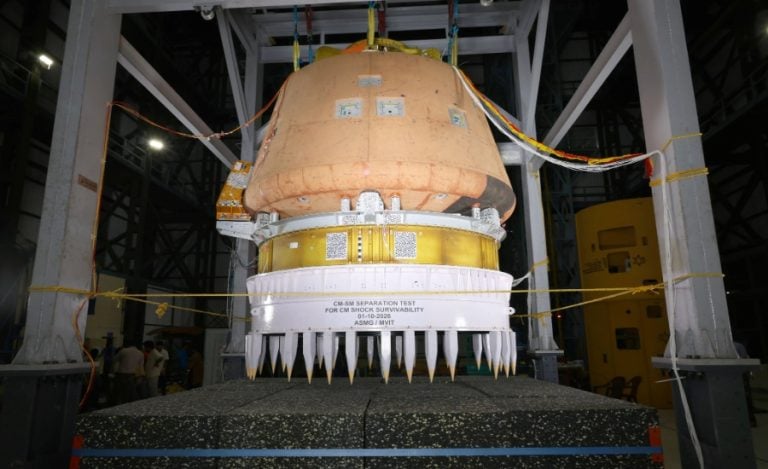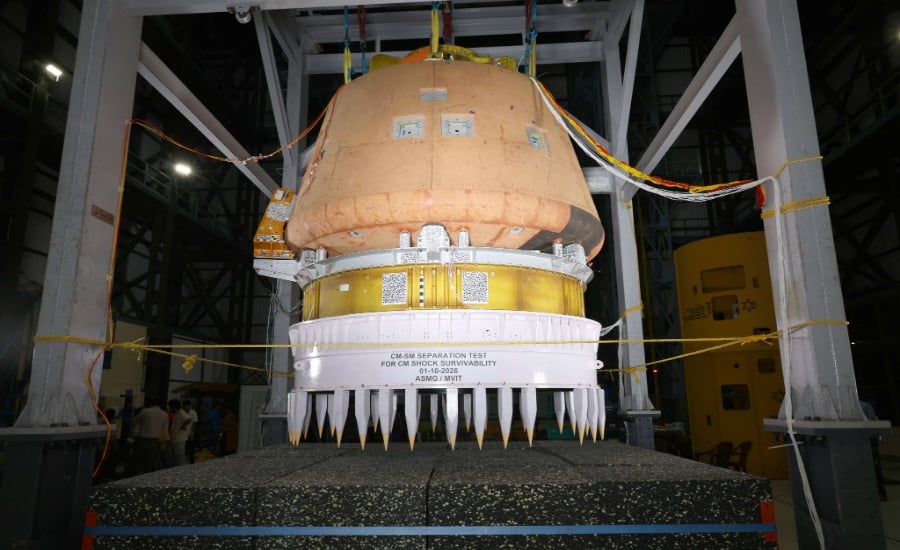
New Delhi: Indian Gaganyaan mission has achieved another important milestone as the Indian Space Research Organisation (ISRO) successfully completed the Gaganyaan Crew Module–Service Module separation tests on October 16, 2026. The tests were conducted at the Vikram Sarabhai Space Centre (VSSC) in Thiruvananthapuram, Kerala.
The successful trials tested a critical system that will help the crew module separate safely before returning to Earth. This development is an important step towards India’s first uncrewed Gaganyaan G1 mission, targeted for launch in 2026.
ISRO Successfully Completes Gaganyaan Separation Tests
ISRO has successfully completed a series of tests to check the separation system connecting the Crew Module (CM) and Service Module (SM) of the Gaganyaan spacecraft.
Read also: What is the ISRO Santulan Programme? How This Non-Tech Space Programme Will Boost Gaganyaan Mission?
The tests aimed to confirm that the two modules can separate properly at the correct stage of the mission. This process is essential for the safe return of the crew module to Earth.
The tests were carried out at VSSC, one of ISRO’s major centres for space technology development. Engineers used a specially designed test setup to simulate the combined structure of the two modules and carefully monitor the separation process.
According to ISRO, the tests confirmed the design adequacy of the separation system and demonstrated that important crew module systems could withstand the shocks produced during separation.
Why Is Crew Module–Service Module Separation Important
The Gaganyaan spacecraft consists of two main parts: the Crew Module and the Service Module. Both modules remain connected during launch and the orbital phase of the mission.
Before the spacecraft begins its return through Earth’s atmosphere, the Crew Module must separate from the Service Module. The Crew Module is designed to carry astronauts and bring them safely back to Earth.
The Service Module supports the spacecraft during its mission by providing essential services and operational support.
If the separation process does not work correctly, it could affect the spacecraft’s safe return. Therefore, ISRO must carefully test the system before attempting a human spaceflight mission.
Tests Check Electrical And Fluid Connections
One of the major objectives of the separation tests was to check the disconnection of the umbilical connections between the Crew Module and Service Module.
These connections carry electrical signals and fluids between the two modules. They support communication and other essential spacecraft functions while the modules remain connected.
During separation, these connections must disconnect cleanly and at the correct time. Any failure could affect the separation process or damage important spacecraft systems.
The tests simulated the separation sequence, including the cutting or release of multiple umbilical connections. This helped engineers assess whether the system could complete the operation as required.
Gaganyaan Separation Test: ISRO Tests Critical Crew Module Systems
The tests also checked the ability of several important Crew Module subsystems to withstand the shocks and vibrations generated during separation.
These systems are necessary for navigation, spacecraft operation, protection from extreme temperatures and other critical functions. The major systems covered during the tests included:
- Avionics Systems: These electronic systems help control and operate the spacecraft.
- Inertial Navigation Systems: These help determine the spacecraft’s movement and orientation.
- Thermal Protection System: The aft and conical heat shields help protect the Crew Module from extreme heat during atmospheric re-entry.
- Crew Module Deployable Umbilical Shield: This system helps protect the relevant area associated with the module’s umbilical connections.
- Crew Module Uprighting System: This system helps position the Crew Module upright after it lands in the sea.
- Thermal And Humidity Control System: This system supports the required temperature and humidity conditions.
The successful tests provide confidence that these important systems can withstand the conditions associated with module separation.
What is Gaganyaan G1 Mission Timeline
The successful separation tests are part of ISRO’s preparations for the first uncrewed Gaganyaan G1 mission, which is targeted for launch in 2026.
Gaganyaan is India’s human spaceflight programme. Its main objective is to demonstrate the country’s ability to send astronauts into low Earth orbit and bring them safely back to Earth.
Before sending astronauts into space, ISRO is working to validate the spacecraft’s design, safety systems and operational procedures through ground tests and uncrewed missions.
The G1 mission is an important part of this preparation. Successful testing of the separation system will help engineers assess the readiness of a critical stage of the mission. However, the separation test is one part of a much larger programme. Other spacecraft systems and mission operations must also meet their required safety and performance standards.
Read also: IAF GSAT-7C Satellite Deal: 5 Ways It Could Strengthen the Indian Air Force
FAQs
The Crew Module must separate from the Service Module before returning through Earth’s atmosphere. This allows the Crew Module to follow its planned return sequence and bring astronauts safely back to Earth.
ISRO successfully tested the Crew Module–Service Module separation system for Gaganyaan on October 16, 2026. The tests checked module separation, the disconnection of umbilical connections and the ability of critical Crew Module systems to withstand separation-related shocks.
ISRO has targeted 2026 for the first uncrewed Gaganyaan G1 mission. The mission is part of the preparation and testing programme for India’s human spaceflight ambitions.