Ranchi: Jharkhand Finance Minister Radhakrishna Kishore has called for stronger financial support to economically weaker states, saying India’s goal of becoming a developed nation by 2047 will require states such as Jharkhand to receive adequate resources for inclusive growth.
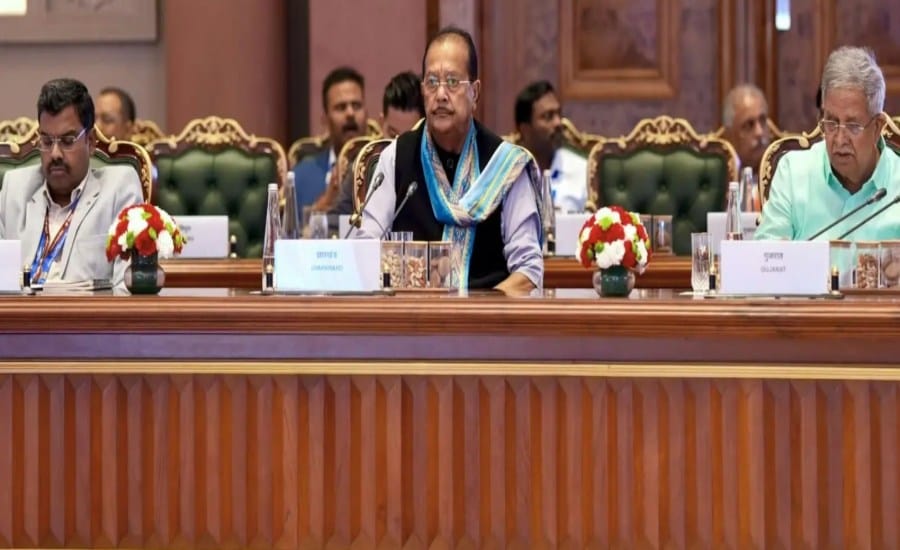
Kishore raised the issue at the two-day conference on ‘Financing the Journey to Viksit Bharat’, organised by the Union Ministry of Finance in New Delhi on September 18 and 19. The conference brought together the Union Finance Minister and finance ministers from states and Union Territories to discuss financial resources and the economic requirements of states.
The Jharkhand minister said the development vision for 2047 should go beyond economic growth and include social inclusion, human development and stronger support for states that face greater development challenges.
Economic Growth Must Reach All Sections
Kishore argued that a developed India cannot be measured only through indicators such as per-capita income, GDP and manufacturing output.
He highlighted the importance of financing, domestic institutional capacity, climate-risk management and fiscal management, along with improvements in health, education and opportunities for different sections of society.
According to the figures cited in his address, India’s annual per-capita income at current prices is around ₹2.05 lakh. While such an average indicates the country’s overall income level, it does not by itself show how income and wealth are distributed across society.
The minister therefore emphasised that economic progress needs to be accompanied by social development so that the benefits of growth reach a wider population.
Read Also: HUDCO Plans Financial Assistance for Jharkhand Power Projects, Focus on Transmission Infrastructure
Focus on Poverty and Rural Economy
Kishore also highlighted the importance of strengthening the rural economy in the run-up to 2047.
The article cited NITI Aayog estimates that 11.28% of the population was below the poverty line in 2022-23, while around 24.8 crore people are estimated to have moved out of poverty between 2013-14 and 2022-23.
For further progress, the minister stressed the need for greater investment in rural infrastructure and agriculture.
Around half of India’s cultivated area depends on rainfall, making irrigation expansion an important part of rural development. He also called for financial support for allied sectors such as dairy, fisheries, animal husbandry and horticulture.
Health and education were another major part of the discussion. Kishore said stronger primary healthcare, higher education and technical education would be necessary to build human resources and ensure that economic development benefits different sections of society.
Why Jharkhand Wants Greater Financial Support
Jharkhand’s position in the discussion was linked to its mineral resources as well as its development requirements.
Kishore argued that economically weaker states need adequate fiscal support if the country is to achieve balanced development by 2047. He said states are an essential part of India’s federal structure and their progress directly contributes to national development.
The minister also raised concerns about the financial impact of recent policy changes on Jharkhand.
According to the claims presented by the state, GST rationalisation and changes associated with the new rural employment framework could result in a combined financial impact of several thousand crore rupees for Jharkhand. Earlier, Kishore had put the impact of GST rationalisation at around ₹4,000 crore and the additional burden from the VB-G RAM G framework at about ₹5,640 crore.
The state has also raised concerns over amendments to the Mines and Minerals (Development and Regulation) Act. Kishore has previously said the amended law could result in a revenue loss of around ₹14,000 crore for Jharkhand and indicated that the state planned to approach the Supreme Court over the matter.
Three Key Demands From Jharkhand
At the conference, three major demands were highlighted for the state.
First, Jharkhand sought restoration of the ability to impose a cess on mining activities, referring to the Supreme Court’s position on states’ taxation powers in the mining sector.
Second, the state sought compensation for the potential financial impact arising from GST rationalisation.
Third, Kishore called for a change in the Centre-State funding pattern under the G-RAM-G scheme for economically weaker states, seeking a 90:10 Centre-State ratio instead of the current 60:40 arrangement cited in the state’s demand.
These demands relate directly to the state’s concern that changes in revenue and expenditure responsibilities could put additional pressure on its finances.
Jharkhand Highlights Its Fiscal Management
Despite raising concerns over financial resources, Jharkhand also highlighted its fiscal performance.
The state’s 2026-27 budget totals ₹1.5856 lakh crore, according to the budget presented in the state Assembly in February.
Kishore has also pointed to the state’s performance on revenue mobilisation, fiscal deficit management, capital expenditure and debt control. The material presented at the conference cited Jharkhand’s inclusion among the leading ‘Achiever’ states in the NITI Aayog Fiscal Health Index 2026, based on 2023-24 indicators.
The state’s 2026-27 budget estimates its fiscal deficit at 2.2% of GSDP, according to the information presented.
A Wider Push for Balanced Development
Jharkhand’s argument at the conference was that achieving Viksit Bharat by 2047 requires reducing financial disparities between states alongside improving national economic indicators.
For Jharkhand, the priorities include strengthening agriculture and irrigation, investing in health and education, protecting the state’s fiscal capacity and ensuring adequate resources for development.
The discussion places state finances at the centre of the broader Viksit Bharat debate, with Jharkhand seeking greater fiscal space to contribute to India’s long-term development while addressing its own economic and social needs.
Read Also: A New Chapter for Jharkhand Schools: 413 Institutions Get PM SHRI Upgrade