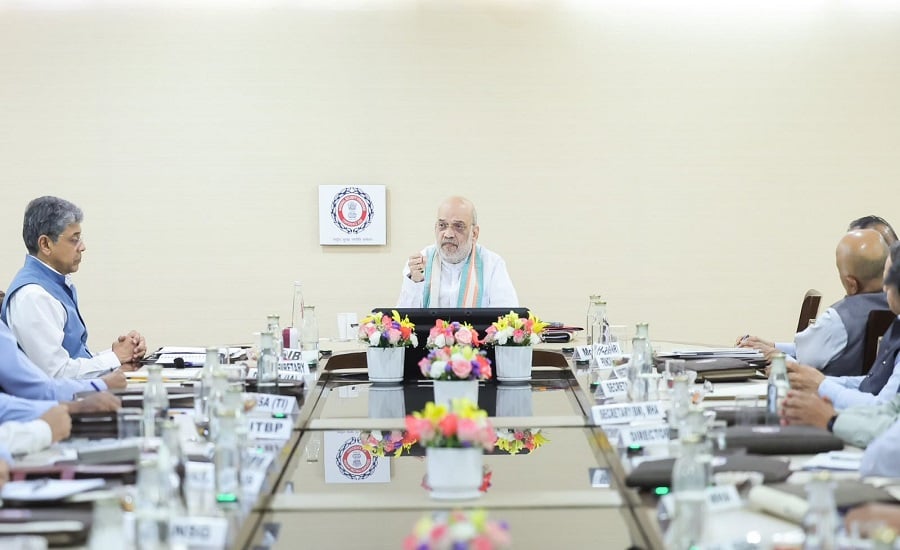
NEW DELHI: Union Home and Cooperation Minister Amit Shah, speaking at the concluding session of the two-day National Security Strategy Conference (NSSC) in New Delhi, called for India to build a proactive and predictive security system capable of identifying emerging threats 15 to 20 years in advance and preventing them from developing into major challenges.
Shah said India’s security strategy must move beyond responding to threats after they have emerged and instead focus on studying national and international trends, identifying early warning signs and taking preventive action.
He said a security challenge becomes considerably more difficult and costly to handle once it assumes serious proportions, making early identification and timely intervention essential to India’s long-term security architecture.
Strong Internal Security Essential for Developed India by 2047
Shah linked India’s long-term security preparedness with Prime Minister Narendra Modi’s goal of making India a developed country by 2047.
He said strong internal security is the first condition for achieving this objective and that India must maintain a stable and secure environment if it is to lead the world across different sectors.
According to Shah, the country’s security policy therefore cannot remain confined to addressing threats that are already visible. It must anticipate potential challenges by closely studying developments within India as well as changing international trends.
The emphasis, he said, should be on building a system that can foresee possible threats well before they become major security challenges.
Read also: National Security Boost: India Expands 83 CAPF Training Network, Approves New Warfare College
NSSC Pushes Predictive Rather Than Reactive Security
Shah said the central message emerging from the National Security Strategy Conference was the need to make India’s security apparatus predictive rather than reactive.
He stressed that responding only after a problem becomes serious is more difficult and expensive, whereas identifying early warning signals and acting on them can prevent threats from escalating.
This approach would require intelligence agencies and security forces to constantly assess emerging developments and identify potential risks across different domains.
The objective is to ensure that security agencies are not merely responding to incidents but are able to anticipate the circumstances that could produce them.
AI Can Accelerate Intelligence, But Human Judgment Remains Critical
Shah also emphasised the importance of AI-led intelligence analysis and pre-emptive action against multi-domain threats.
The growing acceptance of artificial intelligence and advanced analytical tools across India’s intelligence and security establishment has opened up new possibilities for processing large volumes of information and identifying patterns that may otherwise remain difficult to detect.
However, technology alone cannot replace human judgment, particularly at the heart of the intelligence cycle.
The intelligence process is often viewed primarily in terms of information collection. In practice, analysis is one of its most decisive stages, as it is through analysis that raw information is converted into actionable judgment.
The analytical process also creates feedback loops that allow intelligence agencies to assess what worked, identify gaps and refine the next cycle of collection and assessment.
Need to Address Bias and Overconfidence in Intelligence Analysis
The discussion around intelligence effectiveness also underlines the importance of strengthening the analytical capabilities of the Intelligence Bureau (IB).
Human intelligence and analytical functions can be affected by subtle forms of bias and overconfidence. Such weaknesses need not arise from dishonesty but can emerge from insufficient strategic depth, limited domain knowledge or gaps in intelligence tradecraft.
As India moves towards a more predictive security architecture, the challenge will therefore be to combine advanced technology with stronger human analytical capabilities.
AI can accelerate the intelligence cycle by processing information rapidly, but decisions involving complex security threats will continue to require experienced human assessment, contextual understanding and strategic judgment.
Centre-State Coordination Key to Tackling Internal Security Challenges
Shah credited the Centre, state police forces, central agencies and Central Armed Police Forces (CAPFs) with working together to eliminate challenges in three major internal security hotspots.
He said the success achieved in these areas demonstrated the importance of coordination between different layers of India’s security apparatus.
The Home Minister also credited security forces and state police for their role in addressing internal security challenges, while stressing that stronger coordination between the Centre and states can help the country tackle even major and complex security threats.
The emphasis on coordination reflects the need for intelligence, policing, investigation and operational agencies to work together rather than operating in isolated institutional silos.
Amit Shah Calls for ‘Prahar’ to Become Part of Everyday Security Operations
On counter-terrorism, Shah called for the concept of ‘Prahar’ to move beyond being a policy document and become part of everyday policing and security operations.
He called for a 360-degree approach to dismantling terrorist networks, arguing that counter-terrorism cannot be restricted to targeting individual terrorists.
The strategy must instead focus on the entire ecosystem that enables terrorist organisations to survive, operate and expand.
Target Terror Networks, Not Just Terrorists
Shah said counter-terrorism efforts should target every component of a terrorist network, including its funding, logistics, weapons, recruitment, digital networks, sleeper modules and international connections.
A comprehensive approach would therefore require agencies to trace the complete chain supporting terrorist activity rather than limiting operations to those directly involved in attacks.
The focus on financial and logistical networks is particularly important because terrorist organisations depend on wider support systems to acquire resources, recruit personnel, move operatives and maintain operational capabilities.
Similarly, digital networks and international connections can provide terrorist organisations with channels for communication, recruitment, propaganda, financing and coordination.
Security Strategy Must Look 15-20 Years Ahead
The broader message from Shah’s address was that India’s security architecture needs to prepare for threats that may not yet have fully emerged.
Instead of waiting for new challenges to become visible and then developing responses, security agencies need to examine long-term geopolitical, technological, economic and social trends and identify how they could translate into security risks.
The ability to anticipate threats 15 to 20 years ahead, Shah said, should become a central component of India’s national security strategy.
The approach would require continuous intelligence assessment, technological capabilities, human expertise and closer coordination among central and state security agencies.
Towards a More Integrated Security Architecture
The concluding session of the NSSC thus placed emphasis on transforming India’s internal security framework from one that primarily responds to existing threats into one that anticipates and prevents future challenges.
From AI-led intelligence analysis and early-warning systems to human intelligence, strategic assessment, counter-terrorism operations and Centre-state coordination, Shah’s address highlighted the need for an integrated security architecture.
With India’s development ambitions extending to 2047, the Home Minister’s message was that sustained economic and national progress will depend on the country’s ability to maintain a strong internal security environment while anticipating threats long before they become major challenges.
Read also: Japan’s Institutional Investors Eye India’s Next Growth Wave as Piyush Goyal Pushes for More Capital