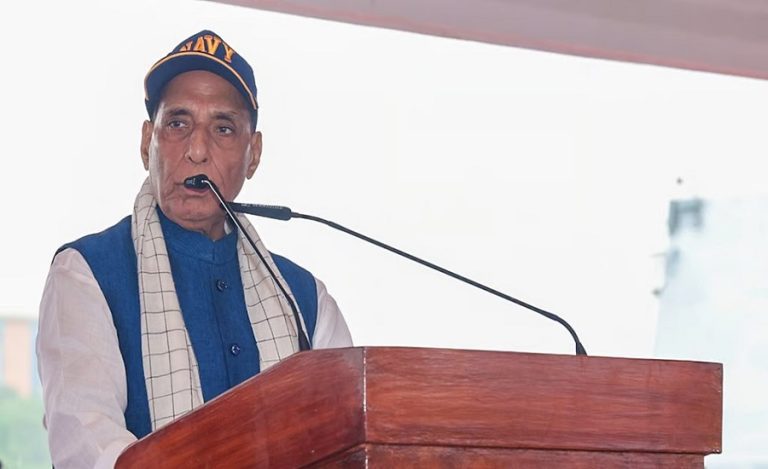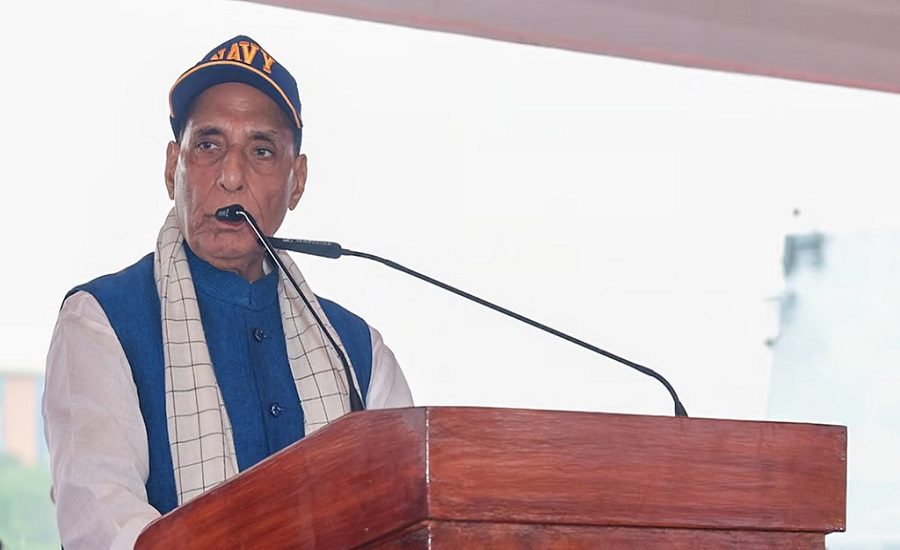
New Delhi: India’s Defence Minister Rajnath Singh has said that Operation Sindoor was stopped “voluntarily” and on India’s own terms, making it clear that the country remains fully prepared for a long war if needed. Speaking at the National Security Summit 2.0, Singh emphasized India’s strong military capability, zero-tolerance policy on terrorism, and refusal to be intimidated by nuclear threats.
His remarks come nearly a year after Operation Sindoor, a key military response to the Pahalgam terror attack, and underline India’s evolving strategic posture on national security.
Operation Sindoor Halted on India’s Own Terms – Rajnath Singh
Rajnath Singh clarified that the decision to stop Operation Sindoor was not due to any limitation in India’s strength. He stated that India had the full capability and readiness to continue the operation for a longer duration, but chose to halt it strategically.
Read also: From Drones to Rafales: How Operation Sindoor Changed Indian Defence Spending Pattern
According to him, India also possesses strong “surge capacity”, meaning the ability to rapidly expand military strength when required.
This statement reinforces that the pause in military action was a calculated strategic move, not a forced decision.
India Prepared for Long War, Military Capacity Stronger Than Before
The Defence Minister highlighted that India’s defence infrastructure has significantly improved.
He pointed out that India’s military-industrial complex is now capable of:
- Supporting both peacetime and wartime needs
- Delivering rapid supplies during emergencies
- Scaling operations quickly during conflict
Singh stressed that India’s defence preparedness is now “even more robust than before.”
India Ignored Pakistan’s ‘Nuclear Bluff’
A key highlight of Singh’s speech was his strong statement on nuclear threats. He revealed that during Operation Sindoor, India was threatened with a nuclear attack, but the government did not take those threats seriously.
According to him:
- India dismissed the nuclear threats as a bluff
- Continued operations based on national interest
- Did not allow intimidation to influence decisions
This reflects a shift in India’s strategic confidence and willingness to act decisively.
‘No Difference Between Terrorists and Their Sponsors’
Rajnath Singh made it clear that India’s policy on terrorism has evolved. He said India now sees no distinction between terrorists and the countries that support them, signaling a tougher stance on global terrorism.
He also credited Prime Minister Narendra Modi for leading a “zero tolerance” policy against terrorism, which has shaped India’s current approach.
Pakistan Called ‘Epicentre of International Terrorism’
In a sharp attack, Singh labeled Pakistan as the “epicentre of International Terrorism.” He contrasted the global image of both countries:
- India is recognized for Information Technology (IT)
- Pakistan, he said, is known for “another IT — International Terrorism”
He also emphasized that terrorism operates in three dimensions:
- Operational
- Ideological
- Political
According to him, tackling terrorism effectively requires addressing all three layers, especially its ideological and political roots.
Operation Sindoor: A Turning Point in India’s Strategy
Operation Sindoor was launched on May 7, 2025, after the deadly Pahalgam terror attack that killed 26 civilians.
Key Developments:
- Indian forces conducted precision strikes
- 9 terror infrastructure sites were destroyed in Pakistan and Pakistan-occupied Jammu and Kashmir
- Pakistan responded with drone attacks and shelling
- India retaliated with strikes near Lahore and Gujranwala
The conflict lasted four days and ended on May 10, 2025, after a ceasefire agreement between both countries’ military leadership.
Rajnath Singh described the operation as a “turning point”, marking India’s shift from reactive to decisive military response.
India’s New Strategic Doctrine After Operation Sindoor
Singh emphasized that India is no longer following the old approach of limiting responses to diplomatic protests after terror attacks.
Instead, the country now:
- Takes direct action when necessary
- Responds strongly to threats
- Holds both terrorists and their backers accountable
He described Operation Sindoor as a symbol of the “new India” in the new global order.