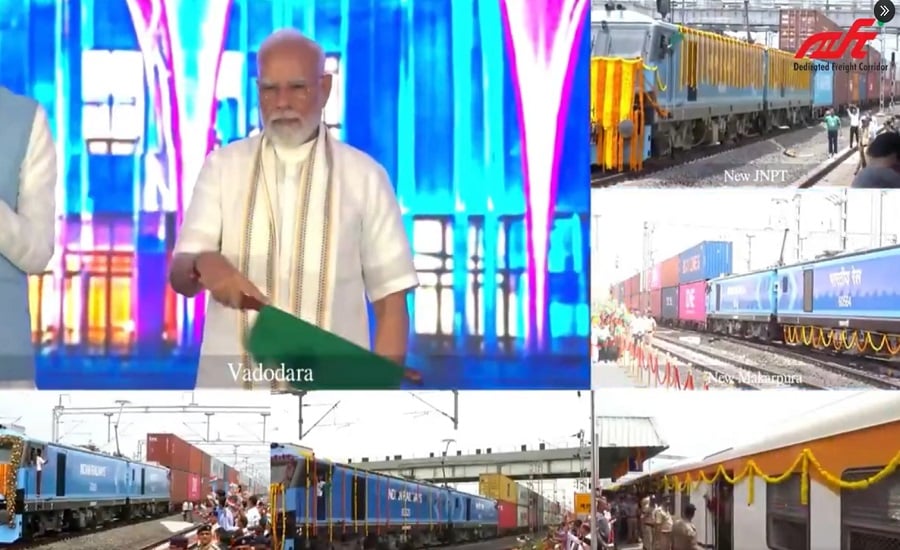
Vadodara: Prime Minister Narendra Modi on Tuesday flagged off freight train services from four strategic stations of the Western Dedicated Freight Corridor (WDFC) and dedicated three key sections of the corridor to the nation, marking a major milestone in India’s freight and logistics infrastructure.
The freight trains were flagged off from:
- New Sanand (North)
- New Makarpura
- New Umbergaon
- New JNPT
The three newly dedicated WDFC sections cover a combined 326 route kilometres and have been developed at a cost of more than ₹20,700 crore.
Three Key WDFC Sections Dedicated to Nation
The sections dedicated by Prime Minister Modi include:
- New Sanand (N)–New Makarpura
- New Umbergaon–New Saphale
- New Saphale–New JNPT
With the commissioning of these stretches, the entire Dedicated Freight Corridor network has become operational across its full length.
The direct connectivity to Jawaharlal Nehru Port is expected to accelerate the movement of export-import cargo, strengthen links between industrial hubs and ports, reduce logistics costs and ease congestion on Mumbai’s railway network.
India’s 2,800-km Dedicated Freight Corridor Network Completed
The Ministry of Railways has developed two major Dedicated Freight Corridors in the country:
- Eastern Dedicated Freight Corridor (EDFC): Ludhiana to Sonnagar, covering around 1,337 km
- Western Dedicated Freight Corridor (WDFC): Dadri to Jawaharlal Nehru Port Terminal (JNPT), covering around 1,506 km
Together, the two corridors span more than 2,800 km.
Addressing the gathering, PM Modi described the completion of the Dedicated Freight Corridor network as a historic achievement for 21st-century India and highlighted its importance for the country’s rapidly developing economy.
PM Modi Highlights Faster Freight Movement
The Prime Minister said the separation of freight traffic from passenger railway lines has significantly improved the efficiency of India’s rail logistics network.
Dedicated freight infrastructure enables goods trains to operate with fewer constraints, helping reduce transit time and improve reliability.
The faster movement of freight is also expected to:
- Reduce fuel consumption
- Lower logistics and transportation costs
- Cut the environmental impact of freight movement
- Improve supply-chain efficiency
- Strengthen connectivity between industrial centres and ports
The Prime Minister noted that the project, which was initially conceived in 2006, faced delays for several years before gaining momentum over the past decade.
DFCs Handle Over 440 Freight Trains Daily
The Dedicated Freight Corridors have steadily increased their operational contribution to India’s freight transportation system.
According to the information shared, the two corridors together handle an average of around 443 trains every day, with freight volumes rising alongside improvements in average speeds, turnaround times and operational reliability.
The DFC network has also released additional capacity on conventional railway routes by shifting freight traffic to dedicated corridors. This allows Indian Railways to operate more passenger and freight services on the existing network.
Indian Railways Freight Loading Reaches 1,670 MT
The expansion of dedicated freight infrastructure has coincided with a sustained rise in Indian Railways’ freight loading.
- 2014-15: 1,098 MT
- 2015-16: 1,104 MT
- 2016-17: 1,109 MT
- 2017-18: 1,162 MT
- 2018-19: 1,223 MT
- 2019-20: 1,210 MT
- 2020-21: 1,233 MT
- 2021-22: 1,418 MT
- 2022-23: 1,512 MT
- 2023-24: 1,591 MT
- 2024-25: 1,617 MT
- 2025-26: 1,670 MT
Indian Railways’ freight loading reached 1,670 million tonnes in 2025-26, making it the second-largest freight-carrying railway system in the world.
Indian Railways’ freight loading reached 1,670 million tonnes in 2025-26, making it the second-largest freight-carrying railway system in the world.
Double-Stack Trains and Heavy Freight Operations Get Boost
The Dedicated Freight Corridors are facilitating greater movement of Double Stack Container (DSC) trains and higher axle-load freight trains.
The infrastructure also provides faster access from India’s northern hinterland to western ports, improving the movement of goods over long distances.
The WDFC’s direct connection with JNPT is particularly significant for EXIM cargo, as it can facilitate faster movement between ports and industrial centres.
New DFC Planned Between Dankuni and Surat
The government’s focus on dedicated freight infrastructure is set to expand further.
The Union Budget 2026 announced a new Dedicated Freight Corridor connecting Dankuni in the east with Surat in the west.
Work on preparing or updating the Detailed Project Report (DPR) for the proposed corridor has already started.
The planned expansion is expected to further strengthen India’s freight network and improve east-west connectivity.
Indian Railways Strengthens Freight Logistics
Indian Railways has adopted a multi-pronged strategy to improve freight transportation, strengthen regional connectivity and increase its share in India’s overall freight movement.
Major initiatives include:
Gati Shakti Multi-Modal Cargo Terminals
Railways is promoting modern freight terminals under the Gati Shakti Multi-Modal Cargo Terminal (GCT) policy while also upgrading and expanding railway-owned goods sheds.
Wagon Investment Schemes
Several schemes have been introduced to encourage private-sector investment in wagons.
These include specialised wagons designed for commodities such as:
- Cement
- Oil
- Steel
- Fly ash
Joint Parcel Product-Rapid Cargo Service
The Joint Parcel Product-Rapid Cargo Service (JPP-RCS) scheme aims to provide customised logistics solutions based on customer requirements, including door-to-door parcel services.
The initiative also provides for online booking of parcel space through aggregators, in addition to India Post, through the Virtual Aggregation Platform (VAPI).
CONCOR Expands Door-to-Door Freight Services
Container Corporation of India (CONCOR), a PSU under the Ministry of Railways, is using the JPP-RCS framework to provide door-to-door parcel services.
CONCOR is providing such services on the Delhi-Kolkata and Mumbai-Kolkata sectors.
The company is also operating a pilot project at Sonik Goods Shed to provide door-to-door logistics services.
New Passenger Train to Connect Tribal Regions
Alongside the freight corridor initiatives, PM Modi also flagged off a new passenger train service between Tanda Road and Vadodara.
The service will improve rail connectivity for remote tribal regions, including Alirajpur, and connect them more closely with the national rail network.
The Prime Minister highlighted the expansion of railway connectivity to regions that had remained without rail services for decades.
₹9,700 Crore Railway Projects and ₹1,780 Crore Highway Projects
During the programme, PM Modi also laid the foundation stones for three railway expansion projects worth more than ₹9,700 crore.
In addition, foundation stones were laid for three National Highway projects costing around ₹1,780 crore.
The projects are aimed at:
- Easing traffic congestion
- Improving regional connectivity
- Strengthening transport infrastructure
- Supporting faster movement of people and goods across Gujarat and Madhya Pradesh
Gujarat Government Projects Worth ₹2,600 Crore
The Prime Minister also launched various civic and infrastructure projects of the Gujarat Government worth around ₹2,600 crore.
These include projects such as the megawatt-scale floating solar plant at Kadana Dam and Pradhan Mantri Awas Yojana (PMAY) housing units.
The projects are part of the broader infrastructure and development push in Gujarat.
PM Modi Highlights ‘Chip to Ship’ Manufacturing Vision
In his address, PM Modi also highlighted India’s growing manufacturing capabilities.
He said India has emerged as a global manufacturing hub and is now producing advanced railway and metro coaches domestically.
According to the Prime Minister, India has added more than:
- 50,000 modern railway coaches
- 2.5 lakh wagons
to the Indian Railways network.
He outlined the vision of “Chip to Ship” domestic production, emphasising the creation of a self-reliant supply chain spanning high-tech electronics to heavy maritime manufacturing.
Focus on Energy Infrastructure and AI
PM Modi also highlighted the government’s focus on solar, nuclear and wind energy, stressing that a robust energy ecosystem will be essential for India’s future growth.
He said emerging technologies such as artificial intelligence (AI) and upcoming industries will require reliable power infrastructure.
The government is therefore focusing on developing a multi-sectoral energy ecosystem to support India’s technological and industrial ambitions.