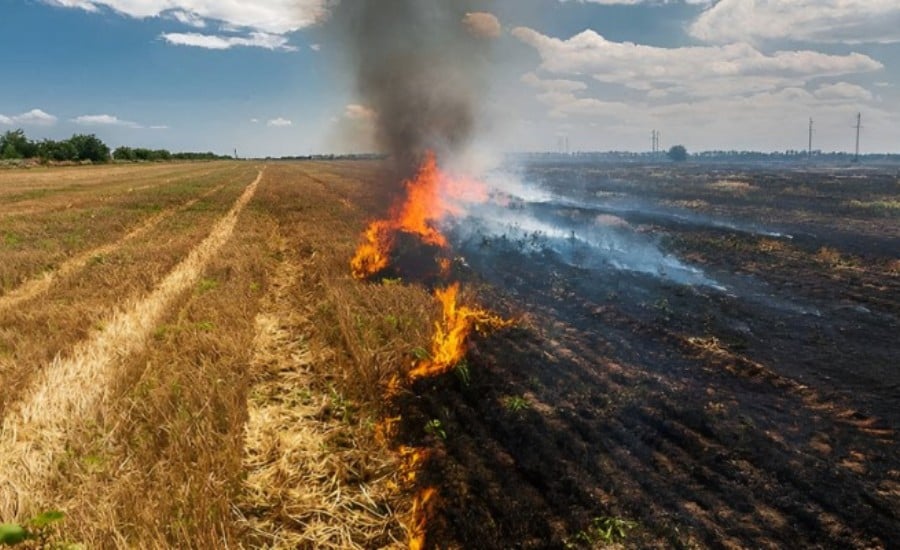
Chandigarh: The Punjab government has prepared and submitted a ₹26.31-crore action plan to the Commission for Air Quality Management (CAQM) to prevent and eliminate stubble burning during the 2026 Kharif season.
The plan places emphasis on farmer awareness, crop-residue management, community participation and communication campaigns across the state. The move comes as Punjab prepares for the paddy harvesting season, with the state seeking to address localised instances of crop-residue burning.
CAQM has separately directed Punjab, Haryana and Uttar Pradesh to implement time-bound action plans for preventing and eliminating stubble burning during 2026. Its May review also called for stronger information, education and communication activities, timely availability of Crop Residue Management machinery and coordinated action at the district level.
₹26.31-Crore Plan Covers Awareness and Residue Management
The state’s proposed allocation includes:
- ₹3.34 crore for Punjab Agricultural University for training and NSS-related activities
- ₹6 crore for the Information and Public Relations Department for print, television, radio and outdoor publicity
- ₹4.98 crore for Information, Education and Communication (IEC) activities
- ₹50 lakh for an SMS campaign
- ₹30 lakh each for social media and content creation
- ₹50 lakh for recognising panchayats, Farmer Producer Organisations (FPOs) and Primary Agricultural Cooperative Societies (PACS)
- ₹60 lakh for demonstrations
- ₹6 crore for bio-decomposer-related activities
- ₹45 lakh for training and stakeholder conferences
- ₹2 crore for activities through the Project Management Unit (PMU)
- ₹1.33 crore for new initiatives
Read Also: Punjab: Mohali Approves 300 TPD CBG Plant at Samgauli to Process Wet Waste from 9 Urban Bodies
Awareness Drive Across 151 Blocks
The IEC component will cover 151 blocks across all 23 districts of Punjab.
The awareness programme will include:
- Field demonstrations on crop-residue management
- Village- and block-level awareness camps
- Publicity through print, television, radio and outdoor media
- Essay, debate and painting competitions in schools
- Publicity vans and printed information material
- Street plays (nukkad nataks)
- Meetings with village sarpanches
- Social media and digital communication
- Identification of 10 progressive farmers per block
- Involvement of ASHA workers in village-level outreach
Focus on Crop Residue Management
The state’s strategy seeks to promote both in-situ and ex-situ crop-residue management and improve awareness about the availability and use of CRM machinery and Custom Hiring Centres (CHCs).
The plan also seeks to communicate the economic and agronomic benefits associated with crop-residue management, including soil-health benefits, timely sowing of wheat and better utilisation of available machinery.
Community Participation and Behavioural Change
The awareness strategy places emphasis on farmer-oriented communication, peer learning, field demonstrations and local examples.
Panchayats, FPOs, PACS, educational institutions and local communities are proposed to be involved in the campaign to encourage alternatives to stubble burning.
CAQM’s 2026 preparedness review has also emphasised strengthened IEC activities, crop-residue management and coordinated action by Punjab and other states to prevent stubble-burning incidents.
Punjab’s Stubble-Burning Challenge
CAQM data has recorded a substantial decline in paddy stubble-burning incidents in Punjab over recent years. Its annual report noted that reported cases fell from 83,002 in 2020 to 10,909 in 2024.
The 2026 plan identifies operational constraints, behavioural patterns and delays in timely paddy-straw management among factors associated with continued localised burning.
The Punjab government has submitted the ₹26.31-crore plan to CAQM as part of preparations for the 2026 Kharif season.
Read Also: Punjab Completes 17,000 PMAY-G Houses, Work on 19,792 More Underway