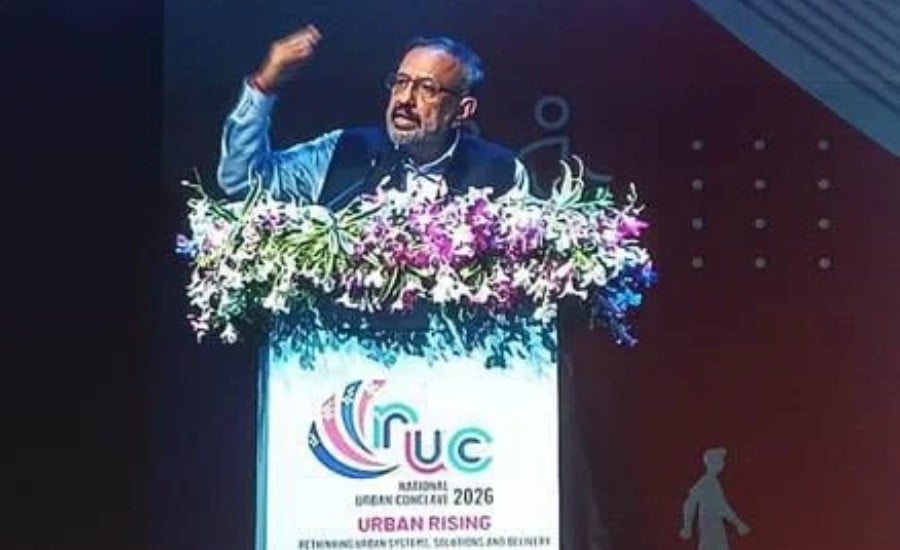
New Delhi: NITI Aayog Member Rajiv Gauba, a 1982-batch IAS officer of the Jharkhand cadre, has called for comprehensive reforms in urban governance, planning and financing, arguing that cities need greater decision-making powers to manage rapid urbanisation and contribute to India’s economic growth.
Addressing the valedictory session of the 2nd National Urban Conclave, Gauba said cities could not be governed effectively from state capitals and stressed the need to strengthen urban local bodies. He called for directly elected mayors with five-year terms, timely municipal elections and the transfer of responsibilities to city governments.
His address focused on the institutional and financial changes needed to prepare Indian cities for a growing urban population and achieve the vision of Viksit Bharat 2047.
India’s Urban Population Expected to Reach 85 Crore by 2050
Gauba highlighted the scale of India’s demographic transition, noting that the country’s population is expected to continue growing for several decades before stabilising at around 165 crore by 2060.
Read Also: NITI Aayog’s Rajiv Gauba Calls for Risk-Based, Light-Touch Regulation to Support Innovation
With nearly half of the population projected to live in urban areas by 2050, India’s urban population could increase from approximately 50 crore at present to 85 crore. This growth will require substantial planning for housing, infrastructure and essential public services.
He emphasised that cities are important centres of economic activity, bringing together talent, investment and ideas. Their ability to support economic growth, however, depends on effective governance and adequate infrastructure.
Directly Elected Mayors and Greater Powers for City Governments
Gauba stressed that urban local bodies need greater authority and institutional capacity to respond to the needs of residents.
Referring to the report Moving Towards Effective City Governance, jointly prepared by NITI Aayog and the Ministry of Housing and Urban Affairs (MoHUA), he called for reforms to strengthen municipal institutions.
Key proposals highlighted in his address include:
- Directly elected mayors: Introduce a system in which mayors are directly elected for five-year terms.
- Mayor-in-Council system: Adopt a governance structure that strengthens executive leadership and accountability within municipal governments.
- Timely municipal elections: Ensure that elections to urban local bodies take place on schedule.
- Transfer of responsibilities: Devolve all 18 functions envisaged under the 74th Constitutional Amendment to urban local bodies.
- Greater local authority: Enable city governments to make decisions on matters affecting their residents rather than depending excessively on state-level authorities.
The 74th Constitutional Amendment provides the framework for strengthening urban local self-government. The functions listed in the Twelfth Schedule include urban planning, regulation of land use, water supply, public health, fire services and other municipal responsibilities.
Gauba argued that meaningful decentralisation would improve service delivery and give citizens a stronger role in local decision-making.
Municipal Finance Reforms Needed to Strengthen Urban Local Bodies
The NITI Aayog Member also highlighted the limited revenue base of many municipal bodies and called for improvements in property tax collection and user-charge recovery
He pointed to the need for more predictable financial transfers from state governments to urban local bodies, alongside support from the Centre.
According to the figures cited in his address, the share of Central Finance Commission grants allocated to urban local bodies has increased from 36% to 45%, with the overall allocation more than doubling compared with the previous provision. However, he noted that the devolution of funds from states to cities remains limited.
He called for State Finance Commissions to be constituted regularly and for adequate fiscal transfers to municipal governments.
The proposed measures aim to improve the ability of cities to finance public services and carry out their assigned responsibilities.
₹1 Lakh Crore Urban Challenge Fund to Support City Growth Hubs
Gauba also referred to NITI Aayog’s Growth Hub initiative and recent budgetary measures aimed at developing cities as centres of economic activity.
The initiatives highlighted during his address include:
- Urban Challenge Fund: A ₹1 lakh crore fund announced in the Union Budget 2025–26 to support urban development through a challenge-based approach.
- City Economic Regions: The Union Budget 2026–27 provided for an allocation of ₹5,000 crore each for seven City Economic Regions over five years.
- Urban transport investment: Investments of approximately ₹3.7 lakh crore have been made in metro rail and bus systems, according to the figures cited by Gauba.
He also referred to major urban programmes introduced in recent years, including the Smart Cities Mission, Atal Mission for Rejuvenation and Urban Transformation (AMRUT), Pradhan Mantri Awas Yojana, Swachh Bharat Mission and the Urban Livelihoods Mission.
Gauba noted that budgetary support for the urban sector had increased significantly, but stressed that investment must be accompanied by reforms in city governance and planning.
Urban Planning Reforms to Improve Housing Affordability
Gauba called for changes to existing urban planning practices, particularly regulations that restrict the availability of land for housing and commercial development.
He identified restrictive floor area ratios (FARs) and building norms as issues requiring attention, arguing that such constraints can limit land supply and increase costs for residents and businesses.
The planning reforms highlighted in his address include:
- Revisiting FAR and building regulations: Review restrictive norms that constrain development.
- Mixed-use zoning: Allow compatible residential, commercial and other uses within designated areas.
- Transit-oriented development: Encourage development around public transport hubs.
- Land pooling: Combine land parcels for planned development and improved infrastructure provision.
These measures were presented as ways to expand the supply of land for housing and economic activities while improving the organisation of urban growth.
Model Tenancy Act Proposed to Expand Rental Housing
Gauba also emphasised the importance of affordable rental accommodation for migrant workers, industrial labourers, students and young professionals.
He urged state governments to adopt the Model Tenancy Act, which provides a framework for regulating rental housing arrangements and defining the rights and responsibilities of landlords and tenants.
Expanding rental housing is an important part of accommodating people who move to cities for work, education and other opportunities, he said.
States Urged to Introduce Municipal Reforms
Concluding his address, Gauba called on state governments to implement the proposed changes through new or revised municipal legislation.
He also urged the Ministry of Housing and Urban Affairs to link support under urban missions with the implementation of governance reforms.
His central message was that cities need empowered municipal institutions, adequate financial resources and greater authority over local planning and service delivery. Such reforms, he said, are essential for strengthening urban economies and advancing the broader goals of Viksit States and Viksit Bharat by 2047.
Read Also: NITI Aayog’s Rajiv Gauba Calls for Risk-Based, Light-Touch Regulation to Support Innovation