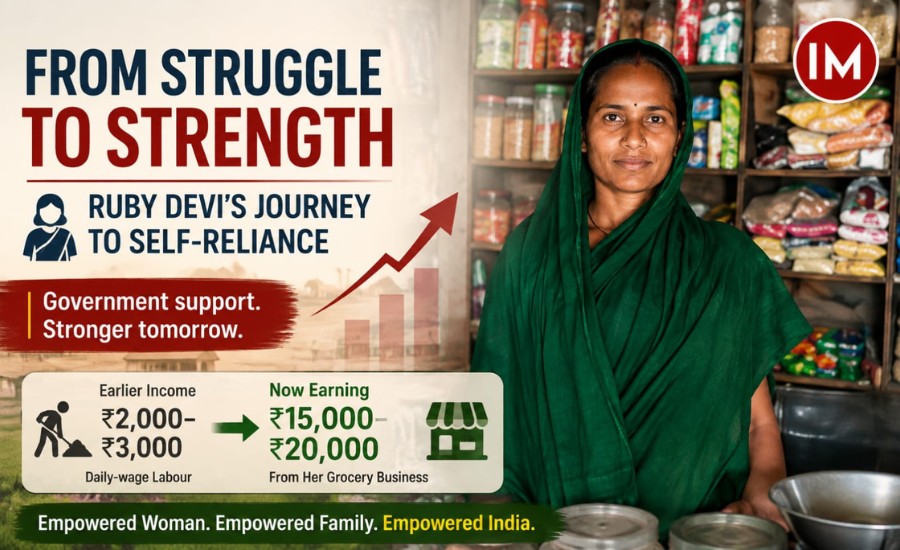
Patna: A combination of livelihood assistance, business training and government welfare support has helped Ruby Devi, a 32-year-old woman from Karanpura village in Vaishali district, Bihar, move from daily-wage labour to running her own grocery and general store.
Ruby, who studied up to Class 8, earlier earned around ₹2,000–₹3,000 a month as a daily-wage worker. She is now earning approximately ₹15,000–₹20,000 per month from her business.
From Financial Hardship to Running Her Own Store
Ruby was left to manage her household and two children after her husband, Ram Krish Chaudhary, died in 2016 following an illness.
Read Also: Bihar Clerk Tushar Kumar Wins Bronze at Commonwealth Fencing Championship 2026
Her financial situation had become difficult, with meeting basic household expenses and supporting her children’s education proving challenging.
Her circumstances began to change after she was selected during a Sustainable Livelihood Scheme (SJY) drive.
Support received through various interventions included:
- ₹10,000 in SIF support from Pragati JEEViKA Mahila Gram Sangathan.
- Grocery shop assets worth ₹20,000 and ₹27,000 through the purchasing committee.
- ₹7,000 in LGF support, provided at ₹1,000 per month for seven months.
- ₹17,000 under the PM-AJAY scheme.
- ₹10,000 under the Mukhyamantri Mahila Rozgar Yojana.
- Three refresher training sessions after her initial business training.
Before receiving business assets, Ruby also underwent a three-day CBED training focused on running and managing the shop.
Income Rises to ₹15,000–₹20,000 a Month
The livelihood intervention has been accompanied by a substantial increase in Ruby’s reported monthly income.
Before joining SJY:
- Earned around ₹2,000–₹3,000 per month through daily-wage labour.
- Did not have a bank account.
- Had no independent grocery business.
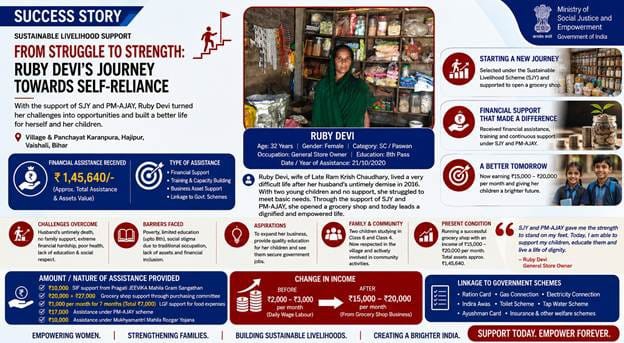
After establishing the business:
- Earns approximately ₹15,000–₹20,000 per month.
- Runs a grocery and general store.
- Developed a habit of regular savings, initially saving ₹10 every day.
Her present assets are valued at approximately ₹1.45 lakh, according to the government. She initially started saving ₹10 a day after her financial situation improved.
Children’s Education and Welfare Access
The improvement in household income has also enabled Ruby to support her children’s schooling. Both children currently attend government schools, with one studying in Class 6 and the other in Class 4.
Ruby has also been linked with several government welfare services, including:
- Ration card
- Ayushman card
- LPG connection
- Electricity connection
- Indira Awas
- Toilet and tap-water schemes
- Insurance benefits
She also participates in social and community activities through her association with Sangam JEEViKA Gram Sangathan.
From Social Exclusion to Community Recognition
According to the government, Ruby’s improved economic circumstances have also changed her standing within the village. She had earlier faced social exclusion because of her husband’s traditional occupation of toddy selling.
Her business and participation in community activities have since earned her greater recognition, with villagers now addressing her as “Ruby Didi” and inviting her to local events.
Ruby now aims to expand her grocery business and build a larger, more stable enterprise while creating better opportunities for her family.
Read Also: Bihar’s Sasaram Gets 4G Push Under DBN, 149 Towers Planned Across Kaimur and Rohtas