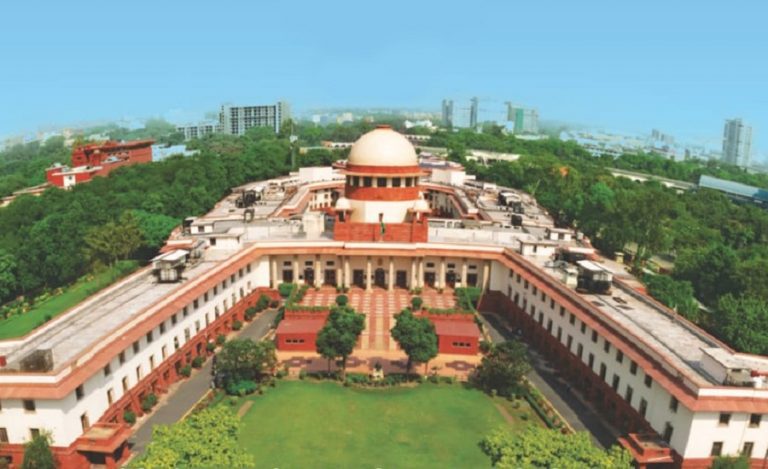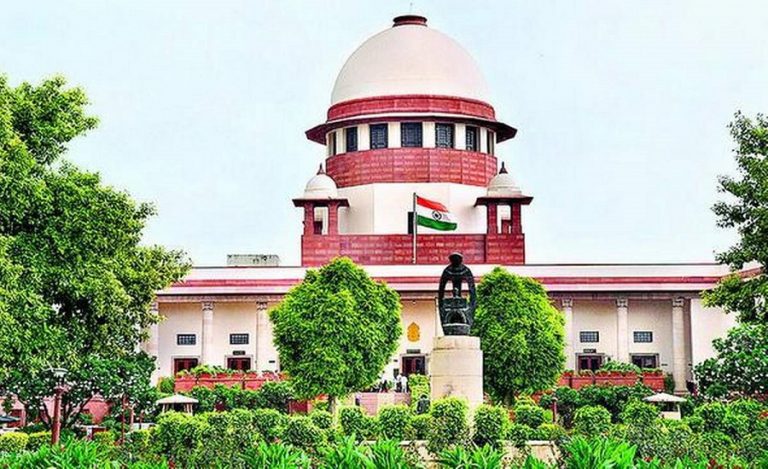
New Delhi/Vijayawada — In a significant legal development with major implications for anti-corruption enforcement in Andhra Pradesh, the Supreme Court of India on January 8, 2026, set aside a controversial Andhra Pradesh High Court judgment that had quashed several corruption-related FIRs.
The apex court restored the investigations by the Anti-Corruption Bureau (ACB) and sharply criticised the High Court’s interpretation of procedural law, calling it a “travesty of justice.”
Details of Supreme Court ACB Investigation Restoration
A two-judge bench comprising Justices M. M. Sundresh and Satish Chandra Sharma presided over the appeals.
Read also: Andhra Pradesh High Court Cancels Default Bail of IAS Officer and Others in ₹3,500 Crore Liquor Scam
They were hearing Special Leave Petitions (SLPs) filed by the Anti-Corruption Bureau (ACB) of Andhra Pradesh and other parties aggrieved by the High Court’s order delivered in August of last year.
What the Andhra Pradesh High Court Had Ruled
In its earlier judgment, the Andhra Pradesh High Court had quashed multiple First Information Reports (FIRs) registered by the ACB under the Prevention of Corruption Act (PC Act) between 2016 and 2020.
The basis of the ruling was a narrow technical interpretation: the court held that the ACB’s Central Investigation Unit (CIU) in Vijayawada lacked jurisdiction to register FIRs because it was not formally notified as a “police station” under Section 2(s) of the Code of Criminal Procedure (CrPC) after the bifurcation of the state in 2014.
This reasoning effectively halted investigations and, in several instances, brought criminal proceedings to a premature end, prompting legal and public interest concerns about the future of corruption probes.
Supreme Court’s Reversal: Substance Over Technicality
“Travesty of Justice” — Supreme Court’s Stark Words
The Supreme Court emphatically rejected the High Court’s approach. The bench described the quashing of FIRs on such narrow grounds as a “travesty of justice” and said it risked undermining substantive anti-corruption efforts.
> “If, on a hyper-technical ground, the FIRs are quashed, the High Court is duty-bound to lay down the law with respect to the jurisdiction that otherwise exists.” — Supreme Court order
Legal Interpretation: CrPC Section 2(s) and Law Continuity
The apex court clarified that under Section 2(s) CrPC, a “police station” can include a post or place where public servants exercise jurisdiction, and does not require formal gazette notification for every procedural change following state reorganisation.
Moreover, applying provisions of the Andhra Pradesh Reorganisation Act, 2014, the bench held that extant laws and notifications issued prior to the bifurcation continue to hold effect until expressly amended or repealed.
This included the 2003 government order that recognised ACB offices as police stations statewide, which continued to govern the ACB’s functions post-bifurcation.
The bench also underscored that the 2022 clarificatory order reaffirming the jurisdiction of ACB’s Vijayawada unit merely clarified existing law rather than creating new powers — a point the High Court had misinterpreted.
What Happens Next in the Supreme Court ACB Investigation Restoration Case
After setting aside the High Court’s order, the Supreme Court:
- Restored all quashed FIRs, effectively reviving the anti-corruption investigations.
- Allowed the ACB to continue investigations under the Prevention of Corruption Act.
- Directed the ACB to file final investigation reports within six months.
- Barred coercive steps — including arrests — during the ongoing investigation period.
- Prohibited the Andhra Pradesh High Court from entertaining further challenges on identical jurisdictional grounds.
- Clarified that the respondents (accused) may still challenge charge sheets on other legal grounds after investigations conclude.
What are the Implications of Supreme Court ACB Investigation Restoration
The verdict is widely seen as a boost to anti-corruption efforts in Andhra Pradesh and beyond. It reinforces the judiciary’s insistence that technical procedural arguments should not frustrate the enforcement of substantive statutes like the Prevention of Corruption Act.
Legal analysts suggest that the Supreme Court’s stand affirms the principle that justice must not be derailed by excessive formalism, especially in public interest cases.
It also sets a precedent against similar jurisdictional challenges based solely on gazette notifications, potentially impacting future corruption and economic offence cases nationwide.
Read also: Hazaribag Land Scam: IAS Officer Vinay Chaubey Officially Declared Accused by Anti-Corruption Bureau