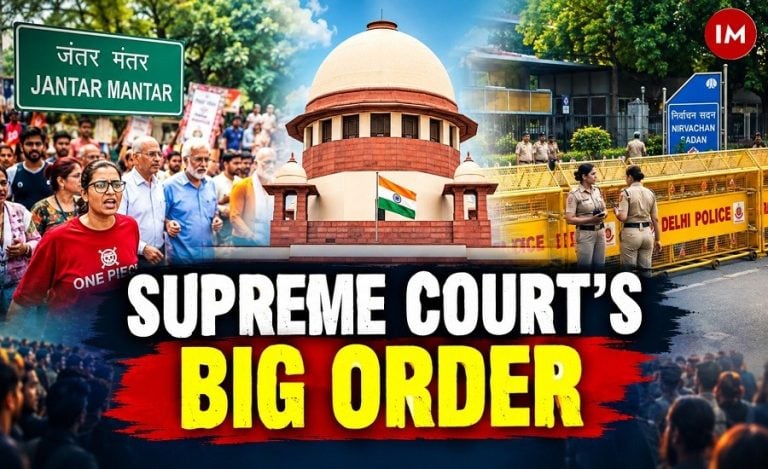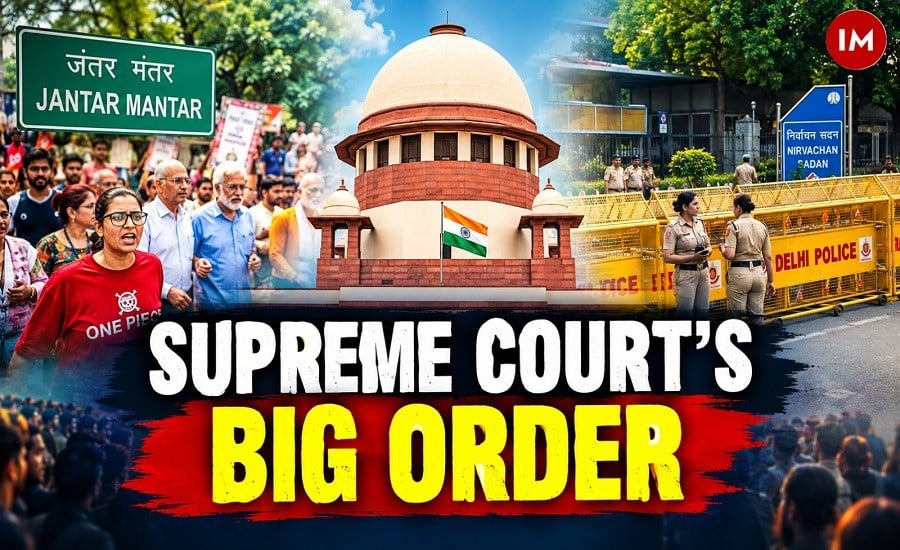
New Delhi: The Supreme Court has issued significant directions concerning restrictions imposed across Delhi during protests at Jantar Mantar, ordering the removal of city-wide barricades, restoration of normal public movement and uninterrupted internet connectivity, subject to genuine public-order concerns.
The directions came during hearings on four petitions questioning the detention of political leaders, lawyers, journalists and ordinary citizens, alleged police excesses, restrictions on Metro and railway services, and the use of phone jammers.
The proceedings also witnessed tense exchanges between lawyers and police personnel, allegations of assaults on advocates, concerns over restrictions near the Supreme Court premises and questions about compliance with the Court’s earlier directions issued on October 9.
Justice Bagchi sought explanations from the authorities regarding the restrictions and detentions, while directing concerned officials to respond to allegations of non-compliance with the Court’s previous order.
Supreme Court Orders Removal of Barricades, Normal Metro Services and Internet Connectivity
During the hearing, the Supreme Court directed authorities to remove barricades imposed across Delhi and ensure that movement within the city returned to normal.
The Court also directed that Delhi Metro services operate according to their regular schedule and that internet connectivity be maintained.
It emphasised that restrictions on public movement should not continue unnecessarily, although authorities could take appropriate measures if a genuine public-order situation arose.
The Court further directed that lawyers must not be obstructed while carrying out their professional duties.
The Centre was asked to submit responses to the petitions challenging the restrictions and detentions.
Supreme Court Issues Show-Cause Notice Over Alleged Violation of October 9 Order
A major development during the proceedings concerned allegations that authorities had failed to comply with the Supreme Court’s October 9 directions.
The Court issued show-cause notices to the concerned officials, asking them to explain why contempt proceedings should not be initiated.
Solicitor General Tushar Mehta objected to the move.
Justice Bagchi responded by clarifying that there was a distinction between issuing a show-cause notice and issuing a contempt notice.
The Court directed the officials concerned to file affidavits explaining their actions and responding to the allegations of non-compliance.
It also sought responses concerning the contempt petitions and the habeas corpus petitions filed in connection with the detentions.
The Court recalled that its earlier order had required authorities to reconsider the proposed closure of 57 Metro stations, widely publicise any revised decision, issue a fresh traffic advisory and submit a compliance report by Tuesday.
The matter was directed to be heard again on Tuesday, despite the Solicitor General’s request for time until Wednesday.
Why Were 45 Delhi Metro Stations Restricted? Supreme Court Seeks Map From DMRC
The restrictions imposed on Delhi Metro services became a central issue during the hearing.
The Court sought a detailed map from the Delhi Metro Rail Corporation (DMRC) identifying stations where entry and exit points had been closed or restricted.
Justice Bagchi questioned why restrictions had ultimately been imposed on 45 stations when the initial proposal concerned 57 stations.
The Court said it needed to examine which stations were affected, which remained accessible and how the restrictions influenced commuter movement.
Solicitor General Tushar Mehta informed the Court that entry and exit restrictions had been imposed at only 45 of the Delhi Metro’s 303 stations.
He maintained that Metro operations had not been curtailed and that services continued according to their regular schedule.
According to Mehta, 7,981 train trips had been completed, while stations near those affected remained operational.
He also informed the Court that all Metro stations had reopened by 10 PM the previous night.
The Court separately sought information about whether any advisory had been issued to the Railways.
Section 163 Outside Supreme Court Raises Serious Questions
The imposition of Section 163 outside the Supreme Court premises prompted sharp objections from several advocates.
Senior Advocate Gopal Sankaranarayanan informed the Court that a board announcing the restrictions had been displayed on Bhagwan Das Road.
He said barricades had been erected outside the Supreme Court and that access to the High Court was also being restricted.
Lawyers alleged that some advocates were prevented from entering the court premises even when they had no intention of participating in the protest.
The President of the Supreme Court Advocates-on-Record Association raised concerns that lawyers had not been informed about the restrictions and that some had allegedly been detained directly from their chambers.
Solicitor General Tushar Mehta stated that the Supreme Court was situated within the area covered by the Section 163 restrictions.
However, when questioned about the specific circumstances of their enforcement, he said he did not have complete information and would obtain the necessary details.
Justice Bagchi observed that there was a difference between imposing restrictions around sensitive government establishments and enforcing those restrictions in a manner that interfered with legitimate activities.
The Court also remarked that failure to provide adequate notification could constitute grounds for challenging or quashing the Section 163 order.
Kapil Sibal Raises Right to Peaceful Protest Under Article 19
Senior Advocate Kapil Sibal argued that citizens must be allowed to exercise their constitutional right to peaceful protest.
Referring to Article 19(1)(a) of the Constitution, he said that a designated location for demonstrations existed at Jantar Mantar, yet people were allegedly being prevented from reaching it.
Sibal argued that restrictions imposed in the name of public order should not exceed constitutional limits.
Solicitor General Tushar Mehta responded that no application seeking permission for the protest had been submitted.
Justice Bagchi observed that while citizens possessed the right to peaceful protest, the manner in which demonstrations were conducted must remain within the framework of the law.
The Court indicated that it would examine whether the police restrictions were consistent with the limitations permitted under Article 19(2) of the Constitution.
Sibal also alleged that journalists had been prevented from carrying out their professional responsibilities.
Seeking interim relief, he urged the Court to direct that trains bound for Delhi be allowed to depart from their originating stations.
He further requested that Section 163 restrictions not be enforced beyond a four-kilometre radius of Jantar Mantar and that people outside that area not be detained merely in connection with the protest.
Lawyers Allege Assaults and Detentions by Police
Several lawyers appeared before the Supreme Court and alleged that they had been assaulted or unlawfully detained during the October 10 protest.
Some advocates objected to the seating arrangements for police personnel inside the courtroom, resulting in tense exchanges.
Senior Advocate K.K. Venugopal informed the Court that a female junior lawyer from his team had allegedly been forcibly placed on a bus while travelling to the Supreme Court.
According to his submission, she was taken approximately 12 kilometres away. He further alleged that the person responsible for detaining her was not wearing an identification badge.
Advocate Sumita Hazarika also described an incident involving lawyers gathered outside the Setalvad Block.
She said approximately 150 lawyers had assembled there and that police began detaining them when they started moving away.
Hazarika alleged that when she asked a female police officer to disclose her name or display her identification badge, the officer did not respond and instead dragged her into a police van.
These allegations were presented before the Court and require examination alongside the authorities’ responses.
Menaka Guruswamy Alleges Thousands Detained, Questions Restrictions on Movement
Advocate Menaka Guruswamy raised concerns over the scale of the police action.
She alleged that approximately 7,000 people had been detained and that 45 detention centres had been established.
Guruswamy argued that the petitions were not limited to the detention of individual political leaders or Members of Parliament but concerned the constitutional rights of citizens more broadly. She sought the release of official figures showing how many people had been detained.
She also requested restoration of Metro and railway services and sought contempt proceedings against the Home Secretary, police authorities and DMRC over alleged non-compliance with the Court’s directions.
Guruswamy questioned why the authorities were being given additional time to explain their actions.
Referring to the Emergency and the Supreme Court’s historic ADM Jabalpur judgment, she questioned whether the restrictions amounted to an undeclared emergency.
Her comparison was part of her submissions before the Court, not a judicial finding.
Supreme Court Questions Habeas Corpus Plea, Seeks Government’s Response
The Supreme Court also examined the scope of the habeas corpus petitions.
A habeas corpus petition is a legal remedy through which a court can examine the legality of a person’s detention and direct production or release where appropriate.
Justice Bagchi asked Menaka Guruswamy whether the relief sought could instead be framed as a declaration that the detentions were unlawful.
Guruswamy responded that the precise number and identities of detained leaders, journalists, lawyers and ordinary citizens had been unavailable when the petitions were filed because of the internet shutdown.
The Court observed that the government should be given an opportunity to explain the circumstances, manner and legal justification of the detentions.
Justice Bagchi also referred to the previous order requiring a compliance report by Tuesday and said responses would be sought from the government and officials accused of contempt.
Three Former Chief Ministers, Over 6,000 People Detained, Lawyer Claims
Advocate Shoeb Alam alleged that people had been detained from their homes and removed from trains.
He also claimed that individuals travelling outside areas covered by Section 163 restrictions had been taken into custody.
According to Alam’s submissions, three former Chief Ministers, opposition leaders and more than 6,000 people had been detained.
Justice Bagchi acknowledged the seriousness of the allegations concerning large-scale detentions and said the Court would seek a response from the government.
The figures presented by different advocates were allegations before the Court and had not been independently confirmed during the proceedings described.
Solicitor General Says Protesters Were Released by 6 PM
Responding to allegations of unlawful detention, Solicitor General Tushar Mehta informed the Supreme Court that people had been removed from the protest site at approximately 2 PM and released by 6 PM.
He argued that a habeas corpus petition was unnecessary under those circumstances.
Mehta maintained that the Court would have to determine the legality of the authorities’ actions and said a formal response would be filed.
He also informed the Court that internet services had been restored.
Justice Bagchi indicated that the Solicitor General’s submissions would remain subject to the Court’s directions and further examination.
Police Personnel Also Entitled to Protection, Supreme Court Observes
The Court also considered submissions concerning alleged attacks on police personnel.
Justice Bagchi observed that any police officer who had suffered personal harm could approach the Court through a separate petition.
He emphasised that the judiciary had an equal responsibility to protect the rights of police personnel, lawyers and ordinary citizens.
An intervention petition was also filed on behalf of a former police commissioner.
The Court said it would consider intervention applications but would prioritise the listed petitions, particularly those concerning detentions.
Video Conferencing Failure Disrupts Hearing, Proceedings Shifted to Courtroom No. 5
The hearing also witnessed procedural difficulties when the video conferencing link in Courtroom No. 18 failed to function.
Lawyers pointed out that Senior Advocate K.K. Venugopal was scheduled to appear through video conferencing and that a working connection was essential.
They requested immediate restoration of the facility or a change of courtroom.
Advocate Menaka Guruswamy also objected to the disruption and said the functioning of the courtroom should not create an impression that one side was receiving preferential treatment.
Concerns were additionally raised when it emerged that proceedings inside the courtroom were being recorded.
Following the exchanges, the hearing was paused for approximately 15 minutes.
The proceedings were subsequently shifted to Courtroom No. 5, where arguments resumed.
What Happens Next in the Supreme Court?
The Supreme Court has directed the Centre and concerned authorities to respond to the petitions and allegations of non-compliance.
Officials facing show-cause notices must explain why contempt proceedings should not be initiated in connection with the October 9 order.
The DMRC has been asked to provide details and a map identifying the Metro stations affected by entry and exit restrictions.
The authorities must also explain the application of Section 163 near the Supreme Court, the circumstances of the detentions and the measures taken to restore normal public movement.
The next hearing is scheduled for Tuesday, when the Court is expected to examine the compliance reports and government responses.
Read also: Why Is The Supreme Court Hearing A Plea On Delhi Peaceful Protests?