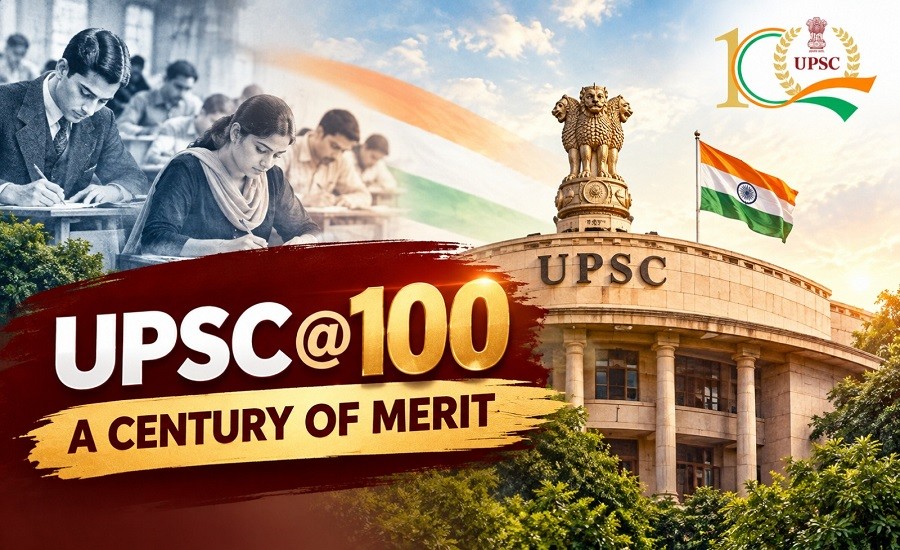
New Delhi: The Union Public Service Commission (UPSC) completes 100 years on October 1, 2026, marking a century since it began its journey in 1926 as India’s first Public Service Commission. What started as an advisory institution has, over the decades, evolved into an independent constitutional body with a central role in recruiting personnel for various services and posts under the Union Government.
The centenary provides an opportunity to look back at how India’s public-service recruitment system developed — from the days of the Indian Civil Service examination being conducted in London to today’s technology-enabled examinations involving millions of applicants. The journey has also been marked by constitutional safeguards, changes in examination patterns, increasing participation of women and candidates from diverse sections, and the adoption of digital systems aimed at making recruitment more secure and transparent.
The UPSC itself traces this evolution through the institutional and technological changes that have shaped its functioning over the past century.
The Beginning: Merit-Based Civil Service Recruitment in 1855
The roots of India’s modern public-service recruitment system go back to 1855, when the Indian Civil Service (ICS) examination was introduced as a formal mechanism for selecting candidates on merit.
At the time, the examination was conducted in London, creating considerable practical difficulties for Indian aspirants. The examination placed considerable emphasis on classical subjects, including Greek and Latin, along with English.
A significant milestone came in 1863, when Satyendranath Tagore became the first Indian to pass the ICS examination. He subsequently joined the service in 1864, marking an important moment in the history of Indian participation in the higher civil services.
Over time, demands for greater Indian participation in the civil services strengthened the case for institutionalising a public-service commission in India.
Read also: UPSC Prelims Under the Lens: 27 Questions Challenged, CAT Seeks UPSC Reply
Government of India Act, 1919, Paved the Way
The institutional framework for a Public Service Commission began taking shape with the Government of India Act, 1919, which contained a provision for establishing such a body.
Another important development followed in 1922, when the ICS examination was conducted in India for the first time. Allahabad became the venue for the examination, bringing the recruitment process closer to Indian aspirants.
In 1924, the Lee Commission recommended the immediate establishment of a statutory Public Service Commission. Two years later, that recommendation resulted in the creation of the Public Service Commission on October 1, 1926.
1926: India’s First Public Service Commission
The Public Service Commission established in 1926 became India’s first such institution. Sir Ross Barker served as its first Chairman, while its office was located at Metcalf House in Delhi.
The Commission’s initial role was primarily advisory. However, the institution represented an important step towards creating a formal mechanism through which appointments to public service could increasingly be associated with principles of merit and institutional oversight.
Its role would undergo a fundamental transformation after Independence, when the framers of India’s Constitution gave public service commissions a constitutionally protected position.
From Advisory Body to Constitutional Institution
The transition from colonial-era public-service arrangements to an independent constitutional system was an important chapter in the Commission’s history.
On August 22, 1949, Dr. B.R. Ambedkar presented provisions relating to the Union and State Public Service Commissions before the Constituent Assembly. These provisions were subsequently incorporated into Part XIV of the Constitution, covering Articles 315 to 323.
The constitutional provisions deal with matters including the constitution and appointment of the commissions, safeguards for their members, their functions and financial autonomy.
This constitutional status fundamentally strengthened the institutional independence of public service commissions and established their place within India’s governance framework.
1950: Federal Commission Becomes UPSC
With the Constitution coming into force in 1950, the Federal Public Service Commission was renamed the Union Public Service Commission.
The change reflected the transformation of India’s governance structure from the colonial administrative framework to the constitutional system of the Republic.
The UPSC’s role today extends well beyond the conduct of a single examination. Under Article 320, the Commission conducts examinations for appointments to services of the Union and performs advisory functions relating to recruitment methods, appointments, promotions and disciplinary matters.
What Examinations Does UPSC Conduct?
Over the years, the UPSC has become associated with some of India’s most important national-level recruitment examinations.
These include the Civil Services Examination (CSE), through which candidates are recruited to services such as the IAS, Indian Foreign Service and IPS, as well as the Indian Forest Service Examination, Engineering Services Examination, Combined Medical Services Examination, National Defence Academy and Naval Academy Examination, Combined Defence Services Examination and the Central Armed Police Forces (Assistant Commandants) Examination.
The Commission also handles recruitment to various posts through selection-based recruitment processes.
The scale of its responsibilities has consequently grown substantially as the Indian state and its administrative requirements have expanded.
Civil Services Examination Gets a New Three-Stage Structure
One of the most important changes in the UPSC’s examination history came in 1979, when the Civil Services Examination adopted its now-familiar three-stage structure comprising the Preliminary Examination, Main Examination and Interview.
The examination system continued to evolve thereafter. An essay paper was introduced in the Civil Services Main Examination in 1993, adding another component to the assessment of candidates’ ability to analyse and articulate issues.
In 2000, the Commission launched an online recruitment application system, marking an early move towards digitisation of its recruitment processes.
Technology Reshapes the Examination System
The pace of technological change increased considerably after 2011.
The Civil Services Aptitude Test (CSAT) was introduced as part of the changes to the Civil Services Examination. Further changes were made to the Main Examination in 2013, while computer-based recruitment examinations were also introduced.
In 2015, CSAT was made a qualifying paper, with candidates required to secure a minimum of 33 per cent marks.
These changes reflected the Commission’s continuing effort to modify examination mechanisms in response to changing requirements, while retaining the competitive and multi-stage character of the selection process.
From Thousands of Applications to Millions
The expansion of the UPSC’s responsibilities can also be seen in the extraordinary increase in the number of applications received over the decades.
According to the Commission’s data, applications received for various examinations and selection-based recruitments increased from 42,727 in 1950–51 to 4,510,044 in 2022–23.
During 2022–23, the Commission conducted 15 examinations and received 233 requisitions for selection-based recruitment, covering 4,411 posts.
The UPSC’s 2022–23 Annual Report also recorded 4,195 recommendations for appointment to civil services/posts and defence services/posts during the year.
The numbers underline how dramatically the scale of public-service recruitment has changed since the early years of the Republic.
A More Inclusive Civil Services
The composition of candidates recommended through the examination has also changed significantly.
In 1952, only three women were among the candidates recommended through the Civil Services Examination. By 2025, women accounted for 299 of the 958 candidates recommended, while women also secured 11 positions among the top 25 ranks.
The participation of candidates belonging to Scheduled Castes, Scheduled Tribes and persons with disabilities has also increased over the decades, reflecting the broader expansion of access to competitive public-service recruitment.
The evolution is therefore not limited to the examination process itself. The pool of aspirants seeking entry into India’s higher public services has become considerably more diverse.
UPSC Moves Towards AI-Based Candidate Verification
In recent years, the Commission has increasingly turned to technology not only for convenience but also for examination security and candidate verification.
An AI-based facial recognition system was introduced on a pilot basis at select centres during the NDA and CDS examinations in 2025.
The technology was subsequently deployed on a much larger scale during the Civil Services Preliminary Examination held on May 24, 2026, covering approximately 5.50 lakh candidates.
The use of digital identity and facial verification forms part of a wider effort to strengthen examination integrity as the number of candidates and the scale of UPSC examinations continue to grow.
569 Applications Rejected Over False Additional-Attempt Claims
The Commission has also taken steps to scrutinise candidate information submitted during the examination process.
After examining 15 years of candidate data, the UPSC rejected 569 applicants who were found to have made false claims relating to additional attempts.
The exercise illustrates how data-based scrutiny is increasingly becoming part of the Commission’s recruitment framework, particularly in an examination where eligibility and attempt limits can have a direct bearing on a candidate’s application.
New Digital Initiatives in 2025 and 2026
The UPSC introduced several digital and administrative initiatives during the years leading up to its centenary.
A Universal Registration Number (URN) was launched in May 2025, creating a common registration mechanism for candidates. The Commission also introduced a system for the random selection of interview boards in 2025.
For candidates seeking assistance, a 30-channel helpdesk was launched in February 2026.
The Commission also added new examination centres in 2026 and made arrangements for the early publication of the provisional answer key for the Civil Services Preliminary Examination.
Together, these initiatives indicate how the UPSC is attempting to combine its century-old institutional mandate with contemporary digital systems.
Dr Ajay Kumar Leads UPSC in Its Centenary Year
Dr. Ajay Kumar has been serving as Chairman of the Union Public Service Commission since May 15, 2025. The current Commission comprises eight members, including three women.
The UPSC’s official records list Dr. Ajay Kumar as Chairman, with Lt. Gen. Raj Shukla (Retd.), Suman Sharma, Bidyut Behari Swain, Dr. Dinesh Dasa, Sheel Vardhan Singh, Sanjay Verma, Sujata Chaturvedi and Anuradha Prasad among the Commission’s members as reflected in its official composition.
The centenary year therefore comes at a time when the Commission is simultaneously preserving its constitutional mandate and undertaking significant technological and procedural changes.
A Century of Change, One Continuing Mandate
From an examination conducted in London in the 19th century to a digitally administered recruitment ecosystem serving millions of applicants, the history of the UPSC mirrors the transformation of India’s public administration itself.
The institution that began in 1926 as an advisory Public Service Commission acquired constitutional status after Independence and gradually expanded its responsibilities across examinations, recruitment, promotions and disciplinary matters. Its examination system has changed repeatedly — through the introduction of the three-stage Civil Services Examination, the essay paper, online applications, CSAT, computer-based examinations and, more recently, AI-assisted candidate verification.
At its centenary, the Commission has linked its institutional journey to merit, impartiality and equal access to opportunity, with the stated responsibility of ensuring that the opportunity to enter public service reaches every deserving Indian.
The UPSC’s 100-year journey, in that sense, is not merely a history of an examination body. It is also a story of how India’s system for selecting public servants has evolved alongside the country’s constitutional, administrative, social and technological transformation.
Read also: Supreme Court Advocate Anurag Kumar Appointed UPSC Panel Counsel Until September 2027