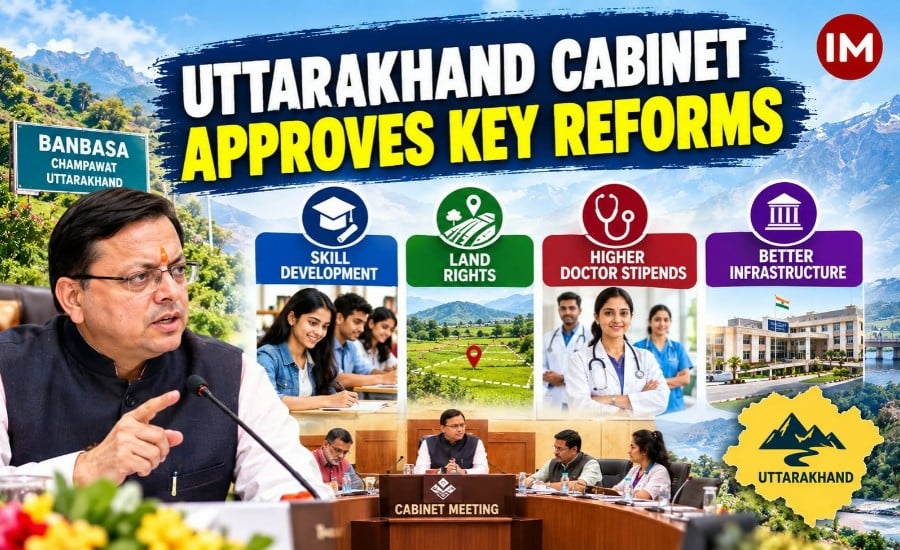
Champawat: The Uttarakhand Cabinet approved 24 proposals during its meeting at Banbasa in Champawat district on October 4, with decisions covering higher education, land rights, medical education, registration services and administrative reforms. The meeting, chaired by Chief Minister Pushkar Singh Dhami, was the first state Cabinet meeting held outside Dehradun.
₹200 Crore Skill Development Scheme for 1.19 Lakh Students
The Cabinet approved the Chief Minister Higher Education Skill Enhancement Scheme-2026 for students enrolled in government and private universities and affiliated colleges in Uttarakhand.
The scheme is expected to cover around 1.19 lakh students, with an expenditure of approximately ₹200 crore over five years. The programme is aimed at improving students’ employability and supporting entrepreneurship.
The Cabinet also approved changes concerning private universities, including revised land-related requirements for their establishment. The revised framework provides for a minimum land requirement of 20,000 square metres under the new provision, while the earlier ₹5-crore guarantee-fund requirement has been removed.
Land Regularisation and Higher Doctor Stipends
The Cabinet approved measures to extend the regularisation of certain Class 3 and Class 4 land held by leaseholders and occupants in areas including Lalkuan in Nainital district and Jaunsar-Bawar in Dehradun district.
Under the decision reported after the Cabinet meeting, regularisation will be extended for one year using the 2004 circle rate, after which the prevailing circle rate will apply.
The Cabinet also approved an increase in the remuneration of senior residents, junior residents and demonstrators working in government medical colleges. The decision comes in the context of vacancies among faculty and medical teaching staff.
New Sub-Registrar Office in Narendra Nagar
The Cabinet approved the establishment of a Sub-Registrar’s Office in Narendra Nagar tehsil of Tehri district.
The office will have jurisdiction over 133 revenue villages, comprising 98 villages under Narendra Nagar tehsil and 35 under the Pawki Devi sub-tehsil.
DG Post Created for Three Departments
The Cabinet approved creation of a Director General-level post for coordination and supervision of the Animal Husbandry, Dairy Development and Fisheries departments.
The move provides for a common senior-level administrative structure for the three departments.
The Cabinet also approved a proposal to replace the Northern India Canal and Drainage Act, 1873 with the proposed Uttarakhand Irrigation and Drainage Bill, 2026, which will be introduced in the state Assembly.
Changes in Group C Recruitment and Prosecution Rules
The Cabinet approved amendments to the rules governing interviews for certain Group C posts. The post of District Youth Welfare and Provincial Guard Dal Officer will be removed from the relevant schedule, while interviews for the Deputy Jailor post will be discontinued because the recruitment process already includes physical efficiency and written examinations.
It also approved amendments to the Uttarakhand Public Service Commission’s regulations concerning the posts covered by the Commission.
Separately, the Cabinet approved notification of provisions under Section 19(3) of the Bharatiya Nagarik Suraksha Sanhita, 2023, concerning the appointment of Assistant Public Prosecutors in specified circumstances.
Property Details and Land Registration Measures
The Cabinet approved changes requiring certain government employees to provide information regarding property transactions with entities that conduct business with the government, according to reports on the meeting.
The government will also introduce a system for verification of PAN details of buyers, sellers and other parties involved in property registrations in the state.
Cabinet Meetings to Be Held in Other Districts
Dhami said future Cabinet meetings would not be restricted to Dehradun and would also be held in different districts of Uttarakhand.
According to the state government’s Information Department, the Banbasa meeting was part of an effort to take governance closer to remote and border areas and bring local issues and regional priorities directly before the government.