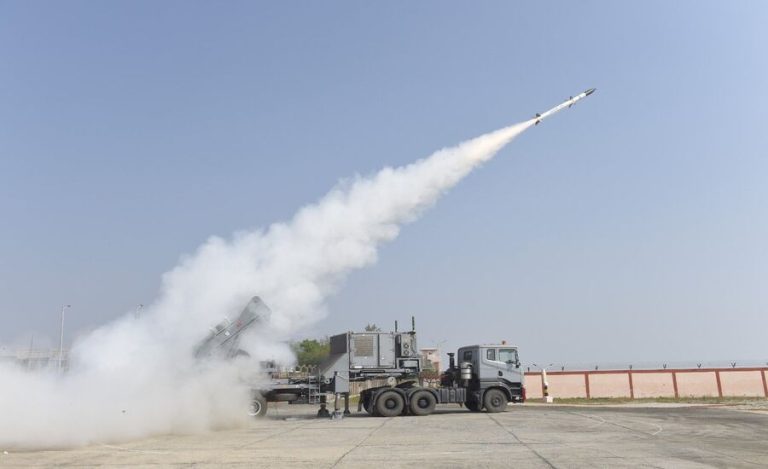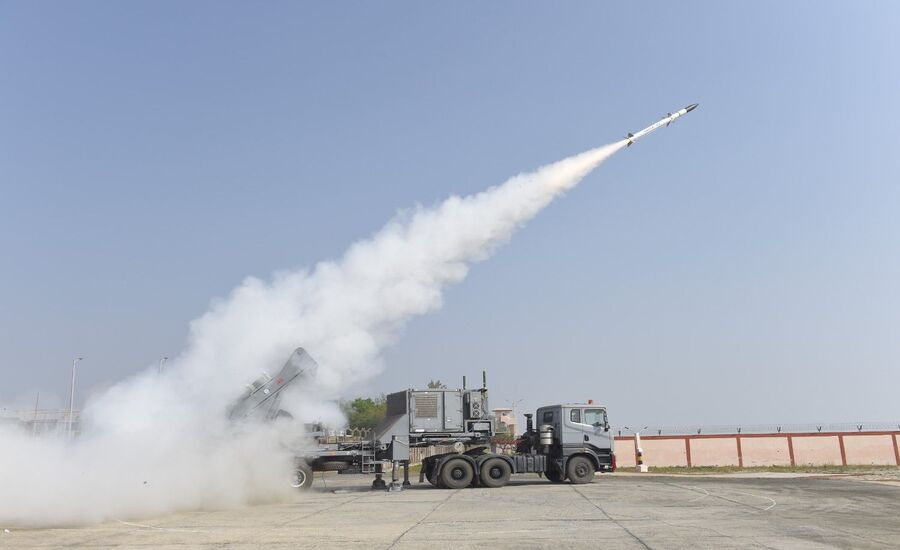
New Delhi: The Vajra Air defence drills have successfully validated the performance of the Akashteer Air Defence System during day and night military exercises conducted by the Indian Army. The exercises focused on improving combat readiness and testing how quickly threats can be detected, processed, and engaged using a modern network-centric air defence architecture.
The drills were designed to evaluate the seamless integration of existing air defence weapons with the newly inducted Akashteer system, a major indigenous capability developed to strengthen India’s air defence network.
What Was The Objective Of The Vajra Air Defense Drills
The primary objective was to validate the critical sensor-to-shooter response chain.
What Is Sensor-To-Shooter Response
Sensor-to-shooter response refers to the complete cycle of:
- Detecting an aerial threat through radar sensors
- Processing the information into actionable intelligence
- Issuing engagement orders
- Neutralizing the threat using air defence weapons
A faster sensor-to-shooter loop significantly improves the military’s ability to respond to hostile aircraft, drones, missiles, and other aerial threats.
Read also: Inside IAF’s New AI-Driven Air Defence Shield to Counter Drone Swarms and Missile Threats in Seconds
During the exercise, troops practiced detecting, tracking, and engaging simulated enemy aerial targets under both daylight and nighttime conditions. This helped validate operational readiness for round-the-clock battlefield scenarios.
Akashteer Played The Central Role
At the heart of the drills was Project Akashteer, an automated and AI-enabled Air Defence Control and Reporting System developed by Bharat Electronics Limited (BEL) for the Indian Army. The project was awarded under a contract worth approximately ₹1,982 crore.
How Akashteer Works
Akashteer connects multiple air defence assets into a single digital network, including:
- 3D Tactical Control Radars
- Low-Level Lightweight Radars
- Surface-to-Air Missile Systems
- Command Posts
- Air Defence Units
The system creates a common operational picture by sharing real-time surveillance and targeting information across all connected units.
This allows commanders and weapon operators to make faster and more accurate decisions during combat operations.
What are the Key Features Of Akashteer
Akashteer automates many processes that were traditionally handled manually, reducing reaction time between threat detection and weapon engagement.
Better Coordination
The platform links sensors and shooters across the battlefield, ensuring that all units operate using the same real-time information.
Reduced Risk Of Friendly Fire
By generating a unified air situation picture, the system helps distinguish friendly, neutral, and hostile aircraft, reducing the possibility of accidental engagements.
Improved Combat Readiness
The successful day-and-night validation demonstrates the Indian Army’s ability to maintain continuous air defence operations in modern high-threat environments.
Why Vajra Air Defense Drills Matter
Modern aerial warfare is increasingly complex due to the growing use of drones, cruise missiles, loitering munitions, and advanced aircraft.
Traditional methods that separate surveillance, coordination, and engagement are no longer sufficient. The Vajra Air Defence Drills highlighted the importance of a network-centric approach where sensors, command systems, and weapons work together as a unified force.
The successful validation of Akashteer’s sensor-to-shooter capability demonstrates India’s continued progress toward advanced indigenous air defence solutions and faster battlefield decision-making.
Future Significance For Indian Air Defence
The Army’s ongoing induction of Akashteer represents a major modernization effort aimed at creating a highly integrated and responsive air defence network.
As more units are connected to the system, the Indian Army is expected to benefit from enhanced situational awareness, faster threat response, and improved coordination across multiple air defence platforms.
FAQs
Akashteer is an indigenous automated Air Defence Control and Reporting System developed by Bharat Electronics Limited (BEL) for the Indian Army. It integrates sensors, radars, and weapon systems into a unified command network.
Sensor-to-shooter response is the time taken from detecting an aerial threat to issuing firing orders and engaging the target. Faster response times improve battlefield effectiveness.
The drills were conducted to test combat readiness, validate Akashteer’s integration with existing air defence systems, and improve the Army’s ability to respond to aerial threats during day and night operations.