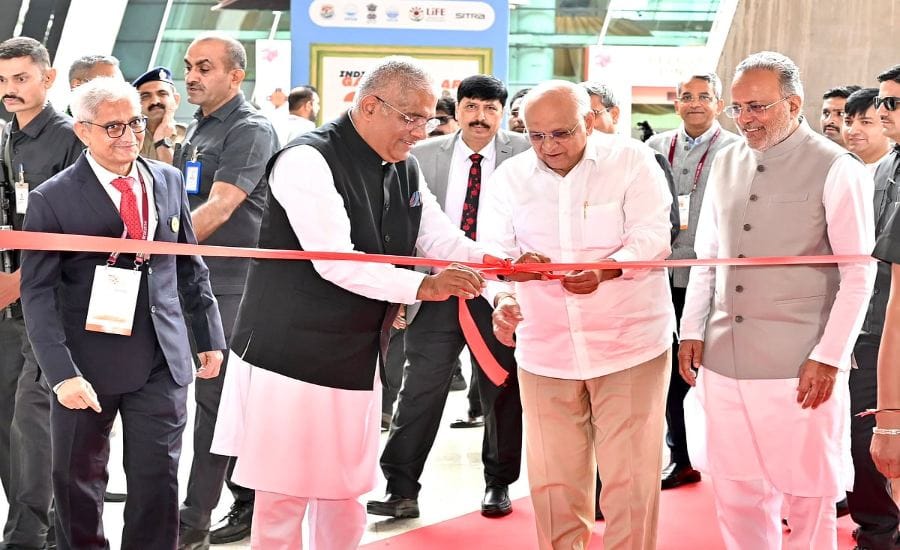
Gandhinagar: Gujarat has become the global meeting point for circular economy solutions as the World Circular Economy Forum (WCEF) 2026 opened in Gandhinagar, bringing together more than 3,600 participants from 62 countries. Union Environment Minister Bhupender Yadav and Gujarat Chief Minister Bhupendrabhai Patel inaugurated the forum on September 15.
The four-day event, being held from September 15 to 18 under the theme “Circular Economy: Transition for People and Prosperity,” is the first WCEF to be hosted in South Asia. It brings policymakers, business leaders, researchers, entrepreneurs and innovators together to discuss how economies can reduce resource consumption while creating sustainable growth.
Gandhinagar Becomes Global Circular Economy Hub
The WCEF 2026 places Gujarat at the centre of international discussions on resource efficiency, waste reduction and sustainable production. The forum is designed to move beyond policy discussions and highlight practical solutions that can be adopted across markets and communities.
Chief Minister Bhupendrabhai Patel linked India’s circular economy approach with Mission LiFE and Gujarat’s experience of pursuing development while protecting natural resources.
Patel also highlighted traditional Indian practices of reuse and resource recovery. Citing the example of offerings at the Somnath Temple being converted into reusable resources while generating livelihood opportunities, he pointed to the cultural roots of India’s approach to turning waste into value.
He called for the forum to reflect the spirit of “Vasudhaiva Kutumbakam” by developing circular solutions that can benefit communities across the world.
Read Also: From Pilgrimage to Industry: Gujarat’s ₹692 Crore Road Plan Boosts Kutch, Banaskantha
India Pushes “Repair, Reuse and Recover” Approach
Union Environment Minister Bhupender Yadav said circularity is not a new concept for India but an extension of the country’s traditional resource-conscious practices.
He described the approach through three principles: repair before replacement, reuse before discarding and recovery before waste.
Yadav also emphasised that economic development and environmental protection do not have to be treated as competing objectives. Instead, the focus should be on making economic growth more resource-efficient, resilient and sustainable.
According to the Minister, the success of a circular economy should not be judged only by the quantity of material recycled. It should also be measured by how much value can be retained before resources become waste.
India Expands EPR and Waste Management Framework
India has been expanding its circular economy framework through sector-specific waste-management rules and Extended Producer Responsibility (EPR) systems.
According to figures presented at the forum, more than 83,000 producers and 4,802 recyclers had registered under different EPR frameworks by August 2026. Nearly 482.24 lakh metric tonnes of waste had also been processed across regulated waste streams.
The figures highlight the growing scale of India’s formal systems for managing waste and encouraging producers to take greater responsibility for products and materials through their lifecycle.
However, Yadav stressed that regulation alone cannot create a circular economy. Changes in consumption patterns are also necessary, with circular practices expected to extend from markets and businesses into households and everyday behaviour through Mission LiFE.
Global Partnerships at the Heart of WCEF 2026
The forum has placed international cooperation at the centre of its circular economy agenda. Yadav said knowledge, technology, finance and responsibility need to move across borders and sectors because no single country, company or community can close the resource loop alone.
India is also promoting international cooperation through initiatives such as the Resource Efficiency and Circular Economy Industry Coalition (RECEIC).
Finland and the Netherlands are among the countries highlighting their own circular economy goals at the forum. Finnish Ambassador Mikko Kivikoski described circularity as a fundamental approach to economic growth and referred to Finland’s ambition to keep resource consumption below 2015 levels by 2035.
Dutch official Marieke Spijkerboer highlighted the Netherlands’ target of becoming fully circular by 2050 and stressed international cooperation to develop resilient circular value chains.
135 Exhibitors Showcase Circular Solutions
The WCEF is not limited to policy discussions. An exhibition at the venue features 135 national and international exhibitors showcasing technologies and practical solutions linked to the circular economy.
The forum’s organisers have also released two publications during the inaugural session: “Best Practices for Reuse of Treated Sewage” and “Driving Sustainability: A Guide to India’s Circular Economy and EPR Initiatives.”
The event’s programme focuses on areas including sustainable resources, market transformation, policy and leadership, with the broader objective of accelerating scalable circular solutions. The official WCEF platform describes the forum as the tenth global edition and says its main programme is being held in Gandhinagar, with additional accelerator sessions taking place through September 18.
Gujarat Puts Sustainable Growth in Global Spotlight
WCEF 2026 gives Gujarat a major platform to showcase its approach to balancing economic development with environmental priorities while connecting Indian institutions with international circular economy networks.
The forum is being jointly organised by the Central Pollution Control Board, Finnish Innovation Fund Sitra, Government of Finland, Ministry of Environment, Forest and Climate Change, Government of Gujarat and Gujarat Pollution Control Board.
For India, the Gandhinagar forum represents an opportunity to connect its waste-management systems, EPR framework, sustainable consumption initiatives and emerging technologies with international experience.
For Gujarat, hosting the first WCEF in South Asia also places Gandhinagar at the centre of a global conversation on how economies can use fewer resources, reduce waste and preserve value for longer. The focus now is on converting the ideas and partnerships emerging from the forum into practical solutions that can support sustainable growth, livelihoods and resource security.
Read Also: India to Put Circular Economy in Global Spotlight as WCEF 2026 Opens in Gandhinagar